Bidspirit auction | Sefer Kerem Shlomo, sermons on
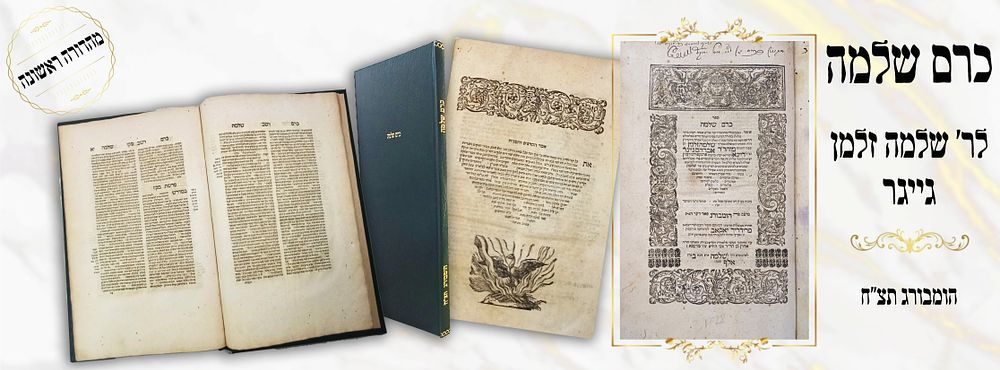
Sefer Kerem Shlomo, sermons on the Torah, by R. Shlomo Zalman Geiger, Dayan of Frankfurt am Main. Homburg 1738. First edition. - Kerem Shlomo, on the Torah, By the gaon Rabbi Shlomo Zalman son of Rabbi Avraham Geiger of Frankfurt am Main, Homburg 1738 – first edition. With the approbation of the renowned gaon Rabbi Moshe Ḥagiz, author of Mishnat Ḥakhamim. With an engraving of the “Phoenix” within a blazing fire on the final page. Rabbi Shlomo Zalman Geiger was a Dayan in Frankfurt. A century later his great-grandson, bearing the same name, held that same position: Rabbi Shlomo Zalman Geiger, author of Divrei Qohelet on the prayer customs of the Frankfurt community. In contrast, another great-grandson, his younger brother, was the reformer Abraham Geiger. Below is the description of the work by Rabbi Mordechai HaLevi Horowitz, author of Mateh Levi, from his volume Rabbanim of Frankfurt (p. 98): ”Rabbi Shlomo son of Avraham Geiger, a man of refined spirit and well-versed in all realms of Jewish literature, published in the year 1738 a book entitled Kerem Shlomo, which interprets verses of the Tanakh and teachings of the Midrash with the aid of the Zohar, the writings of the Ari, the ethical-philosophical literature, and responsa literature. In brief, he drew upon all the hidden treasures of Jewish writings, at times with striking success according to the taste of his generation. With his wit and originality he was able to employ in his interpretations every method of dialectic and distinction, and to weave into the sharpness of his language even the most serious and profound philosophical issues. He cites a saying from the Zohar that evidently served as a guiding light in his studies: איכא בזוהר, מכל עץ הגן אכול תאכל, כולהו ביחודא שריא, דהיינו, אם היה אוכל גם משאר אילנות לא היה נחשב לו לחטא, אבל על שאכל מעץ הדעת לבד בזה חטא, דעשה פירוד למעלה וקצץ בנטיעות. He himself gathered from every tree and every branch; therefore he deemed himself entitled to draw also from Sefer ha-Ikkarim, Moreh Nevukhim, and other works addressing such inquiries, presenting their ideas in his manner, in language accessible to everyone. At that time the rabbis of Frankfurt refused to grant approbations for the printing of new books, and thus there is no wonder that the work of R. Shlomo Geiger was furnished with approbations from rabbis of other communities. Yet four years after the book appeared and found favor among wide circles, a resolution was issued by the communal board that for nine years Rabbi Shlomo Geiger was not to officiate as Chazan in any of the great synagogues, and that he would never be eligible for communal office, and that an announcement concerning his book would be posted in the synagogue. The reason given was that R. Shlomo Geiger, together with two other members of the community, had conducted themselves improperly in the communal chamber. We do not know whether the leaders found fault solely with R. Shlomo’s character or also with his book, but it is evident that the punishment was directed at both together. In any case, it is known that readers continued to study the book even thereafter.” Owners: “שייך להתורני כ”ה יחזקאל יצ”ו הקטן פנחס בן לא”א מו”ה יחזקאל יצ”ו”. On the leaf beyond the title page appears the inscription: “הספר הזה נתן לי מהור”ר סענדר למתנות החתונה שלי הקטן יחזקאל בן לא”א המנוח מהור”ר פנחס זצלה”ה”.