Bidspirit auction | She’elot u-Teshuvot Maharam Ziskind By R.
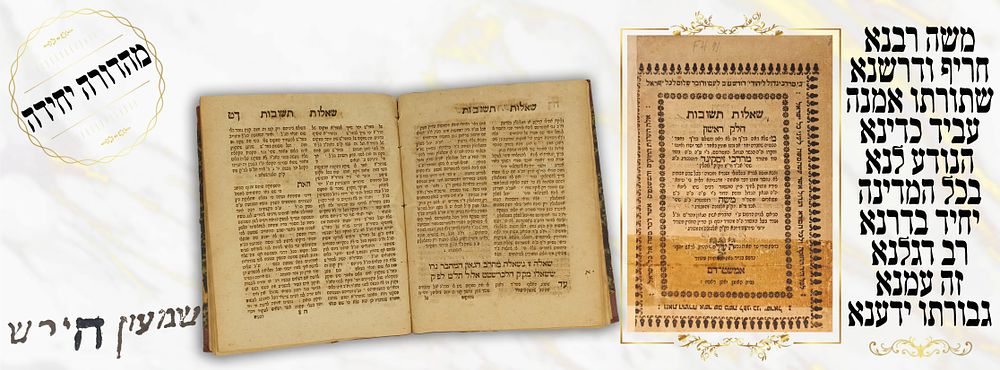
She’elot u-Teshuvot Maharam Ziskind By R. Mordechai Ziskind Rotenberg and his son R. Moshe Rotenberg Hamburg 1716 Unique edition! - Responsa by Rabbi Mordechai Ziskind Rotenberg. On the title page: Amsterdam, 1746. In truth: Hamburg, 1716. [5] + 74 leaves, 20.5 cm. Wide margins. Ancient ownership signatures on the title page and on leaf 7. Includes responsa by other sages of the generation as well. The book was printed shortly after his passing. The title page states Amsterdam and, by the calculation of the small letters, the year 1746. However, although “Amsterdam” appears in large letters, the intention was merely to state in smaller type that the paper and type were of Amsterdam origin; the Lamed—indicating the year—was mistakenly emphasized, leading to an mistaken adition of 30 years to the printing date. R. Mordechai Ziskind Rotenberg (before 1640 – 1714) was born in Germany to R. Moshe Rotenberg, a descendant of the Maharam of Rothenburg. In his youth he was appointed rabbi of Witzenhausen, serving there until 1683, when he became rabbi of Horodno and was considered among the great rabbis of the region. In 1691 he assumed the rabbinate of Lublin, where he served until his passing in 1714. In all his rabbinic posts he founded yeshivot and taught many disciples. The great sages of his generation held him in high esteem and sent their questions to him. The Panim Me’irot permitted an agunah only on condition that the elders of the generation, especially Rabbi Mordechai Ziskind, would concur. Among his disciples was Rabbi Yeḥezkel Katzenellenbogen, author of Keneset Yeḥezkel, who wrote an approbation to the book. The son of the Maharam Ziskind, Rabbi Moshe, learned under his father, served as rabbinic judge in Brisk and Tiktin, and afterward moved to Hamburg, where he functioned as rabbi and head of the court, though without formal appointment. In 1706, after the passing of Rabbi Meshulam Zalman Mirels, he was appointed rabbi of the triple community AHU (Altona–Hamburg–Wandsbek), alongside the Ḥakham Tzvi, in a rotation agreement of six months each. In 1709 the famous dispute erupted between the two rabbis regarding the case of the hen that was found without a heart. A hen was discovered lacking a heart, and the Ḥakham Tzvi ruled that since a creature cannot live even a moment without a heart, it must have had one which was consumed by a cat, and the hen should therefore be permitted. Because of the disagreement, the Ḥakham Tzvi was compelled to resign in 1709, whereas R. Moshe was appointed sole rabbi and head of the court of AHU. During his short tenure he established ordinances for the benefit of the community, particularly regarding the ḥevra kaddisha. He passed away during his father’s lifetime, on 4 Shvat 1712. He left many manuscripts of responsa and novellae, and a portion of them was printed by his wife after his passing in the volume She’elot u-Teshuvot Maharam Ziskind of her father-in-law. On the title page: “Brought to the press by the rabbanit, wife of the gaon Maharam זצ”ל.” From responsum 27 onward are the answers of R. Moshe. Responsum 33 concerns the question of the rooster found without a heart. The Ḥakham Tzvi permitted it; R. Moshe Rotenberg firmly forbade it. This dispute between the rabbis of Hamburg spread among the rabbis of Europe and became a controversy of great magnitude, whose consequences are vast in the annals of history. On his tombstone it was written: משה רבנא, חריף ודרשנא, שתורתו אמנה, עביד כדינא, הנודע לנא, בכל המדינה, יחיד בדרנא, רב דגלנא, זה עמנא, גבורתו ידענא, הגאון הגדול אב”ד ור”מ, מ”ו מהור”ר משה בהגאון מוה”ר זיסקינד רוטנברג. Owners: On leaf 5, at the top of the page beside the letter ה' of the pagination, appears: “Shimon Hirsch.” Possibly Rabbi Shimon Hirsch Weil, son of the author of Korban Netanel.