Bidspirit auction | She’elot u-Teshuvot u-Sugyot “Kedushat Yom
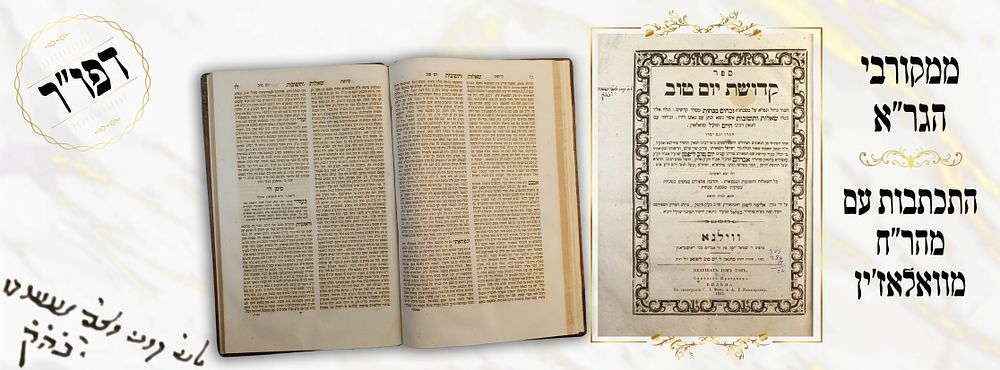
She’elot u-Teshuvot u-Sugyot “Kedushat Yom Tov”, including responsa exchanged with R. Ḥayim of Volozhin. Vilna 1865 — first edition - autograph of the Tzuf Devash - Kedushat Yom Tov On Zevachim and Menachot, together with a series of responsa the author exchanged with the great sages of his generation, especially Rabbi Ḥayim of Volozhin. By Rabbi Yom Tov Lipmann Halperin. Vilna 1865. The author: The wondrous gaon Rabbi Yom Tov Lipmann Halperin was born circa 1756, son of Rabbi Avraham, rabbi of Alik. At seventeen he married and was appointed rabbi of the town of Loyhisan near Pinsk. In 1785 he became rabbi of Kapule, by which name he became renowned. He secluded himself every day of the week in the local synagogue, studying with his disciples, and there composed his writings — a portion of which are gathered in Kedushat Yom Tov. He returned home only on Sabbaths. He was held in great esteem among the rabbis of Lithuania. The Vilna Gaon, who was older than he, traveled especially to Oshmiany to participate in the betrothal celebration of one of his children (Aliyot Eliyahu, Ma’alot ha-Sulam, note 14). When controversy broke out in Vilna between the local rabbi, Rabbi Shmuel ben Avigdor, and the communal leadership, Rabbi Yom Tov was one of the three arbiters who sought to resolve the dispute. After the passing of Vilna’s last rabbi, the communal leaders offered Rabbi Yom Tov the rabbinate; but fearing the disturbance of his Torah study that would result in so large a city, he declined the appointment and returned the letter of investiture. Consequently, the leaders resolved never again to appoint a rabbi in Vilna. He served as rabbi of Kapule until his passing on 25 Tishrey 1794. Owners: On the title page appears: ”לע' קוני הצב״י מעט דב״ש יבה״ק”. This is the sacred signature of the gaon Rabbi David ben Shimon — Tzuf Devash. Rabbi David Ben Shimon, known as “Tzuf DevaSh, ” was born in Rabat, Morocco, in 1824. At a young age he was surrounded by many disciples, teaching Torah and expanding the bounds of holiness in his city. In 1854, at age twenty-eight, he left all his honor in Morocco and ascended to cherish the Holy Land, to which his longing clung all his life, and most of his written Torah concerns its matters. He was joined by dozens of families of his disciples, among them Rabbi Yaakov Bibas, author of Sha‘arei Torah and She’erit Yaakov, and Rabbi Elazar Ben Tovo, author of Pekudat Elazar. In Jerusalem he found the Western community in a state of poverty, destitution, and want. He organized the Western community and established an independent congregation, separate from the Sephardi community council of Jerusalem. He built synagogues and founded institutions in the Old City, and he personally sent emissaries to the Maghreb communities to raise funds for the community at large, and for his principal purpose — establishing the first neighborhood outside the city walls for the welfare of the Western Jews. He became known for his care for orphans and widows, many of whom found shelter in his home. In 1866 he established the neighborhood “Maḥaneh Yisrael, ” the second neighborhood outside the walls of Jerusalem, all its houses designated for the poor of the Western community. He was in contact with Sir Moses Montefiore, who assisted the Western community at his request. He became renowned as a worker of salvation and a holy man, and many flocked to him to receive his blessing. His Torah teachings are cited by the Sdei Ḥemed, the Ben Ish Ḥai, and Rabbi Ḥayyim Palagi. He passed away on the 18th of Kislev, 1879, at the age of fifty-three, and was buried on the Mount of Olives in Jerusalem.