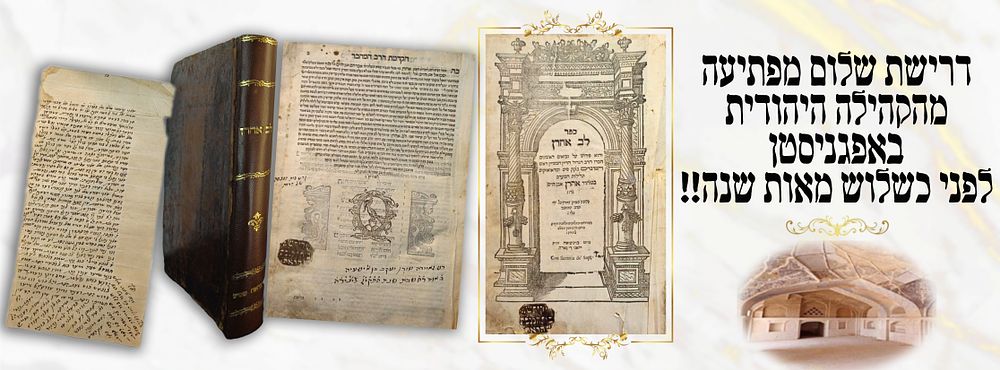
Bidspirit auction | Lev Aharon on the books
Lev Aharon on the books of Yehoshua and Shoftim Venice 1609 – A surprise: a book from the Jewish community of Afghanistan from approximately three hundred years ago!! - A surprising greeting from the Jewish community of Afghanistan from about three hundred years ago!! An important scholarly work – Venice printing – that arrived at an unexpected place! Includes a long letter in Judeo-Persian written in Herat, in Afghanistan. Lev Aharon on Yehoshua and Shoftim [separate title page]. Venice 1609 Title page: Sefer Lev Aharon - And it is a commentary on the Former Prophets, composed by the great rabbi, the eminent judge, chief among the speakers of the holy community of Fes and of Morocco and the regions of the West, our teacher and master Rabbi Aharon Ibn Ḥayyim, may his light shine, and edited with diligent scrutiny by the author himself. And the beginning of his labor, a sacred labor, was on Rosh Chodesh Cheshvan 5369. Printed in Venice at the house of Giovanni di Gara. Stamp and inscriptions from Herat, Afghanistan: Stamp: בית הכנסת הראת Inscription: בית קודשי הקדושי' הכנסת הראת ר”ח תמוז [...?] רוונזי עיר הקודש ... .... .... Second title page, fol. 2a: Introduction of the Author Stamp: קודש בית הכנסת הראת Inscription: קדש בית הכנסת של הראת Inscription at bottom of the page in Judeo-Persian: רוז גאיידה שודן יעקב בן א' ישעיה ב' אוס ר'ח' טבת שנת שנת ה'ת'ק'י'ז' ל'י'צ'י'ר'ה'. Fol. 2b: “The Elegance of the Pupil of the Author” – The author’s student Ezra son of R. Shlomo Elḥadab writes in praise of the book, and a laudatory poem on the initials “Ḥayyim, may he be preserved.” Fol. 3a, at the top: Correction of a Scribal Error Fol. 76a: A letter [unrelated to the book – yet also from Herat] in Judeo-Persian, sent to “Shmuel, may he be preserved; also mentioned are Mashiaḥ, may he be preserved, Yonah, may he be preserved, R. Shalom and Ḥayyim.... At the end of the section on Joshua – indices. Afterward – a new section begins: Sefer Shoftim, with the author’s introduction to the Book of Judges. Fol. 31a: A slip of paper with inscriptions. Fol. 35a: Scribbles of letters and a drawing. Fol. 71b: A synagogue stamp. Fol. 74a: A fragment of a printed Ḥumash. Rabbi Aharon Ibn Ḥayyim: He was born to Rabbi Avraham in Fes, Morocco, around the year 1555. He studied in his father’s yeshiva and under Rabbi Yosef Almosnino, whom he cites as his principal teacher. He served as a judge in the rabbinical court of Fes alongside Rabbi Vidal Ẓarfati. He traveled to Venice in Italy in order to bring his works to print; he remained there for at least three years and earned the esteem of the rabbis of Venice and nearby cities, who would consult him on matters of Jewish law. During that time he published Korban Aharon (two volumes) on the Sifra, which became a fundamental work and was printed several times. He also printed Middot Aharon, dealing with the thirteen hermeneutic principles of Rabbi Yishmael, and Lev Aharon on the Books of Joshua and Judges, in which he gathers all the teachings of the Sages, interprets them, and expounds the biblical verses at length and with great depth. Subsequently he left Italy and traveled to Egypt, where he taught Torah. In his later years he ascended to the Land of Israel and settled in Jerusalem, where he passed away in the year 1632. Among the rabbis who composed eulogies and lamentations for him were the Maharit and the author of Giddulei Terumah. The Jewish Community of Herat: Herat once had a large and flourishing community. For a long period it bore the status of the largest Jewish community in all of Afghanistan. The Jews of Herat were very close to the Jews of Iran due to their geographical proximity. In 1840 roughly 200 families arrived there from the city of Mashhad in Iran after being coerced into converting to Islam. For various reasons many Jews left the community over the years, and by the mid-20th century the Jewish community of the city had almost completely disappeared. The only surviving remnants of the community are four synagogues discovered in 1978, among them the Yu Aw, or Yoav Synagogue. The Yoav Synagogue, in the Momanadeh quarter of the old city of Herat, is thought to have been built more than 600 years ago. It is the only remaining synagogue in the area, and it was restored only recently. A lone Torah figure known to us from this period is Rabbi Siman Tov Melamed, a rabbi and liturgical poet who served in Herat and died around the year 1800 – and it seems he was active in Herat at the time the inscription in this book from the year 1757 was written.