Bidspirit auction | Responsa Shemesh Tzedakah, by Rabbi
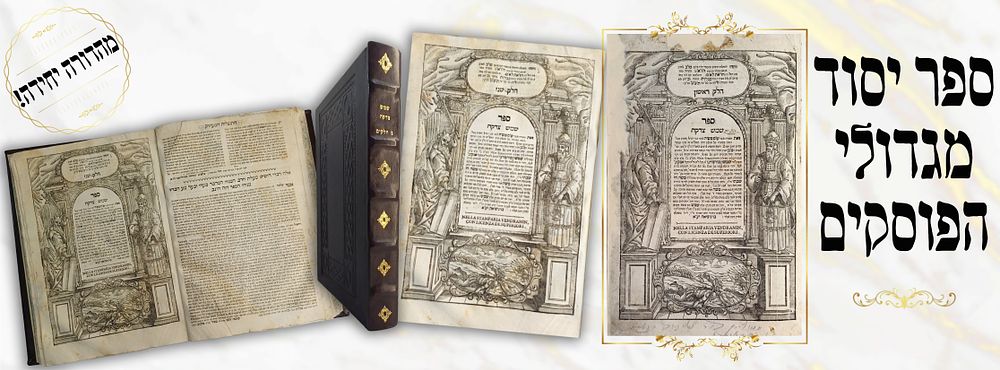
Responsa Shemesh Tzedakah, by Rabbi Shimshon Morpurgo, Venice 1743 Sole edition. Two parts. - A separate title page for each part. The title pages are illustrated with figures of Moshe and Aharon, and a scene of the youth David subduing Goliath the Philistine. The author, the Gaon Rabbi Shimshon Morpurgo (1681–1740), one of the great rabbis of Italy and rabbi of the city of Ancona. In addition to his role as rabbi, halachic decisor, and head of yeshivah in Ancona, he was a certified physician and even served as a leader of the community, coming to the aid of all who sought his help. When a plague broke out in Italy in 1730, he was active as a volunteer physician. He left behind many writings, including responsa, sermons, and various letters to the rabbis of his era. Rabbi Shimshon Morpurgo passed away on the first day of Passover, 1740, before the age of sixty. His sudden death struck all of Italian Jewry with shock, and its great rabbis, among them Rabbi Yitzchak Lampronti, delivered dirges and eulogies for him. Among the Jews of Ancona there was a tradition to visit his grave on the eve of Rosh Hashanah and Yom Kippur, and a special prayer was even composed for this occasion. The Shemesh Tzedakah was brought to print by the author’s son, Rabbi Chaim Shabbetai Morpurgo, and attained an important standing in halachic literature. Several responsa in the book deal with polemical topics that characterized the Torah world of Italy, such as the dispute regarding the donning of tefillin on Chol HaMoed [his responsum n. 4 permitting it, and his son writes at the end of the responsum that he possesses many letters from the great sages of Italy who agreed with his father, though he considers it unnecessary to include them in the book. Later in the book, beside n. 15, the printer writes that during the preparation of the work for print, the book Aderet Eliyahu appeared, which forbids the donning of tefillin on Chol HaMoed, and therefore he found it proper to insert there the earlier responsa. Aderet Eliyahu is the work of Rabbi Immanuel Chai Ricchi, author of Mishnat Chassidim, containing a section titled ‘תפילין דמרי עלמא’ on this subject, and this is what the printer of Shemesh Tzedakah refers to.] Another polemic brought before the author of Shemesh Tzedakah for decision concerned the recitation of “מלאכי רחמים” in the Selichot and the prohibition of praying to angels. In this matter he permitted. The polemic is presented at length in Pachad Yitzchak by Rabbi Yitzchak Lampronti, his contemporary, who also wrote an approbation and a poem in honor of the book. There a single responsum was inserted, n. 23 of the book, but it appears that the controversy did not abate and he was compelled to reinforce his ruling with an additional responsum, n. 24, which is absent from Pachad Yitzchak.