Bidspirit auction | Orach LaChaim by the “Keli
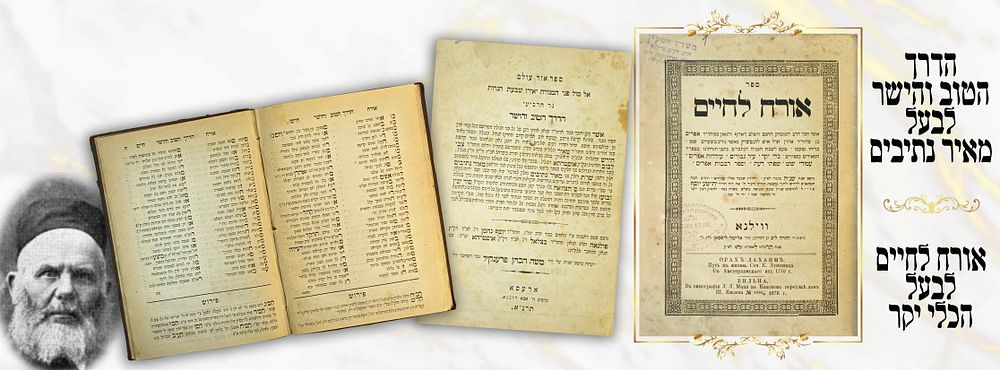
Orach LaChaim by the “Keli Yakar” bound with the rare Sefer “Or Olam – HaDerech HaTov VeHaYashar” by the author of “Meir Netivim”, a rare edition. Copy of R. Moshe Chaskin. - Sefer Orach LaChaim Derashot on the Festivals By Rabbeinu Shlomo Ephraim of Luntshitz, author of the “Keli Yakar” and “Ollelot Ephraim”. Vilna 1878 Rare – Sefer Or Olam – HaDerech HaTov VeHaYashar By Rabbi Meir Margoliot, author of Responsa Meir Netivim. Odessa 1891. Second edition, rare. Rabbi Meir Margoliot (1707 – 10 Iyyar 1790) was among the earliest rabbis of the chassidic movement and rabbi of Ostroh, a disciple of the holy Baal Shem Tov. He became known by his book “Meir Netivim” – responsa and novellae. He served as dayan in Brody, as rabbi and Av Beit Din of Horodenka, and afterwards as rabbi of Yazlovitz. From there he became Av Beit Din of Lviv. In 1754 he was elected rabbi of Lviv and the entire district. In 1777 he was appointed rabbi and Av Beit Din of Ostroh and its region. The author’s son, Rabbi Shaul Margoliot, Av Beit Din of Lublin, approached his father with a request to arrange a system of mnemonic markers, to serve those issuing halachic rulings in recalling where each topic is to be found. In his introduction the author writes that he responded “to Shau”l fittingly – I shall answer halachically” – a play on the name of his son Shaul, who is the “sho’el”. In the introduction he explains the way the book is to be used: each siman has two rhymed lines, the first an acronym of the siman number, the second a single letter of his name “Meir”, and in this way the learner will not skip, for he will remember that the second rhyme always repeats the name “Meir”. Some of the simanim he left for his son Rabbi Shaul to complete, and he instructed that they be done with his name “Shaul” in the second rhyme. In the laws of visiting the sick and mourning he replaced the initials of his name with a dedication to the memory of his father. Owners: Rabbi Moshe Chaskin (1872 – 1950). He was a rabbi in Lithuania and Ukraine, and afterwards in Jerusalem. He began to study in Kovno in 1890, where he met the Chafetz Chaim, who introduced him to the Gaon Rabbi Yitzchak Elchanan Spektor, with whom he studied halachic decision making for three years. In 1900 he was appointed rabbi of the town of Karkinova (Kovno district, Lithuania), where he served for fifteen years. In 1912 he founded a yeshivah in Karkinova, in which about sixty students learned. The yeshivah gained a fine reputation and was considered a preparatory school for the renowned Slabodka yeshivah. Before Shavuot 1915 the Jews of Karkinova were expelled, whereupon he moved to the city of Priluki (Poltava district, Ukraine), and in 1919 he was appointed rabbi of the town. He suffered greatly during the Communist revolution, especially under the Communist regime which persecuted rabbis. He was forced to sweep the streets of the city, his home was confiscated, and he lived with his wife in the women’s section of a small beit midrash. At the beginning of 1933 his wife passed away. On the eve of Pesach that year, through the efforts of his admirers abroad, he received a permit to leave the Soviet Union and ascended to the Land of Israel. In Jerusalem he served as treasurer of the Union of refugee rabbis from Russia and other lands. In 1938 he published in Jerusalem his book “Kalkalat Shevi’it”, in which he gathered the laws of the Sabbatical year from the Mishnah, Babylonian Talmud, Jerusalem Talmud, Rambam, Rishonim and the great Acharonim, and explained them. He also authored “Ohel Moshe” on Seder Zera’im of the Jerusalem Talmud. He passed away in Jerusalem in 1950.