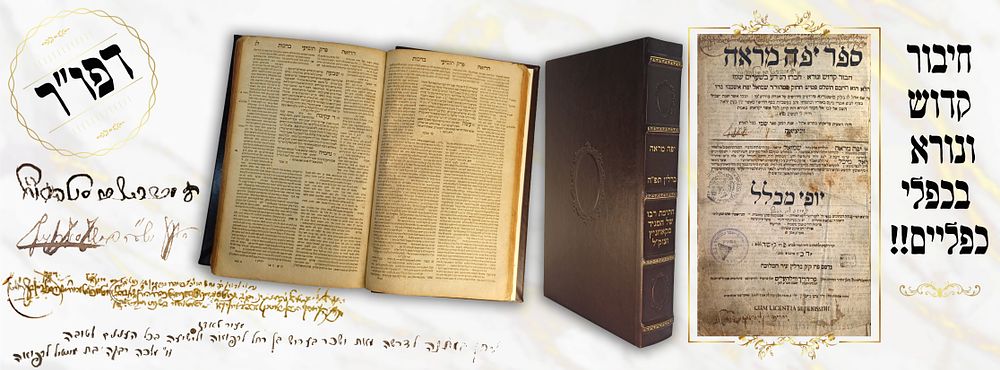
Bidspirit auction | “Yafeh Mar’eh”: the sanctified copy
“Yafeh Mar’eh”: the sanctified copy that passed among the greats of the generations... among them: the grandfather of the Rebbe R’ Henech of Alexander, and the holy gaon R’ Mordechai Tzvi Horowitz, son of R. Itzikel of Hamburg – and teacher of the holy Maggid of Kozhnitz!! - The book “Yafeh Mar’eh” – a commentary on the Aggadot of the Jerusalem Talmud by the great commentator of Midrash, R. Shmuel Yafeh Ashkenazi, author of “Yafeh To’ar” on Midrash Rabbah and more. With the commentary “Yofi Miklal” by Rabbi Yechiel Michl Ḥasid, Av Beit Din of Berlin. Berlin 1725 – first edition of the commentary “Yofi Miklal”. Rabbi Shmuel Yafeh Ashkenazi, and his composition Yafeh Mar’eh: Rabbi Shmuel Yafeh Ashkenazi was a younger contemporary of Maran the Beit Yosef. Despite his surname “Ashkenazi”, which attests to his origin, he lived all his life in the Ottoman Empire, mostly in its capital city, Constantinople. In Constantinople he stood at the head of one of the communities and was among the rabbis of the city. He was engaged in teaching and even authored a responsa work that was never printed, yet he became renowned through his commentaries on the Midrashim. His commentaries are lengthy, yet deep and comprehensive, descending into the profound intention of the authors of the Midrash, the Tannaim and Amoraim. His great composition on Midrash Rabbah, “Yafeh To’ar”, is a work of immense scope. Perhaps for that reason its printing was delayed, and before it he chose to print his commentary on the Aggadot of the Jerusalem Talmud, “Yafeh Mar’eh”. In the year 1590 the book went to press in Venice. The proofreader was Rabbi Yosef Samiga, author of the book “Mikra’ei Kodesh” [see item 20]. In a generation that did not engage in exaggerated language – the printer chose to call the book on its title page: “A holy and awesome composition”! The printer recounts beyond the title page that he is under pressure of work because of several books he was occupied in printing, “but many unique individuals, benefactors of the holy people”, urged him to prioritize this book. One of the supporters of the publication was none other than “the exalted noble for praise and honor, Don Shlomo ben Ya’ish” , see about him item 96. This book before us was bound up in a controversy. Around the year 1720, two scholars labored to bring Yafeh Mar’eh to print with their own additions, but each was unaware of the other. Rabbi Yechiel Michl son of R’ Yehuda Leib Darshan, Av Beit Din of Berlin, who had already travelled from city to city gathering subscribers and approbations; and Rabbi Avraham of Gluga, author of “Zera Avraham”, who sought to print it with his notes and the innovations of his teacher, Rabbi Shim’on of Pintchov. The result was that one year after the Berlin printing, Yafeh Mar’eh was printed again in Amsterdam; see in the article of M. Benayahu (R’ Shmuel Yafeh Ashkenazi, Tarbitz 42) concerning the development of the matter. Rabbi Shmuel Yafeh Ashkenazi passed away on 2 September 1535. Rabbi Ḥaim Palaggi testified of him that were it not for his books – we would have neither hand nor foot in the Aggadot of our Sages! Owners: On the book’s title page is a signature: “מרדכי צבי סג”ל הורוויץ”. This is the sacred handwriting of the holy gaon Rabbi Mordechai Tzvi HaLevi Horowitz, Av Beit Din of Brod, son of the holy gaon Rabbeinu Yitzchak HaLevi Horowitz, famed as “R’ Itzikel of Hamburg”, friend, Mechutan, and also disputant of the Noda BiYehuda. The holy Maggid of Kozhnitz was his disciple in the revealed Torah. A dispute that took place between R’ Itzikel of Hamburg and the Noda BiYehuda involved a case where a husband appointed an agent to divorce his wife against her will. The ban of Rabbeinu Gershom forbids divorcing against the woman’s will, and the question arose whether to invalidate the get even post facto because “there is no agency for a transgression”, and since there is no agency – there is no get. This discussion is famous in the yeshivah world. In this debate R. Mordechai Tzvi also participated, responding to the Noda BiYehuda to defend his father’s opinion. The Noda BiYehuda answers him with great honor: “ה' עמך גיבור החיל, בכיילא רבה כייל, בלא בר עייל, ה”ה אהובי ש”ב ידידי וחביבי, הרב הגדול המופלא ומופלג, החריף ושנון, המושלם במעלות ומידות..., ומעלתו יפה עושה להיות ברא מזכה אבא, וכבוד אביו מרתחא ליה ומתאמץ לעמוד על דעתו” (Responsa Noda BiYehuda, Second edition, Even HaEzer section 112). Likewise Rabbi Mordechai Tzvi discussed this matter with his relative, the author of “Ha’flah” (Responsa Giv’at Pinḥas, sections 29–30). R. Mordechai Tzvi was the son-in-law of the gaon Rabbi Moshe, Av Beit Din of Satnov. He passed away in Brod on 25 December 1810. Of his responsa were printed in the book Responsa Leḥem Matza [item no. 17]. Additional inscriptions: Several lines in handwriting at the top of the title page describe two stages in the book’s journey: how it came into the possession of Rabbi Yosef Shatin,