Bidspirit auction | Tov LeYisrael - passed from
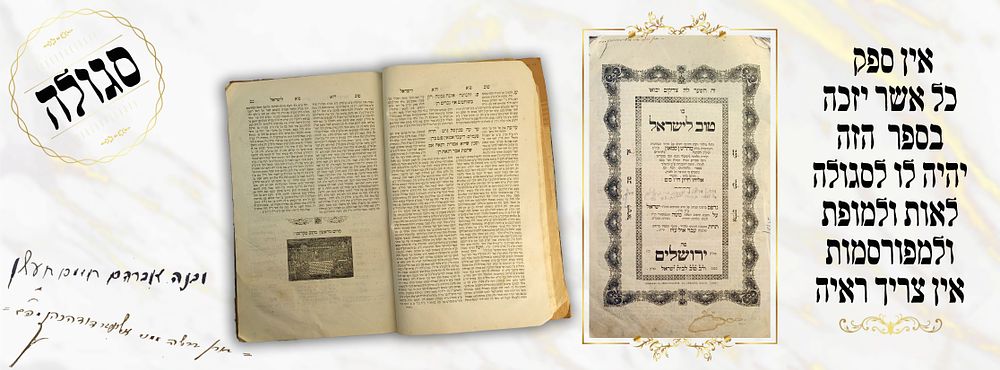
Tov LeYisrael - passed from hand to hand as a gift among the great men of Jerusalem a hundred and fifty years ago! Printed by R. Yisrael Bak - “Tov LeYisrael” A segulah-book that passed from hand to hand as a derashah-gift among the great men of Jerusalem a hundred and fifty years ago! Tov LeYisrael, an explanation and some halachic novellae in rhymed verses on shechita and tereifot, composed by R. Sh. ben Samaon, with aditions by Eliyahu ben Yitzchak Chayyon. Jerusalem, Yisrael Bak press (see below) 1869. At the beginning of the book appears the introduction of the publisher, R. Nissim Ezra Chayyon, the uncle of the author: “The author commanded me to print this book Tov LeYisrael to be for him a memorial, for, alas, he went to his eternal home at the age of thirty-three in the year 1867.” And he writes: “And there is no doubt that whoever merits this Torah-book, it will be for him a segulah, a sign and a wonder, for the merit of the rabbi-author, peace be upon him, can shield him, and that which is well-known needs no proof.” Following this the uncle added the eulogy-sermon that he delivered upon the completion of the thirty days after the author’s passing. At the end of the book, a number of responsa by the author. Owners: Flyleaf: This book belongs to the young scholar Shemaria the son of the rabbi Yehoshua Zvi of Kovno. On the title page: A derashah-gift from me Eliezer David HaKohen of P.B. [apparently Pressburg]. And in the middle of the title page: A derashah-gift to me, Avraham Chaim the son of Rabbi Yitzchak Cheshin, from R. Shemaria the son of Rabbi Yehoshua Zvi. Avraham Chaim signed also on leaf 1, where he uses the page number as the first letter of his signature: A’vraham Chaim. It seems that the book was first given as a derashah-gift by Rabbi Eliezer David HaKohen to R. Shemaria b. R. Yehoshua Zvi, and he gave it, after the passing of a generation, as a derashah-gift to Avraham Chaim Cheshin. This refers to the Gaon, Rabbi Avraham Chaim Chashin; his biography appears in the book “Anshei Emunah” (56–62) by R. Sh. Rotman, 2022. R. Eliezer David HaKohen is Rabbi Eliezer David, son of the tzaddik Pinchas Katz of Pressburg; see about them in “Anshei Emunah” (95–107). The author of “Arugat HaBosem” addresses him in a letter dated 13 October 1886 (Toldot Arugat HaBosem, pp. 99–100): “May the Lord bear him upon the blessing of His festivals and show him the uplifting of the horn of His people, praise to all His pious ones, my beloved yadinaf sh.b., the sharp and expert, pure of speech, exalted righteous man, the honorable our teacher Rabbi Eliezer David HaKohen, among the prominent of Jerusalem, may it be rebuilt and established… and let him not cease from mentioning us and praying for me in the holy places as my soul hoped, for even in the holy days and the days of mercy I did not remove his remembrance from my mind. I shall not hide from his honor my dear friend that He Who exalts all inspired the hearts of the congregation of Kleinwardein to place the office of the rabbinate there upon my shoulders, and I inclined my head to them. Pray for me that the Blessed One will cause my way to prosper and help me to magnify Torah and glorify it until the coming of the righteous Redeemer, for He is our life and the length of our days. His friend who seeks his peace, awaiting salvation and the ingathering of the dispersed of Israel speedily in our days, the insignificant Moshe, son of my father and master Amram Grünwald.” The Printing House of Rabbi Yisrael Bak: R. Yisrael Bak was among the first Hebrew printers in the Land of Israel, and the first to establish a printing press in Jerusalem. He viewed his work as sacred, referring to his press as a “printing altar.” In the introduction to his early works he wrote: “I printed them in holiness and purity, for the letters I created were fashioned with the wisdom granted to me by God.” In his later years he wrote: “I do not speak to glorify my own deeds, for it is He Who gives me strength to accomplish. My printing house is holy, for all the letters and all the instruments required are fashioned by my own hand. Nowhere in my press will you find even a single letter made by another, and certainly none made by gentiles, for the letters are sacred. One must intend properly during their creation, for with them the heavens and earth were fashioned, though I, in my own limited understanding, cannot fathom their true intention. Still, my intention is to follow the intention of Bezalel, who knew how to combine the letters through which the heavens and earth were created.” It is no wonder that the Kabbalists of the yeshivah Beit El were careful to use the books printed by R. Yisrael Bak.