Bidspirit auction | Attributed to Lavinia Fontana (Bologna,
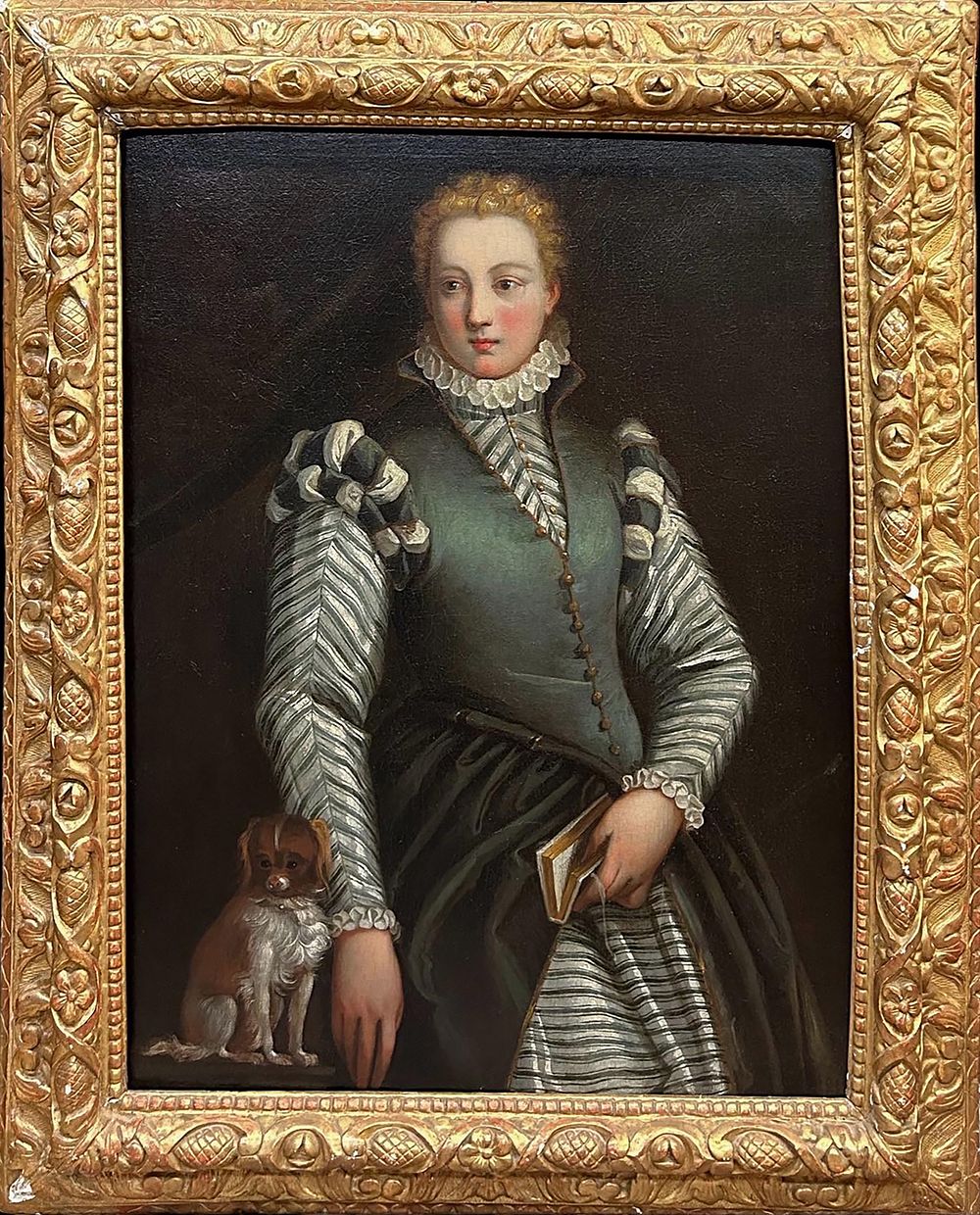
Attributed to Lavinia Fontana (Bologna, 1552 – Rome, 1614) - Portrait of a young lady with a dog and a book - Oil on canvas. Dimensions: 99 x 80 cm. This elegant three-quarter portrait depicts a young noble lady, dressed in elaborate period costume and accompanied by a small lapdog, a frequent symbol of fidelity and status. The figure holds a book with one of her fingers placed between the pages, a gesture that alludes not only to reading as a feminine virtue, but also to intellectual introspection. The work we present here is a more academic model, though from the same period, which differs significantly from the painting by Veronese housed in the Thyssen Museum. In this case, the stylistic and technical elements diverge notably from the color palette typically associated with the Venetian school. In terms of form and use of color, the piece is closer to the style of Lavinia Fontana or an artist from the Roman circle, which highlights its uniqueness within the artistic context of its time.The work has been attributed to Lavinia Fontana, one of the first recognized female painters of the late Renaissance, for several formal and contextual reasons. First, the genre of the female portrait was central to her output, and this work fits perfectly into that corpus. The support, the palette, and the sitter's attitude—particularly her expression of gazing calmly and serenely at the viewer—are strong references to other compositions by Fontana. A key detail that supports this attribution is the inclusion of the finger inside the book, a compositional motif found in the celebrated Portrait of Lucia Bonasoni Garzoni (1590). Likewise, the refined and naturalistic manner of depicting the hands, with delicate fingers and a measured pose, bears a close resemblance to works such as Portrait of a Lady, Three-Quarter Length, sold at Sotheby's in 2017. Although Fontana's direct authorship cannot be confirmed with certainty, the numerous elements common to his style make it plausible that he was directly involved, or that it was executed within his circle or workshop. The combination of stylistic characteristics allows this work to be valued as part of the immediate entourage of one of the most important female figures of Italian Mannerist art. Located in international storage.