Bidspirit auction | Fèlix Ziem (Beaune, 1821 -
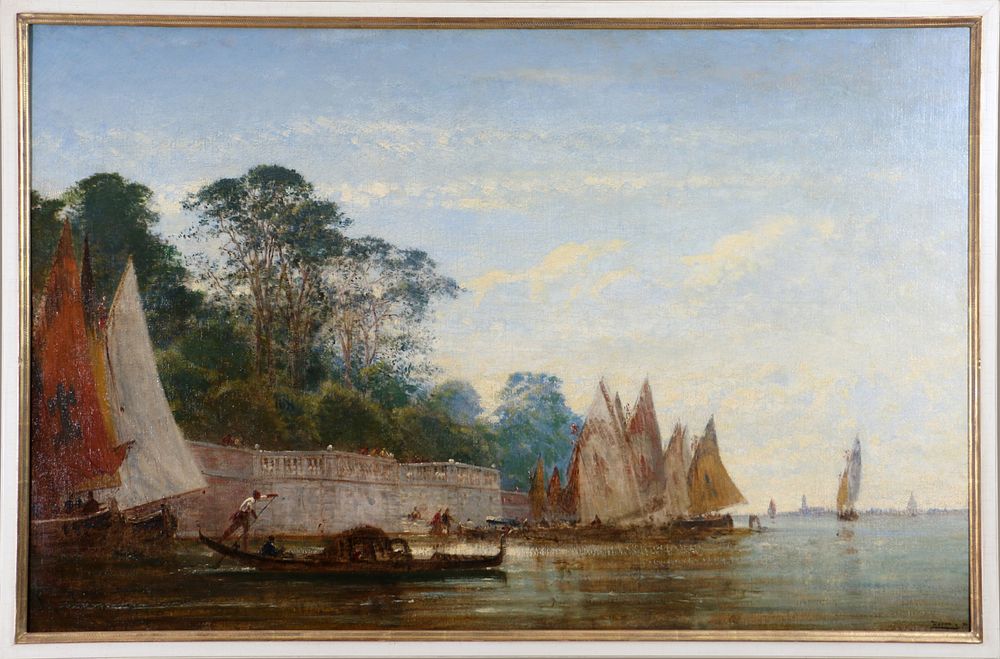
Fèlix Ziem (Beaune, 1821 - Paris, 1911) - Venise, les jardins français (1871) - Oil on relined canvas. Dimensions: 127 x 82 cm, 132 x 88 cm (framed). Signed and dated lower right. The work has been certified by the Félix Ziem Association, represented by Mathias Ary Jan and David Pluskwa. Certificate No. 293/0324 will be given to the buyer. The painting will also be included in the artist's catalogue currently being prepared. This exceptional painting, by Félix Ziem, offers a lively view of the main entrance to the French Gardens in Venice, created by order of Napoleon I. Dated 1871, the work corresponds to a period of artistic maturity, just before the stylistic shift that would mark the 1880s. Still dominated by detail, the composition displays a rich but restrained palette, although an evolution toward a freer use of color is already evident, especially evident in the trees in the center, painted in light blue with green hues that capture the attention despite being in the background. The treatment of light in the sky and its reflections in the water—fundamental elements in Ziem's work—are magnificently represented here. Félix Ziem, initially trained as a watercolorist, began his artistic career with a light and transparent technique, similar to that of plein-air painters such as Corot and representatives of the Barbizon school. From 1855 onwards, his style evolved toward a painting richer in impasto and lyricism, focusing on views of Venice and Turkey, which earned him great acclaim for his ability to capture an idealized vision of the Orient and the Serenissima. In the 1880s, his strokes became freer, his colors more intense, and the overall impression came to dominate detail, in line with avant-garde movements that anticipated modern art, such as Boudin and Jongkind. His constant interest in atmospheric variations and light marked his entire output. Born in 1821, he studied at the École des Beaux-Arts in Dijon, then moved to Marseille, and in 1840 decided to devote himself entirely to painting after a commission from the Duke of Orleans. He traveled extensively in Italy, Russia—where he was a watercolor teacher to the Grand Duchesses—the south of France, and Constantinople. From 1849, he exhibited regularly at the Paris Salon and lived between Paris and Barbizon, where he associated with Rousseau and Millet. In 1856, he made his great oriental trip, which took him to Egypt, Greece, Turkey, and Lebanon. In the following years, he continued traveling throughout Europe, with regular stays in Venice. In 1859, he settled in Montmartre, without losing his connection to Barbizon, where he lived until his death in 1911. Located in an international warehouse.