Bidspirit auction | Exquisite Still Life with Trophies,
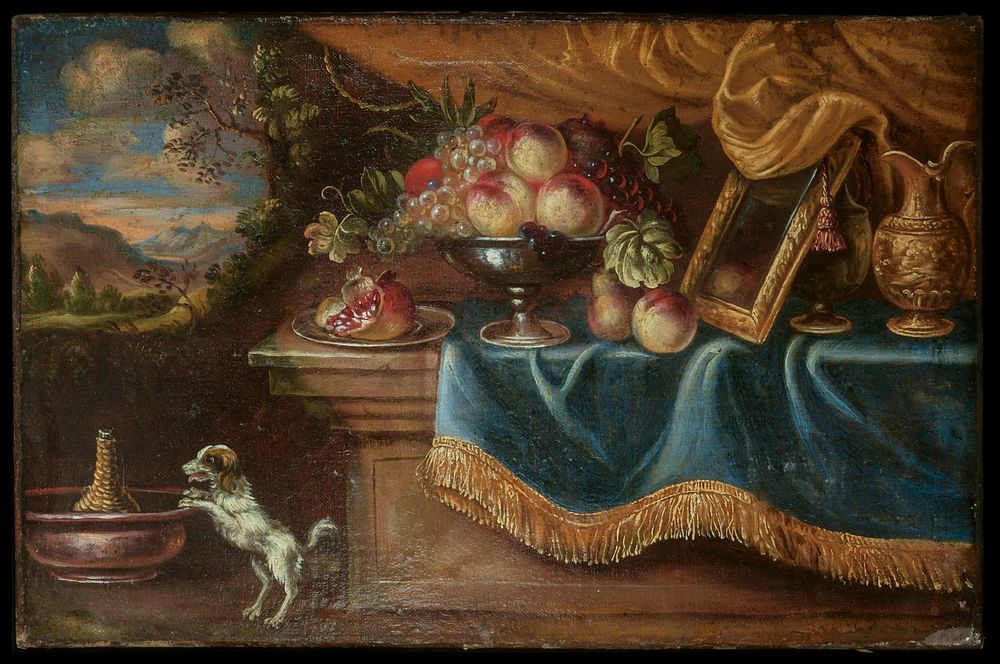
Exquisite Still Life with Trophies, Fruit and Dog, attributed to FRANCESCO NOLETTI, CALLED IL MALTESE (VALLETTA c. 1611 - ROME, 1654), Italian school of the 17th century - Oil on canvas, measuring 53 x 33 cm. A work typically associated with the artistic canons of the Italian Baroque and which is directly linked to similar models by the famous painter of the Roman school Francesco Noletti, called il Maltese and born in Valletta, Malta (Valletta? c. 1611 - Rome, 1654) Noletti was an Italian Baroque painter, born, as his nickname indicates, in Malta and specialized in still life painting. Noletti's still lifes have been attributed to the so-called Francesco Fieravino or Fioravanti, a confusing creation of the 18th century, until, in the early 2000s, his true identity was discovered from an anonymous portrait kept at the Foundation for International Studies in Valletta, in the building of the old university. His biography shows that around 1640 or so he settled in Rome, where he married and collaborated with Andrea Sacchi, and died there on 4 December 1654. The death certificate called him a ”famous painter”. Although his surname was soon forgotten, he was praised, always by his nickname, by Cornelis de Bie and Joachim von Sandrart and later also by Joshua Reynolds, among several others. In the absence of signed works, two engravings published in 1703 by Jacobus Coelemans on paintings by the Maltese, entitled Omnis salus in ferro est and Quaedam sensum instrumenta, have served as a basis for establishing his style, in which some elements are repeated.5 His rich still lifes are always characterised by the presence of Turkish carpets, tapestries and curtains covering the tables and shelves on which rest tableware, flowers and fruit arranged alongside some precious object, musical instruments and framed paintings or mirrors. Three still lifes by the Maltese master are preserved in the Museum of Fine Arts in Bilbao, where they entered in the 1920s with attributions to Antonio de Pereda and Pieter Boel. Provenance: important French private collection.