Bidspirit auction | Nicolas de Largillière (Paris, 1656
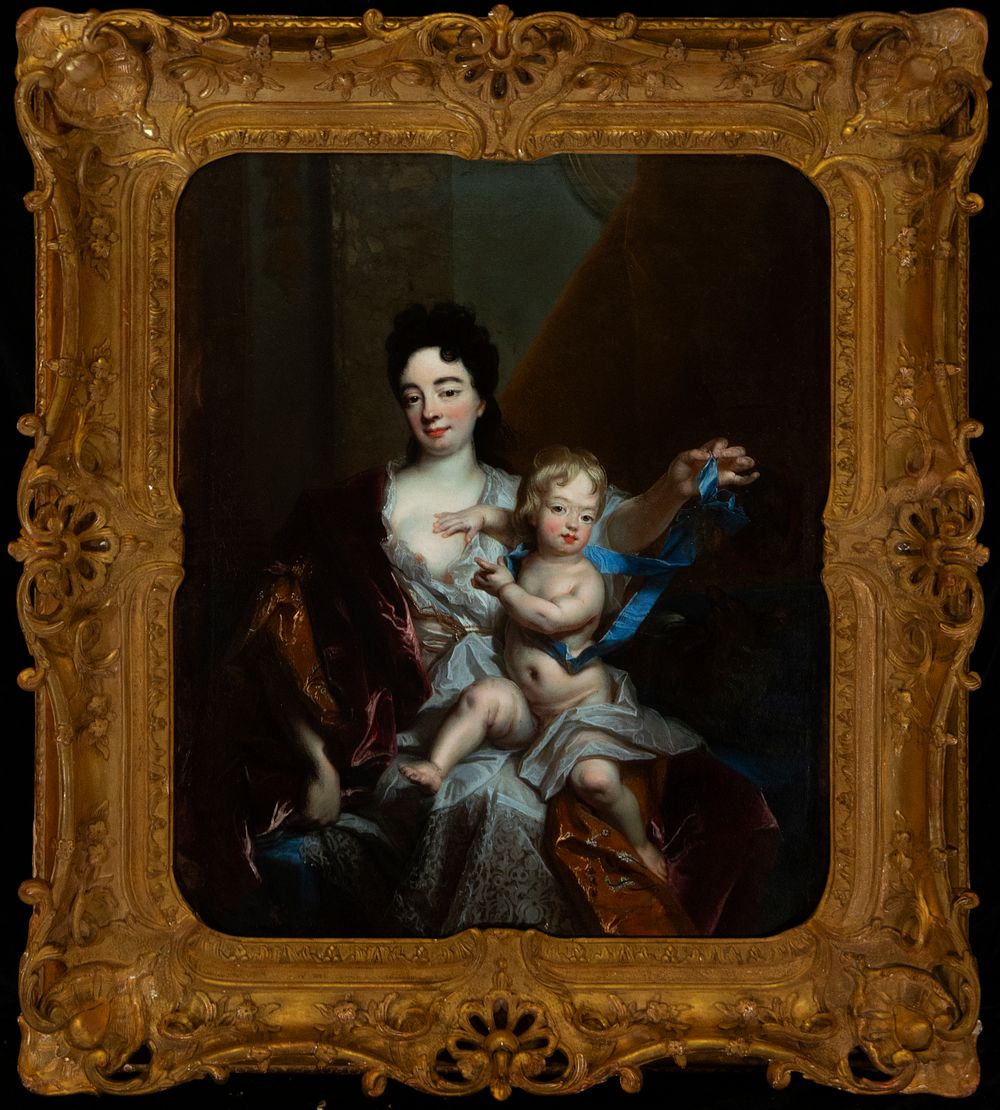
Nicolas de Largillière (Paris, 1656 - 1746) - Portrait of Marie Madeleine Mercier and Louis de Bourbon, 2nd Duke of Brittany (c.1708) - Oil on canvas. Dimensions: 65 x 55 cm (unframed). We would like to thank Dominique Brême for his help in cataloging this work. On the back of the frame, there is an erroneous inscription ”Duché de Ventadour, gouvernaunce des enfants de France. Louis XV, D(…) par Largillière (ND)” and, in the upper left corner, a shipping label from the Chenue house (Paris). However, this attribution to the Duchess of Ventadour suffers from several inconsistencies. First, the style and workmanship of the painting place it around 1710—due to the lady's hairstyle and the composition—when the real Duchess of Ventadour was around fifty-six years old, a far cry from the youth displayed by the female model. Furthermore, the child portrayed appears to have blue eyes, not the dark ones of the Duke of Anjou. For all these reasons, we can affirm that the female figure actually represents Catherine Marton, known as “Madame Bailly, ” second wet nurse to the 2nd Duke of Brittany, Louis de Bourbon, born on January 8, 1707. Both appear in an intimate and maternal atmosphere: the child, about two years old, rests one hand on the wet nurse's bare breast, while with the other she holds the medallion of the Order of the Holy Spirit worn by the Duke of Anjou. infant, a sign of his status as “Enfant de France.” This gesture, unusually “erotic” for court painting, confirms that this is not the governess, but the one who breastfed and raised the prince. The youthful freshness of the child—Louis de Bourbon, 2nd Duke of Brittany—and the gentle, restrained gaze of the wet nurse coincide with other portraits of her, particularly the group painted by Jacques Dumont “le Romain” in 1731 (Louvre, RF 511), where, at fifty years old, Madame Mercier (his successor) displays identical features (eyes, upturned nose, dimple in the chin). Although the portrait could serve to recognize the prince, its true intention is to highlight the role of the wet nurse. She extends her arm to proudly display the medal of the Order of the Holy Spirit. This detail not only indicates the royal status of the child, but also highlights the authority she exercises over him. Here, the artist adopts an almost provocative—not to say irreverent—approach by turning the sacred emblem of the heir on a toy casually held by the maternal hand. This underlines the role of the wet nurse not as a mere companion, but as the dominant and protective figure in the prince's childhood. This iconographic device even suggests that Marie Madeleine Mercier may have commissioned the work; however, it is also possible that the king (or the Grand Dauphin, or the Duke of Burgundy) wished to honor her by giving her her portrait, in her role as wet nurse and thanks to Largillière's work. There is a large canvas of identical composition in a private Parisian collection (160 × 130 cm), published by Georges de Lastic, attributed to the 2nd Duke of Brittany with his wet nurse (”without doubt Madame Bailly”; L'Œil 323, June 1982, p. 30, repr. 27). After examining both versions, it is confirmed that this is a ”ricordo”—a reduced-size replica intended for future clients—since it presents the same ”pentimento” on the nurse's arm.If this correction had been a ”modello”—a preparatory figure to validate the composition—it would not have been visible in the final work; once it was inserted into the large canvas, it would have also been replicated in this parallel ”ricordo.” A detailed examination of the original, carried out ”in situ” by Dominique Brême, confirms its autograph nature: ”The generous paint content, the precision of the drawing, the freedom of the strokes, and the beautiful harmony of the palette leave no room for doubt. This is an original work by Nicolas de Largillière.” An extensive report prepared by Dominique Brême in May 2025 is attached. It will soon be added to the artist's catalogue raisonné.