Bidspirit auction | Antiveduto Grammatica (Siena, 1571 –
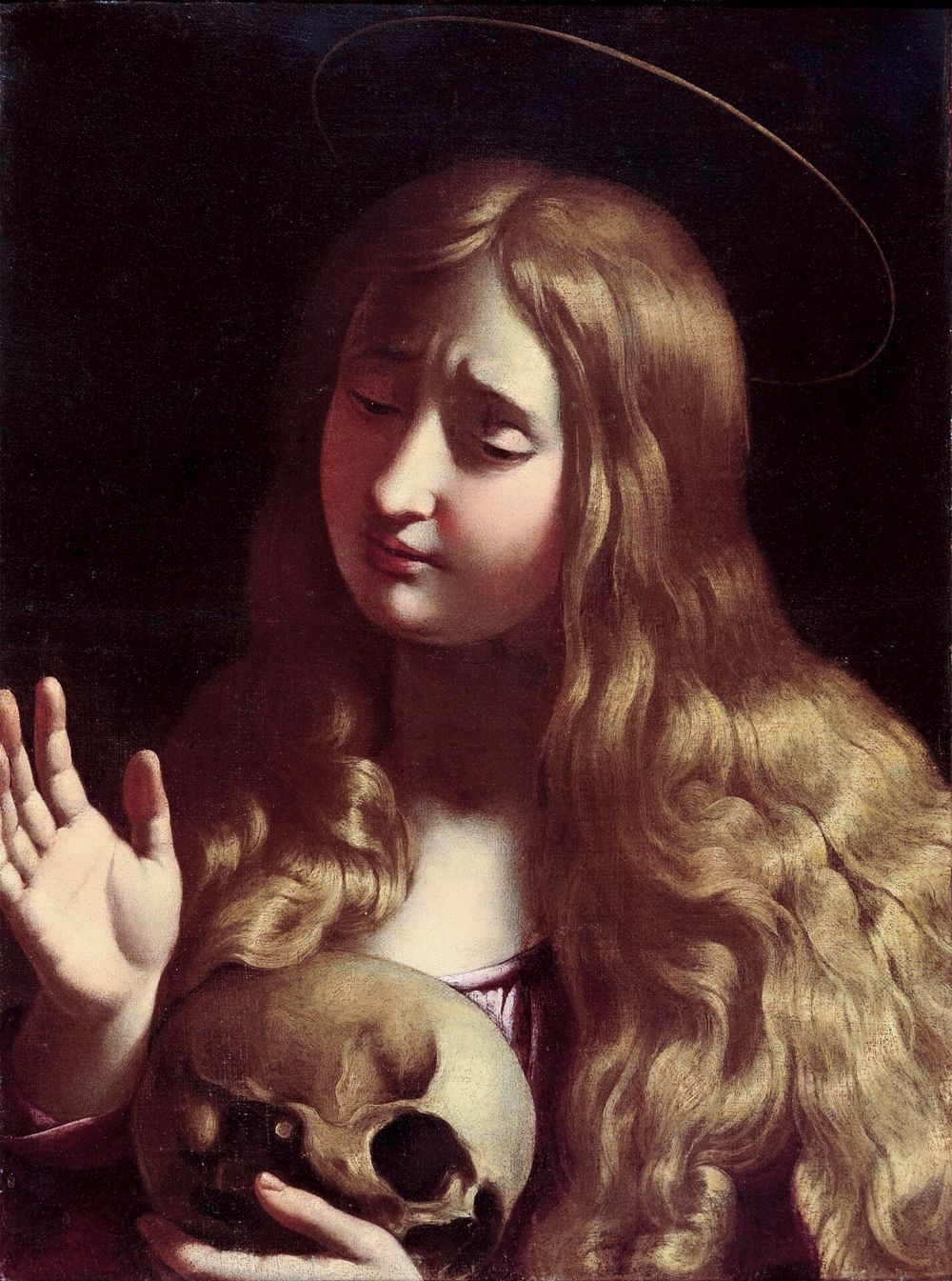
Antiveduto Grammatica (Siena, 1571 – Rome, 1626) - Penitent Magdalene - Oil on canvas. Dimensions: 58 × 43.2 cm. We expressly thank Professor Gianni Papi for his assistance in the cataloging and study of this work. A certificate from Professor Gianni Papi is attached. This is a work from Antiveduto Gramatica's fully mature period, datable to the third decade of the 17th century, a key moment in the artist's evolution, when his pictorial language underwent a decisive shift towards a refined classicism without entirely abandoning its naturalistic roots. The work depicts Mary Magdalene in prayer, holding a skull, a symbol of penance and meditation on the fleeting nature of life, treated with restrained emotional intensity and remarkable formal balance. When Professor Gianni Papi first examined the work, the painting was affected by an old restoration that made it appear closed and with the paint somewhat hardened; However, certain fundamental elements—such as the raised hand and the skull in the foreground—already suggested a quality fully consistent with Antiveduto Gramatica's own work. The recent restoration process has revealed a painting of exceptional quality, leaving no doubt as to its authorship and allowing a clear appreciation of its original depth, thickness, and chromatic richness. The work fits coherently within the group of Magdalenes painted by the artist in the 1620s. The raised hand can be directly compared to that of the ”Magdalene kneeling before Christ in the Noli me tangere” in the Duomo of San Severino Marche, attributed to Gramatica in 1990, while the imposing hair, in its structure and arrangement of strands, recalls the figure of Mary in the canvas with ”Martha and Mary” auctioned at Finarte in 1991. This type of abundant, flowing hair also corresponds to the description by Giulio Mancini, who noted how Antiveduto ”exceeds expectations in painting the hair, ” an observation that reinforces the attribution to the artist. The treatment of the skull is particularly noteworthy, rendered with a direct and striking naturalism, demonstrating how Gramatica had not lost his taste for a sincere and truthful representation, despite his growing interest in the compositional elegance of the Bolognese school. In this particular passage, one also perceives an early reception of Ribera's innovations, a rare element in the painter's work, which gives this painting a unique value within his oeuvre. Bibliography: G. Mancini, Considerazioni sulla pittura, ca. 1617–1621, ed. A. Marucchi and L. Salerno, Rome, 1956–1957, 2 vols., I, p. 245. G. Papi, Note al Gramatica e al suo ambiente, in «Paradigma», 9, 1990, pp. 107–127. G. Papi, Antiveduto Gramatica, Soncino (CR), 1995. G. Papi, Aggiornamenti di Antiveduto Gramatica, in «Arte cristiana», Milan, 91, 2003, pp. 117–124. Provenance: Important Lombard aristocratic collection.Batch in international warehouse (within the EU). Intra-EU shipment: no import duties apply within the EU. Export permit from the country of origin may be required.