Bidspirit auction | Attributed to Pedro de Mena
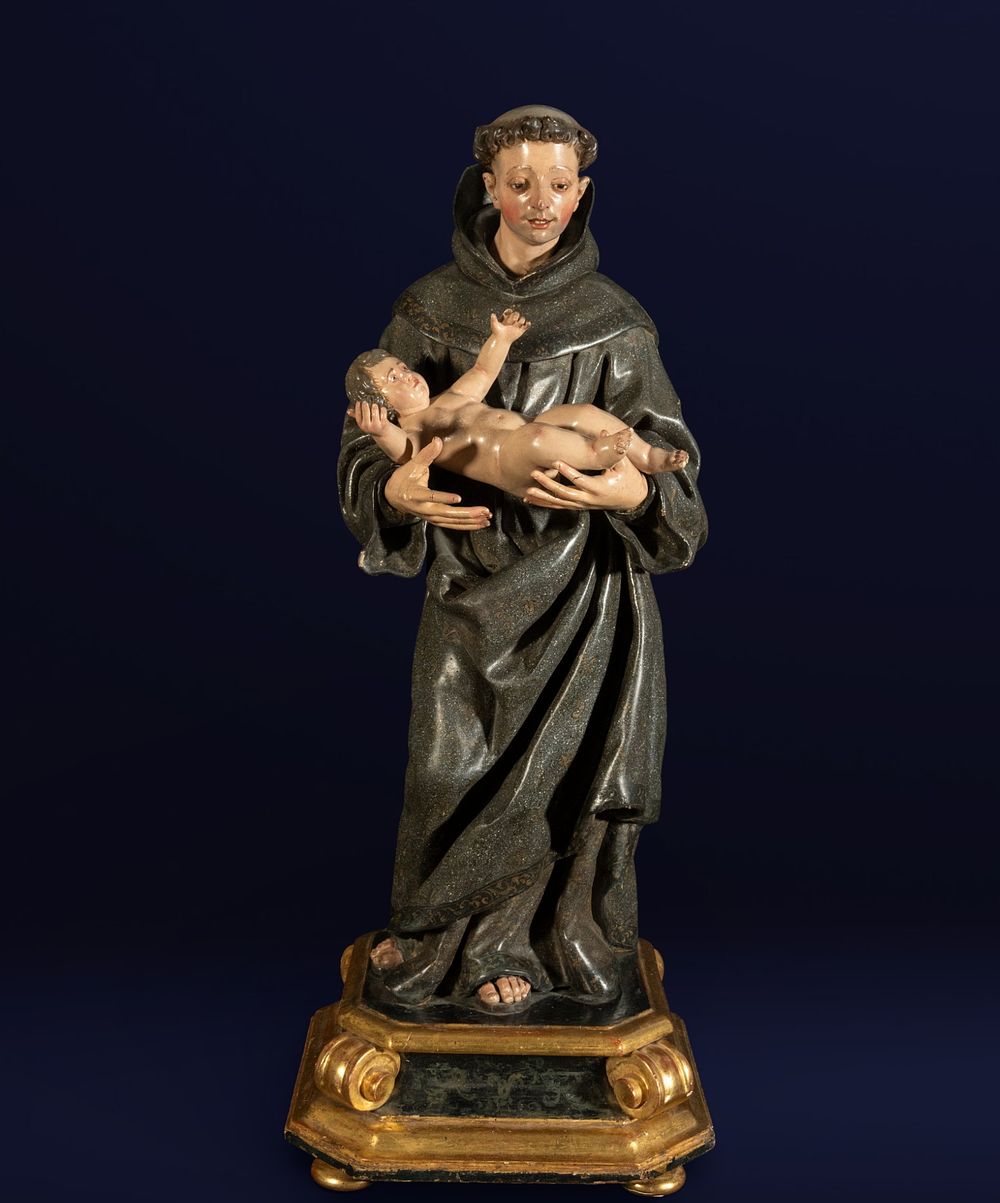
Attributed to Pedro de Mena (Granada, 1628-Málaga, 1688), 17th century - Accompanied by a report from Dr. Ángel Rivera de las Heras, PhD in Art History. 75 x 30 x 30 cm. Carved and polychromed wood. The Portuguese saint is depicted cradling the Holy Child Jesus in a brown Franciscan habit, with a rope tied around his waist. This rope has five knots, alluding to the five wounds of Christ; in other instances, three knots are found, representing the vows of chastity, obedience, and poverty. Over his shoulders, he wears the characteristic Franciscan cape, fastened at the neck with a pointed hood. All his garments are painted in a sober and austere polychromy. His right leg is extended in a walking position, revealing his bare foot beneath his habit. He has fair skin, rosy cheeks, and his hair is cut in a crown. His arms are held away from his body at waist level, as if to hold or embrace something. Having lost his attributes, he may be holding either the Christ Child or the Bible with the lily. He inclines his head forward, his gaze directed toward what he would have originally held in his hands. Saint Anthony rests on a prismatic black base with molded edges. The work on this image is reminiscent of that of the important Granadan sculptor Pedro de Mena. We find a great similarity to the sober and simple folds of the habit in other sculptures of his, such as the Saint Peter of Alcántara now in the National Sculpture Museum of Valladolid or the one in the National Art Museum of Catalonia. His features are also comparable to those of the Saint Diego of Alcalá in the Diocesan Museum of Vitoria.