Bidspirit auction | ANTOINE LE NAIN (Laon, c.
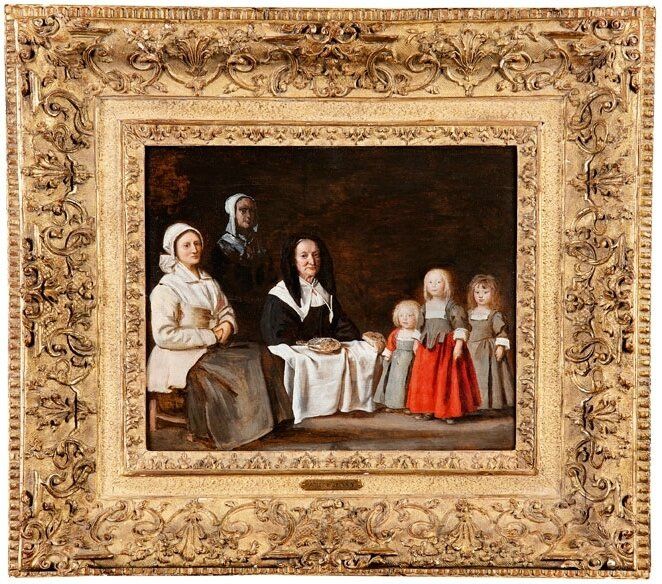
ANTOINE LE NAIN (Laon, c. 1588 – Paris, 1648) - Three Women with Three Children (c. 1640) - Oil on panel. Dimensions: 29.5 x 36.5 cm. Certificate of Authenticity from René Millet Expertise is included. This delicate composition depicts three women accompanied by three children dressed in tunics, as was customary in 17th-century children's clothing, worn by both boys and girls until approximately the age of six. Although positioned on the right side of the scene, the three children are the true focus of the work. They appear elegantly dressed in fine linen gowns over white shirts with cuffs extending beyond the sleeves, and one of them even wears a scalloped bib, emphasizing his privileged background. Their rigid, parallel poses, with arms hanging at their sides and their gaze directed at the viewer, lend them an almost ceremonial solemnity, as if they were about to bow. Opposite them, the three women on the left—two seated and one barely visible in the shadows of the background—present a more somber appearance, likely as a wet nurse, governess, or servants attending to the children. The interior space is barely defined, absorbed by a dark background that focuses attention on the figures in the foreground and the table covered with a white tablecloth upon which rest a plate and a loaf of bread. The palette, restricted to browns, grays, and whites, fully reflects the Le Nain family's style, where chromatic restraint becomes a vehicle for intimacy and gravity. The white, distributed with varying intensity on sleeves, collars, and headdresses, also serves to visually hierarchize the figures, while the reddish accents reinforce the presence of the three children, the true protagonists of this group portrait of a 17th-century bourgeois family. Antoine Le Nain, the eldest of the three Le Nain brothers, along with Louis and Mathieu, developed one of the most distinctive styles of French painting in the first half of the 17th century. Settled in Paris since 1629, the three brothers achieved great renown for their genre scenes and group portraits, characterized by a restrained mise-en-scène, a quiet atmosphere, and particular attention to facial expressions. In contrast to the dominant Caravaggism of the time, the Le Nains preferred a more direct and restrained style, focused on everyday reality and the dignity of humble or bourgeois figures. This work, specifically attributed to Antoine Le Nain, is particularly interesting because it is a group scene with a portrait-like character, a less frequent type within his oeuvre and likely linked to a private commission. This lot is in an international warehouse (outside the EU). For shipments to the European Union, import duties and/or taxes will apply and are the responsibility of the buyer.