Bidspirit auction | Balthasar van der Ast (Midelburg,
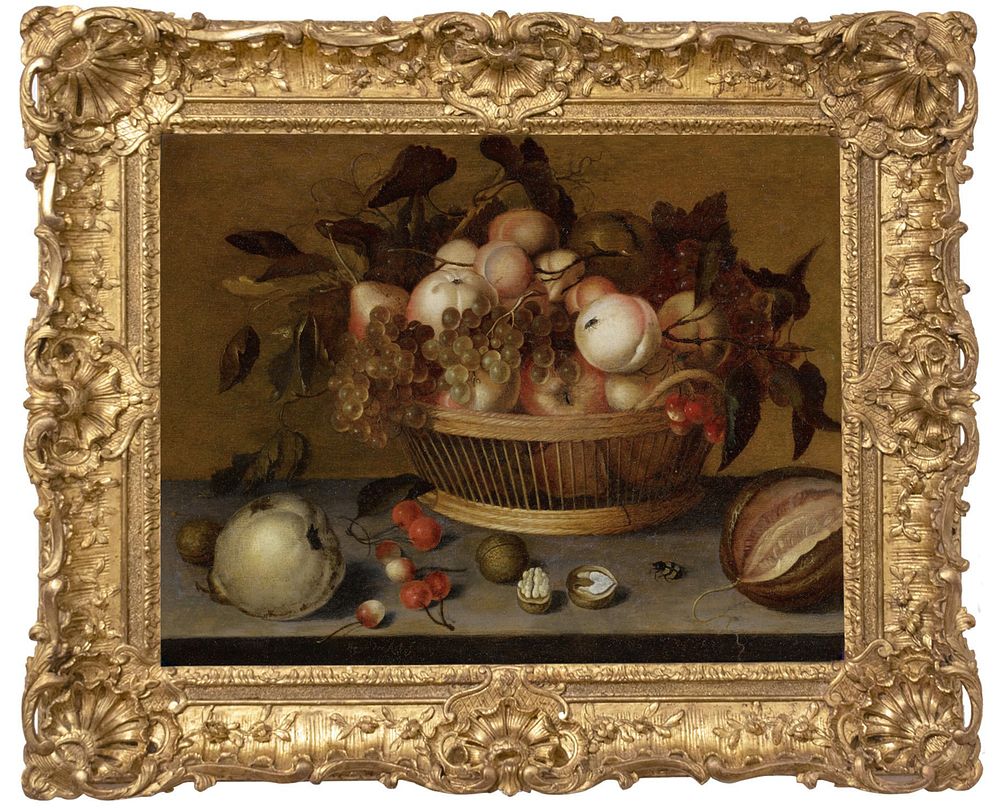
Balthasar van der Ast (Midelburg, 1594 - Delft, 1657) Attributed - Still Life with Basket of Fruit (c. 1627) - Oil on panel. Dimensions: 38.4 x 52 cm. Signed and dated in the lower left corner: “B. van der Ast f. 1642”. The abundant basket of fruit that dominates the composition is not merely decorative, but rather partakes of the complex moral and religious symbolism characteristic of 17th-century Dutch still lifes. The fruits, arranged with careful balance both within the basket and on the table, acquire a hierarchical meaning that reinforces the spiritual message of the scene. Peaches, apricots, and bunches of grapes, associated with the redemption of sins, partially cover an apple, a traditional symbol of original sin. In the foreground appear other fruits also imbued with symbolic resonance: walnuts, whose interior recalls the flesh of Christ and whose shell alludes to the wood of the Cross; cherries, evoking Paradise; the pear, linked to the Virgin Mary; and the melon, which refers to earthly pleasures. To this spiritual dimension is added the theme of vanitas, suggested by the presence of insects: the butterfly alludes to the fragility of life, while the fly perched on the fruit introduces the idea of the corruption of matter. In this way, the cycle of the seasons and the abundance of fruit become a reflection on the fleeting nature of existence, the inevitability of death, and, at the same time, the promise of resurrection. From a stylistic point of view, the work belongs to the pictorial tradition developed by Balthasar van der Ast, one of the leading specialists in still lifes of the early 17th century. Trained alongside his brother-in-law Ambrosius Bosschaert, Van der Ast worked in Utrecht and later in Delft, where he developed refined compositions characterized by the meticulous depiction of objects, the clarity of the neutral background, and the careful arrangement of flowers, fruits, shells, or exotic porcelain, reflecting the commercial and maritime power of the Dutch Republic. However, the painting also exhibits close affinities with the early work of Jan Davidsz. de Heem, one of the great masters of Baroque still life. Born in Utrecht in 1606, De Heem began his career around 1626, at which point his pictorial language still shows a marked dependence on the style of Van der Ast. In fact, several studies have suggested the possibility that the young artist received some form of training in Van der Ast's circle during the years Van der Ast was active in Utrecht, between 1619 and 1632. De Heem's early still lifes display such a remarkable stylistic proximity to the works of the older master that they have sometimes been mistaken for them. In this respect, the present still life fully fits within that shared artistic context, both in the arrangement of the fruit and in the delicacy of the execution and the descriptive precision of the elements.According to specialist Fred Meijer, who proposed a possible attribution to Jan Davidsz. de Heem based on photographs, the painting could be dated to around 1627–1628, a period when the artist was producing compositions closely linked to the style of Van der Ast. The signature “B. van der Ast” and the date “1642,” possibly added later, should be interpreted within this framework of stylistic proximity between the two painters, particularly evident in the early phase of De Heem's career. Provenance: Important private collection. Lot in international warehouse (outside the EU). For shipments to the European Union, import duties and/or taxes will be the responsibility of the buyer.