Bidspirit auction | JACOBELLO DEL FIORE (Venice, ca.
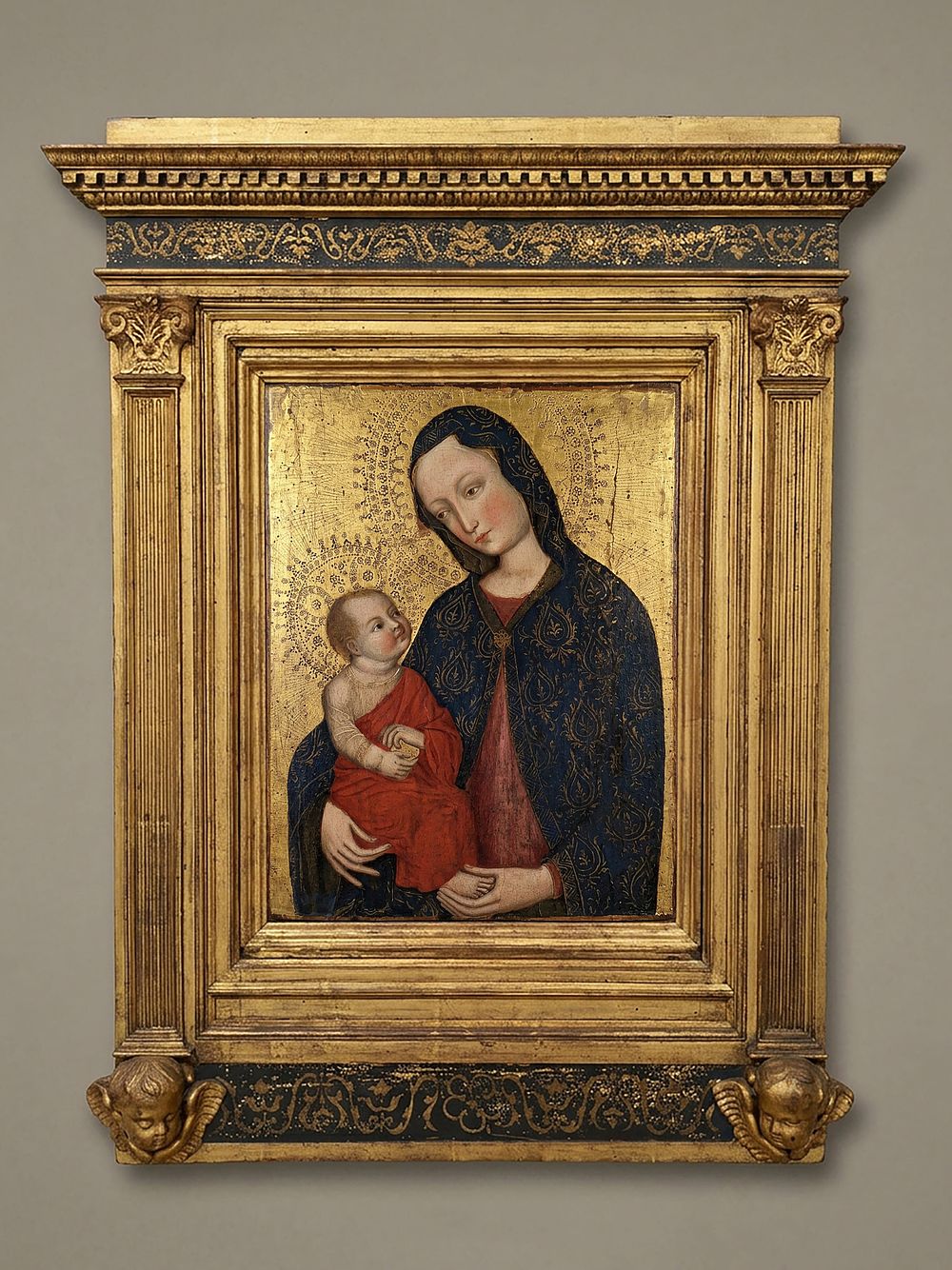
JACOBELLO DEL FIORE (Venice, ca. 1370 – Venice, 1439) - Madonna and Child - Tempera, gold, punched and sgraffito on panel. Dimensions: 47 x 37 cm. Jacobello del Fiore was one of the most important figures of the Venetian school of the early 15th century, playing a fundamental role in the evolution of painting in Venice from the Byzantine tradition towards the refined models of International Gothic. This Madonna and Child, datable to around 1420, is a magnificent example of this period of artistic maturity. Its attribution to the Venetian master is based on the numerous stylistic, iconographic, and morphological similarities the work presents with other universally accepted compositions within his oeuvre, especially with the Madonna and Child in the Correr Museum in Venice, where identical stylistic features can be seen in the construction of the faces, the almond-shaped eyes, the linear treatment of the folds, and the delicate, affectionate relationship between the Virgin and Child. Similarly, it bears a close resemblance to the Virgin and Child housed in the Fine Arts Museums of San Francisco, both in its compositional arrangement and in the conception of the halos and the ornamentation of the gilded surfaces. Jacobello draws directly from the Byzantine iconographic tradition, especially from the Marian models disseminated in Venice through its close ties with the East. The composition derives from the Eleusa or Virgin of Tenderness type, in which Mary holds the Child in an intimate and affectionate pose that emphasizes the maternal bond between them. This model, inherited from Byzantium, is reinterpreted by the artist according to the sensibilities of the Italian Trecento and early Quattrocento, maintaining a certain hieratic quality in the figures while introducing a greater emotional closeness between Mother and Child. The scene unfolds against a broad gold background worked using techniques of punching and sgraffito, characteristic elements of late Gothic Venetian painting. Particularly noteworthy is the treatment of the Virgin and Child's halos, decorated with intricate, punched floral motifs that create richly ornamented, lobed forms—a recurring device in some of the master's most refined works and one of the most distinctive elements of his decorative language. The Virgin appears adorned with a wide blue mantle fastened by a brooch at her chest and covering her head, beneath which a fine, translucent glaze is visible. The surface of the mantle is enriched with delicate, palm-like vegetal motifs created using sgraffito, reflecting the taste for decorative refinement characteristic of Venetian painting of the period. Beneath the blue mantle emerges the red tunic, a color that in Christian iconography alludes to the future Passion of Christ. The Christ Child holds a golden apple in his hands, a symbolic attribute that refers to the original sin committed by Adam and Eve, andAt the same time, it alludes to Christ's redemptive mission as the new Adam, destined to restore humanity's salvation through his sacrifice. Likewise, the delicate, translucent fabric that partially envelops the figure of the Child, executed with subtle glazes, symbolically anticipates both his human nature and the events of the Passion that will mark his destiny. Provenance: Toledo Museum of Art, Toledo (Ohio, USA); currently in a major Italian private collection. Lot in international warehouse (within the EU). Intra-EU shipping: no import duties apply within the EU. An export permit from the country of origin may be required.