Bidspirit auction | Ligovsky People's House. Collector. With
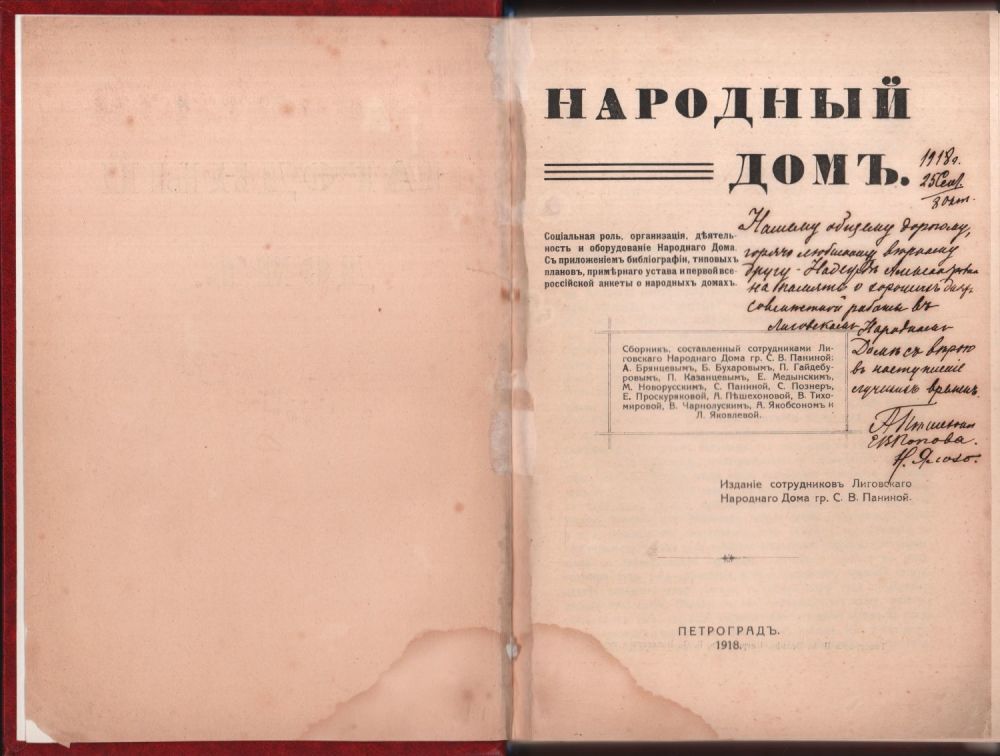
Ligovsky People's House. Collector. With a gift inscription from employees. - Petrograd. Publication of employees of the Ligovsky People's House, printing house of B. M, wolf. 1918. X, 424 p. Modern hardcover, size 16 x 24 cm. The original covers are preserved inside. Very good - excellent condition, traces of moisture. Ligovsky people's house appeared on the map of the city in the early 20th century. Its Creator and inspirer of all its works was an amazing woman — Countess Sofia Vladimirovna Panina. She was the last representative of the extinct family of counts Panin. Her life was not quite normal. Her father, Vladimir Viktorovich Panin, was a notorious liberal. Like all Panins, a very well-read man, he married the beautiful Anastasia Maltseva, who grew up at the court with the children of Alexander II, and undertook to expand her horizons by communicating with the then cultural intelligentsia-doctors, University professors, Zemstvo figures, most of whom adhered to progressive views. He was so successful in this that after his early death, Anastasia Sergeevna completely immersed herself in this environment. She remarried to Petrunkevich, a prominent Zemstvo figure who later became one of the leaders of the cadet party. Sophia's grandmother, fearing the corrupting influence on the impressionable granddaughter of the environment in which her mother moved, fearing, moreover, that the money issued from the huge family inheritance for the maintenance of her daughter would go to revolutionary propaganda, resorted to an unheard-of measure at that time: by personal order of Alexander III, Sophia was taken from her mother and placed in the care of her grandmother, who enrolled her in the Catherine Institute. In 1890, Sofia Vladimirovna, who was considered the richest bride in Russia, married the son of state Secretary Polovtsev. The planted father at the wedding was the Emperor Alexander III. But they did not see eye to eye with her husband, and after a scandalous divorce process, they separated, and Panina regained her maiden name and title. Maternal influence was not lost: Sofya Vladimirovna shared the political views of her stepfather, whom she greatly respected, and eventually became a member of the Central Committee of the cadet party. Having no children of her own, but being the sole owner of huge family wealth, Countess Panina engaged in social activities and charity: she helped the starving, schools and hospitals were maintained at her expense, but her most famous business was the Ligovsky people's house. According to the memoirs of Sofia Panina herself, the decisive moment in her life was a meeting in 1890 with another remarkable Russian woman-Alexandra Vasilyevna Poshekhonskaya, a teacher at a modest district school in St. Petersburg. She came to the Countess with a request to help arrange a free canteen for needy students of the primary city schools of the Alexander Nevsky part, where she taught, and which lay behind the Obvodny canal. They started with the organization of a canteen - for two shifts of 25 children, which soon arranged extracurricular activities, reading with ”foggy” pictures, a library with home delivery of books and evening classes for adults. Over time, there was a kindergarten for kids, craft and needlework classes for teenagers, General education classes for their parents, halls with Newspapers, magazines, chess and checkers. Whole families of artisans and workers from this area of St. Petersburg came here on their free days. This enterprise required more and more funds, which were mainly provided by Countess Panina, larger premises and more and more specialized personnel. Gradually, the two women were joined first by singles, and then by dozens of volunteers-men and women who were infected with their enthusiasm. In 1903, at the corner of Tambov and Prilukskaya streets, built at the expense of the Countess, the Ligovsky people's house was opened, which was popularly called the Panina house, after its Creator. The construction of the house was carried out under the project and under the guidance of the famous Russian architect Yuli Yulievich Benois, the Creator of projects for many industrial buildings in our city. In the lower floor of the house, which was reserved for children, there was a dining room, gym and children's reading room, and on the upper floor there was a theater hall. The dining room is a large, high room lined with rows of tables and chairs. In the middle was a large hot-water cube that replaced the samovar. The dining room could accommodate several hundred children. In a specially arranged hall were conducted, according to the method of Prof. Lesgaft, gymnastic exercises for children under the guidance of a teacher Of the society for physical development. A large, bright hall that followed the gymnasium – a children's reading room. In the cabinets was a carefully selected children's library, with various atlases and textbooks; here, in the corner,