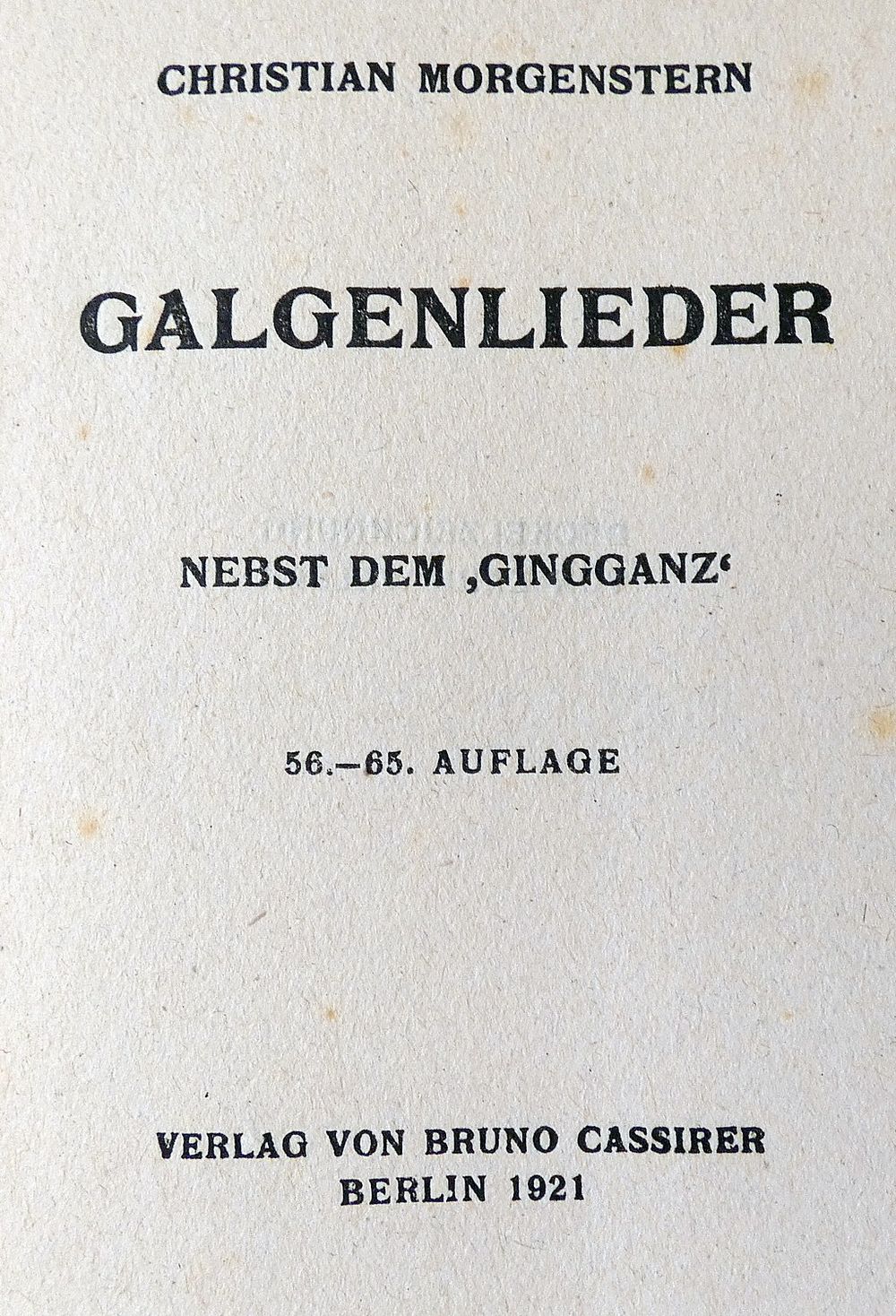
Bidspirit auction | Christian Morgenstern, Galgenlieder. Nebst dem
Christian Morgenstern, Galgenlieder. Nebst dem 'Gingganz', 1st ed., 1921, Litho cover by Karl Walser, Berlin, in German - Christian Morgenstern, Galgenlieder. Nebst dem 'Gingganz', 1st ed., 1921, Litho cover by Karl Walser, Berlin, in German Cassirer, 1921. Condition: Gut. Galgenlieder. Nebst dem 'Gingganz' / Morgenstern, Christian AutorMorgenstern, ChristianBuchdaten & Bucherhaltung 56.-.65. Tsd., Cassirer, Berlin, 1921. 6, 72, 2 pp., Inscription / dedication in pencil on front endpaper. Handmade art paper. Lithographed hard cover by Karl Walser, size: 18.5 x 15 cm.Condition: wear, rubbing and staining to cover; spine damaged; spme foxing to endpapers and some stains internally Karl Walser (8 April 1877, Biel/Bienne, Canton of Bern - 28 September 1943) was a Swiss painter, stage designer, illustrator, muralist, and artist. He was the older brother, by one year, of the writer Robert Walser, and provided illustrations for Robert's first book Fritz Kocher's Aufsätze (1904). Christian Otto Josef Wolfgang Morgenstern (6 May 1871 – 31 March 1914) was a German writer and poet from Munich.[1] Morgenstern married Margareta Gosebruch von Liechtenstern on 7 March 1910. He worked for a while as a journalist in Berlin, but spent much of his life traveling through Germany, Switzerland, and Italy, primarily in a vain attempt to recover his health. His travels, though they failed to restore him to health, allowed him to meet many of the foremost literary and philosophical figures of his time in central Europe. Morgenstern's poetry, much of which was inspired by English literary nonsense, is immensely popular, even though he enjoyed very little success during his lifetime. He made fun of scholasticism, e.g. literary criticism in ”Drei Hasen”, grammar in ”Der Werwolf”, narrow-mindedness in ”Der Gaul”, and symbolism in ”Der Wasseresel”. In ”Scholastikerprobleme” he discussed how many angels could sit on a needle. Still many Germans know some of his poems and quotations by heart, e.g. the following line from ”The Impossible Fact” (”Die unmögliche Tatsache”, 1910)