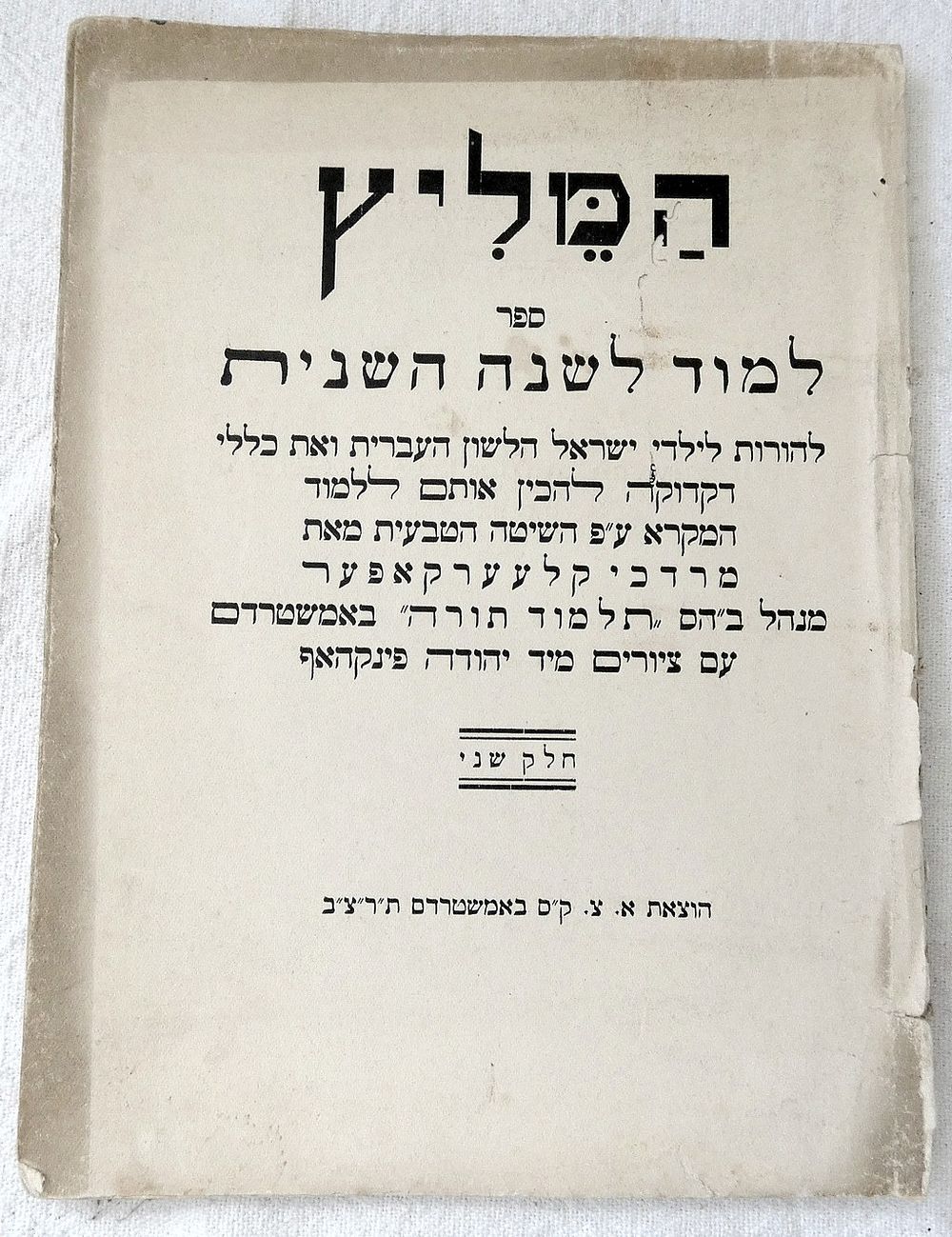
Bidspirit auction | Jacob Kleerekoper, perished in Holocaust,
Jacob Kleerekoper, perished in Holocaust, 1932, Ha-Meliets. Textbook for Hebrew Primary School. illust. by L.Pinkhof (perished in Holocaust) Cover by Jo Spier (Holocaust survivor), Amsterdam - Jacob Kleerekoper, perished in Holocaust, 1932, Ha-Méliets. Textbook for Hebrew Primary School. 2nd part, With drawings by L. Pinkhof (perished in Holocaust) Cover by Jo Spier (Holocaust survivor), Amsterdam Ha-Méliets. Leerboek voor het Hebreeuws op de Lagere school. Met teekeningen van L.Pinkhof. Omslag Jo Spier. Amsterdam, 57 pp., richly illustrated by Leonard Pinkhof, cover by Joseph Eduard Adolf Spier Soft cover, 20.5 x 15.5 cm. Condition: some wear, some brown stains near upper and lower edges Jacob Kleerekoper (Amsterdam 4 April 1871 – Sobibor, 16 April 1943) was a son of Gerrit Jacob Kleerekoper and Catharina Agsteribbe. He was married on 27 November 1894 in Zaandam to Elisabeth van Es, daughter of Aron van Es and Sara Huijsman. The couple had five children: Gerrit, Sara and Mina but Herman and Catharina have survived the Holocaust. City Archive of Amsterdam, archive card of Gerrit Kleerekoper, family registration card of Jacob Kleerekoper Leonard Pinkhof (1898-1944) was a Jewish-Dutch painter and educator. He spent most of his adult life in Den Helder, Holland, and was active in the life of the Jewish and artistic communities of the town. In 1940, when Holland was occupied by the German army, he was fired from his job. He wandered between several towns until he was captured in 1944 and deported to the extermination camp in Sobibor, where he was murdered. Joseph Eduard Adolf Spier (26 June 1900 – 21 May 1978) was a popular Dutch artist and illustrator. Jo Spier was born in Zutphen, the Netherlands. From 1924 to 1939 Jo Spier worked for the newspaper De Telegraaf where he created humorous illustrations and cartoons about everyday life. He also worked as a courtroom sketch artist and theater review artist for them.[1] During World War II his subject matter became more political and he was arrested for his satirical depiction of Hitler. He was first sent to the camp at Westerbork, then to Villa Bouchina with his wife and three children. For a period of a few months in 1943 they were protected from transport to German concentration camps, supposedly due to the influence of the leader of the pro-German Nationaal Socialistische Beweging, Anton Mussert. On 21 April 1943 Spier was transferred to the Theresienstadt concentration camp, where he was held with his family until the end of the war. During his internment in Theresienstadt, Spier also cooperated with the Germans by assisting with the film Theresienstadt, ein Dokumentarfilm aus dem jüdischen Siedlungsgebied.