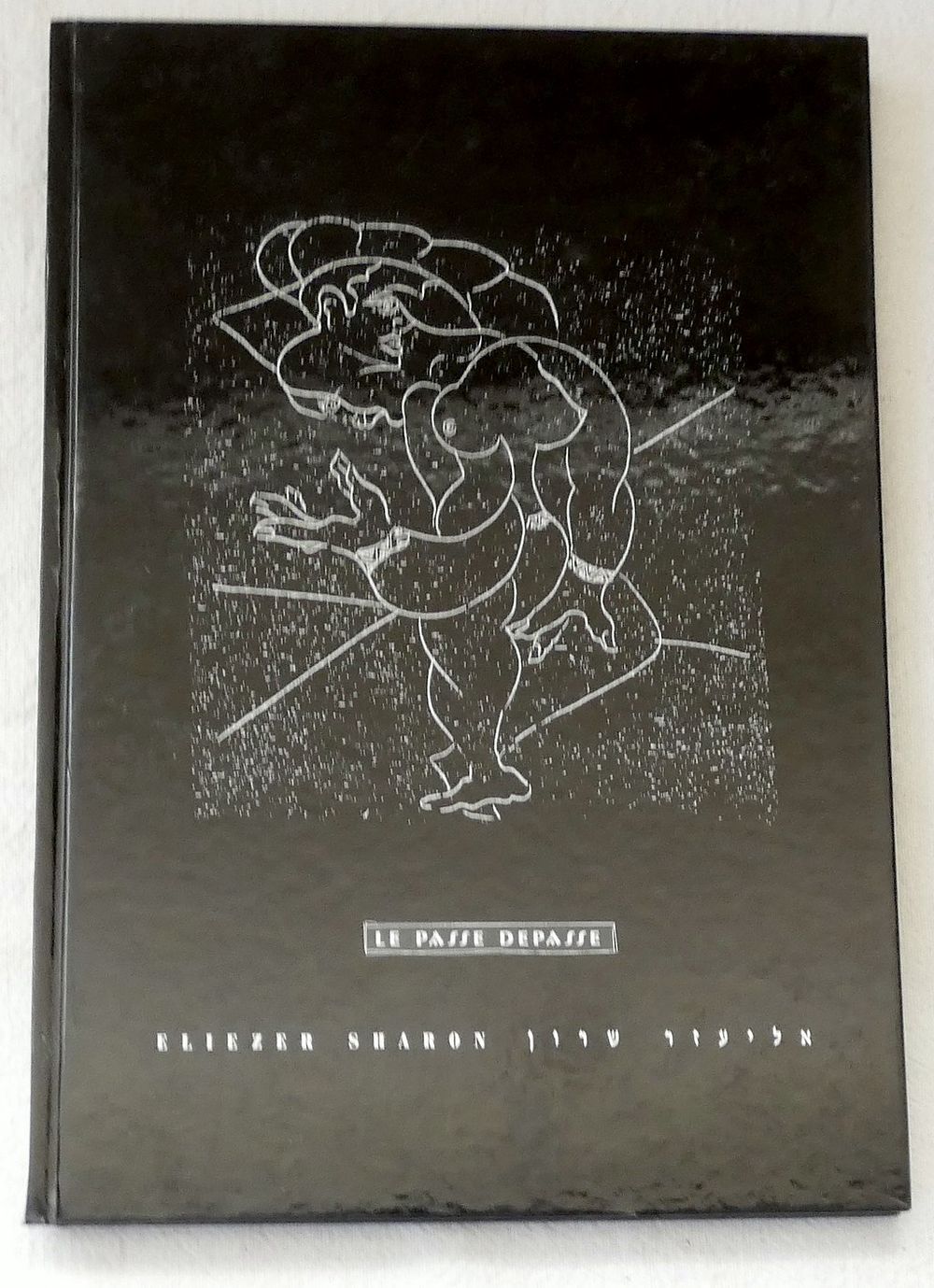
Bidspirit auction | Eliezer Sharon, Autograph on book:
Eliezer Sharon, Autograph on book: La Passe Depasse, illust., 1994, French and Hebrew. - Eliezer Sharon, Autograph on book: La Passe Depasse, illust., 1994, French and Hebrew. Signed by the author in Hebrew, 1995. La Passe Depasse. Texte hebreu: Jaffa Alon. Preface et mots sur le livre: Shua Amorai-Stark. Traduction en francais par Catherine Supé. The Past Overtaken. Hebrew text: Jaffa Alon. Preface and words about the book: Shua Amorai-Stark. French translation by Catherine Supé. 118 pages, illustrated throughout the book. Hard cover, 31 x 21.5 cm. Good condition, light wear to cover. Weight: 580 gr. Sharon (Kozkowski), Eliezer Ben Nechama (nee Klatsk) and Ziska. Eliezer was born in Poland in the town of Kamionka on March 27, 1924. The family lived in a wooden house on the street leading to Szczecin, near the Jewish synagogue and not far from the Catholic Church that they could see from the window of their house. There were about five hundred inhabitants in Kamionka, half of them Jews. Shtetl was a religious Jewish life. Eliezer Lazar, as he was called by his family and friends, had a large family: parents, uncles, aunts, two sisters and two brothers. The little brother and sister were twins. Nechama’s mother, Hamza, worked as a seamstress to support the family. At the age of six, Eliezer began to study at the “Yavneh” school, a Jewish school in which Yiddish was taught. In the fourth year of his studies, he moved to the Tarbut school, where the studies were conducted entirely in Hebrew. The language of the state, Polish, was learned as a second language. On September 1, 1939, World War II broke out. Two weeks later, the Soviets entered Kamionka and its environs as part of the “Ribbentrop-Molotov” agreement. The school was closed by the Soviet authorities and Lazar’s studies were interrupted in the tenth school year. Eliezer apparently moved to the nearby town of Grodno. On June 22, 1941, the German armies invaded the Soviet Union at the time, and the war also reached the area where the Kuzkowski family lived. Lazar fled east, and his large family remained where she lived. After shaking for a month on Soviet soil, without any knowledge of the language, Eliezer volunteered for the Red Army. As soon as he was drafted, without any military training, he was sent to the front. In September of that year, in the battles on the outskirts of Smolensk, he was wounded in his hand and taken to a military hospital in the city of Kubishev. At the beginning of 1942 he was released from the army and sent to Central Asia, to work in the rear (“Trud-Arami”). A year later he was sent to Orl, to the city of Chelyabinsk, where he worked until the end of the war in a large wood processing plant. The world war was over. Ania nee Sidranski, Eliezer’s neighbor in Kamionka, returned to Kamionka, the city of her birth from the kolkhoz in Orl, where her small family had fled. In the post office of the neighboring town, Szczecin, she found a letter Eliezer Kuzkowski sent to his family in Kamionka informing him that he was alive and was in Ural in the army. The letter remained orphaned at the post office because there was no one to ask for it. Anya ran with the letter to her mother: “He’s alive! Lazar is alive!” Lazar received a month’s leave, arrived in the town of his birth, and found that no one had survived his extended family. In Szczecin they married Lazar and Ania in a modest ceremony and went together to Chelyabinsk to get Eliezer out of the army. In February 1946, Anya and Eliezer set out for Russia. They traveled on trains that the Soviet authorities had made available to those returning from the Soviet Union to Poland. After a long journey they reached Wroclaw. They met there with young Jews who organized a hachshara for immigration to Israel and joined them. They were sent to Reichenbach, where the kibbutz lived, and stayed there for more than a year. Eliezer was active in the security field and was engaged in acquiring weapons for self-defense. From time to time a group of friends set out for Israel. Eliezer and Ania were also on the “Bericha” route. They were taken to the Czech border and passed on foot, secretly. The border guards stood with their backs to them. Someone had bothered to prepare them and allow the escape. From there they moved to Austria and about two weeks later moved to Germany. In Neustadt they stayed for six months until Eliezer was called to take up a position in the Bad Reichenhall DP camp in Germany. They moved to the camp. In those days, the camp was active in recruiting and preparing Haganah youth for preparation for the War of Independence in Israel. Eliezer worked there as director of the Jewish Agency’s recruitment department for immigration. In Bad Reichenhal, Ania and Eli’s first son was bornhelped. In July 1949, Ania and Eliezer traveled via France to Israel on the ship Negba and spent some time in an immigrant camp in Kiryat Shmuel near Haifa. After a while they moved to Acre,