Bidspirit auction | Samuel Alman, Cantor Composer “
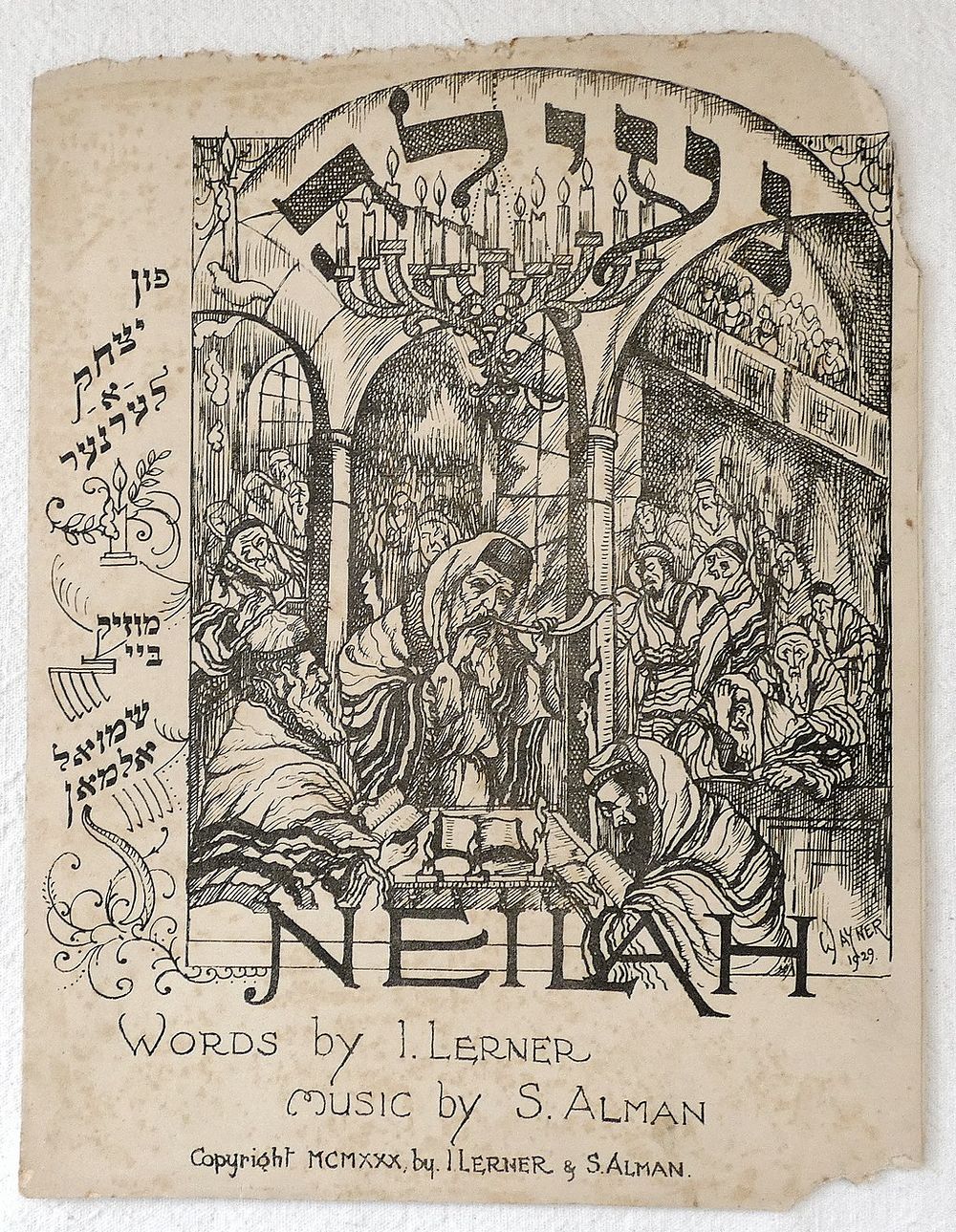
Samuel Alman, Cantor Composer “ N’ilah” Yiddish Music sheet, Engraved Cover by Mark Wayner, 1930, London. - Samuel Alman , Cantor / Composer“ N’ilah” Yiddish Music sheet, Engraved Cover by Mark Wayner, 1930, London. Words by I. Lerner Engraved Cover signed by the artist in the plate London, 5 pages, size: 31.5 x 24 cm. Condition: corners and upper edge are damaged; foxing stains to covers; spine of cover almost torn to two parts. Samuel Alman was born in Sobolevka (Russia), in 1877. The sixth child of a family of 14 children, his father was a talmudist and musician, and his mother an amateur poet. At the age of 5 he sang in the synagogue’s choral and quickly became a soloist. He was nicknamed “the singing child of Sobolevka”. He learned to read music at the age of 10. When he was 17 years old, he entered the music conservatory of Odessa and began to write liturgical music. During the four years of his military service, he was a member of the musicians of the Russian army. He then attended the music conservatory of Kishinev. Witnessing the pogroms that took place there in 1903, he decided to leave for London where his uncle is settled. In England, he continued his musical studies at the Guildhall School of Music and then at the Royal College of Music. He terminated his PhD studies when the First World War breaks out. He rapidly became choirmaster in the Great Synagogue of London and then, for 22 years, the choirmaster of the synagogue of Hampstead quarter. He also conducted the London Hazzanim Choir and established the Halevi Choral Society, in which the repertoire is dedicated to compositions in Hebrew and in Yiddish. In 1911 and 1912, he conducted concerts of synagogue music at the Queen’s Hall and the Royal Albert Hall. In parallel to these activities, Samuel Alman composed works for piano, organ (Eleven short pieces for the Organ), string quartet (Ebraica Quartet Suite, 1932), arrangements of popular Yiddish songs, as well as the first big Yiddish opera Melech Ahaz (The King Ahaz), created in 1912. He also wrote liturgical music for the synagogues in which he sang. His compositions are often dedicated to great cantors of his time (Halter, Shechter and Boyars) and are for choir, cantor, piano and organ . In 1925 and 1938, he published a two-volume compilation of music works for cantor and choir, entitled « Shirei Beit ha-Knesset », for the Sabbath services. The first volume, published in Berlin, gathers together 55 music pieces, with some of his own compositions. The second volume was published by the Oxford University Press, and contains 97 music pieces for the yamim noraim. 1929, a concert of his works was given at the Wigmore Hall, which achieved great success. It was the first concert of Jewish music performed in this concert hall. In 1933, he was asked to update the « Blue Book, The Voice of Prayer and Praise – A Handbook of Synagogue Music », published in 1899. It is a complete edition of the « Shirei Kenesset Yisrael – A Handbook of Synagogue Music for Congregational Singing », published ten years before. Samuel Alman added 58 music pieces, among them 15 of his own compositions. It was planned that each member of the congregation, every worshipper would have a copy of the songbook to follow the service. Alman died in 1947. Considered as the greatest English composer of Jewish music, Samuel Alman influenced the entire London synagogal music. Mark Wayner was born Mark Weiner into a Jewish family in Lomza, Congress Kingdom of Poland, Russian Empire, in 1888, and immigrated to England with his parents in 1893, settling in Whitechapel’s Jewish quarter in London's East End. He displayed an early flair for drawing and was a friend of Mark Gertler and David Bomberg. After an apprenticeship, he painted commercially on silk for Liberty, made Chinese lacquer work, and designed cards for the Jewish firm of Raphael Tuck, also creating Union banners, and specialist designs for Jewish subjects for clock faces. He studied at Birkbeck College between 1902 and 1906, and later briefly at the Slade School of Fine Art (from 1909–10), alongside Gertler, Bomberg and Stanley Spencer, assisted by a Jewish Education Aid Society grant (which was withdrawn due to poor attendance). Bomberg and Jacob Epstein included two of Wayner’s works on paper (an Old Testament study and another of a Jewish East End workman) in the so-called ‘Jewish Section’ at the Whitechapel Art Gallery exhibition 'Twentieth Century Art: a Review of Modern Movements' in London in May 1914. Wayner quickly established a reputation as a caricaturist. In 1911 his cartoon of Russian pogroms showing the Czar as a double-headed eagle, censored in Russia, was published in the ‘Jewish Chronicle’ and several of his graphic works were reproduced in ‘Colour’ magazine, moving gradually from a traditional realist style (‘The Jew’, September 1915), to sparer, more contemporary images,