Bidspirit auction | M. Grosman, Holocaust Survivor, Orig.
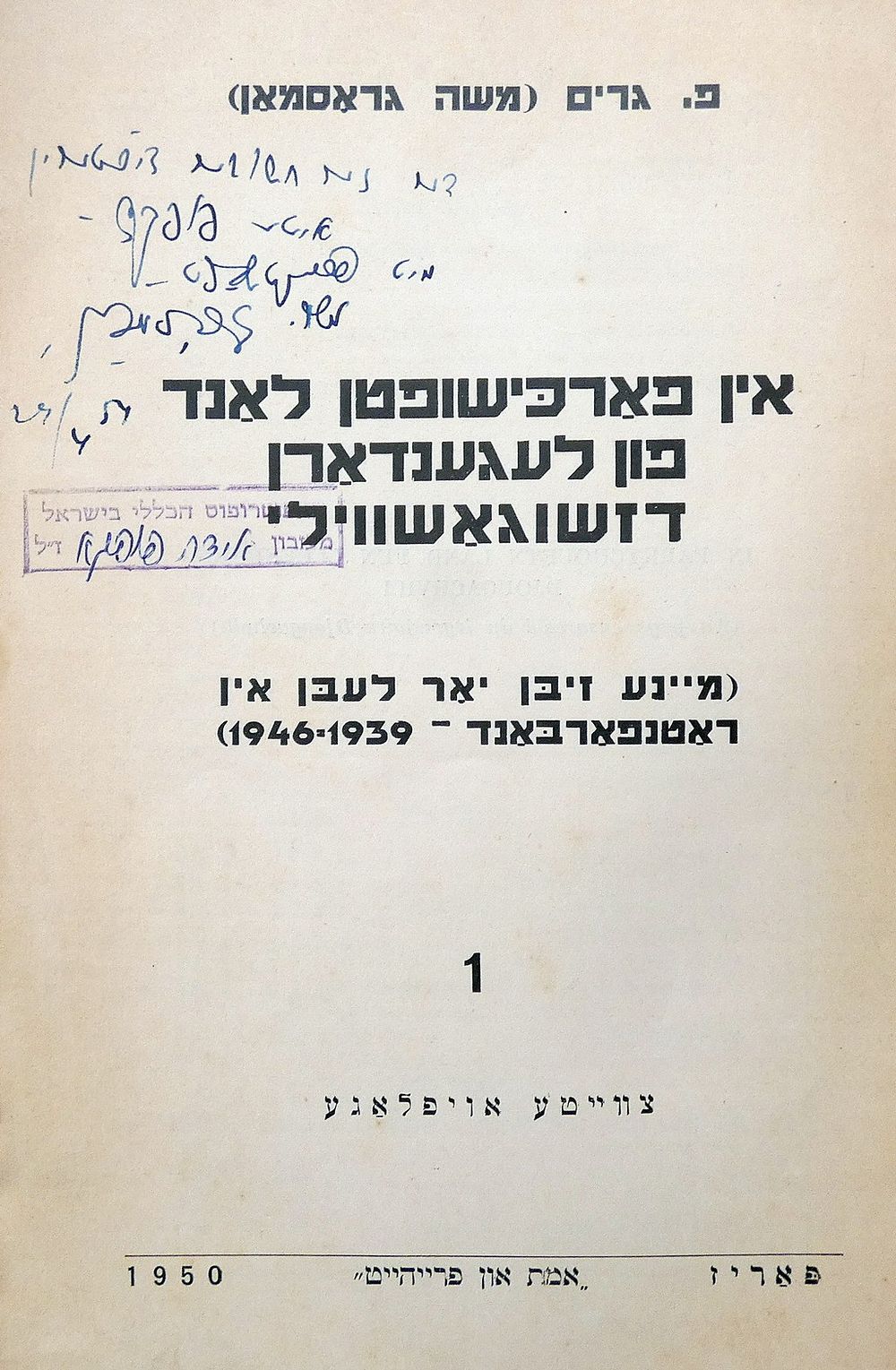
M. Grosman, Holocaust Survivor, Orig. Autograph on his Yiddish Book: In the enchanted land of the legendary Dzhugashvili (Stalin), illust., 1st ed., 1950, Paris. - M. Grosman, Holocaust Survivor, Orig. Autograph on his Yiddish Book: In the enchanted land of the legendary Dzhugashvili (Stalin), illust., 1st ed., 1950, Paris. Autograph /dedication of Moishe Grosman in Yiddish on title page, 1954 ”In farkishuftn land fun legendarn Dzshugashvili”. Mayne zibn yor lebn in Ratnfarband: 1939-1946 PARIS, 1950., 2 volumes in one book, 336 pp., illustrated by photo of M. Grosman, , made in USSR in a camp. Lithographed soft cover, 24 x 15.5 cm. With the outbreak of WWII, in October 1939 he sought refuge in Soviet Russia. He was, though, arrested there, tortured by the Soviet authorities, and deported to local concentration and labor camps. After the end of the war, in 1945 he returned to Poland. CONDITION: EX-LIBRARY STAMPS, COVER WORN, WITH BROWN, FOXING AND DAMPING STAINS TEARS TO EDGE OF REAR COVER. MISSING PARTS UPPER AND BELOW (0.5 & 2.5 cm.) TO SPINE LIGHT SOILING TO EDGES AND TITLE PAGE. LIGHT TRACKS OF USE. Weight: 515 gr. Grosman, Moyshe (April 3, 1904–September 27, 1961) April 3, 1904–September 27, 1961 MOYSHE GROSMAN (MOSHE GROSSMAN) (April 3, 1904-September 27, 1961) He was born in Koriv (Kurów), Lublin region, Poland. As a child, in 1910, he moved to Warsaw. He studied in religious elementary school, yeshiva, in a seminary course, and self-preparation as an external student. During WWI in 1917, suffering from hunger, he returned with his parents to Koriv. At age fourteen in his hometown, he was giving private lessons in Yiddish, Russian, and accounting. In 1920, following the death of his father, he returned to Warsaw by himself. There he was a street salesman, a business employee, and laborer, and in the evenings he studied primarily on his own. From 1921 he was a member of the Labor Zionist organization “Yugend” (Youth). For a time he worked in the secretariat of the Warsaw artists’ association, was an employee in the Labor Zionist publishing house, secretary of the youth section of the association of employees, and from 1925 until just the time of the German occupation of Warsaw, when the last issue of the newspaper had already appeared, he worked in the administration of Haynt (Today) in Warsaw. Grossman began writing at age fourteen. Using the pseudonym Godlman, he published several short, humorous items in Bontshe’s (Avrom Rozenfeld’s) humor magazine Der foygl (The bird). In 1923 he published his first short story, “Brokhe un klole” (Blessing and curse) in Veltshpigl (Mirror of the world) in Warsaw (edited by A. L. Yakubovitsh). From that point forward, he placed his writings in such serials as: Yugnt-fon (Banner of youth), Veltshpigl, Literarishe bleter (Literary leaves), Vokhnshrift (Weekly writings), Farmest (Challenge), Fraynd (Friend), and Haynt—in Warsaw; Yidishe bilder (Jewish images) in Riga-Warsaw; Arbeter tsaytung (Workers’ newspaper) in Warsaw-Lodz. His first book appeared in 1931: Flamen un roykh, roman fun an arbeter-svive (Flames and smoke, a novel from a workers’ environment) (Warsaw), 136 pp. Later, he published: Hamer af harfe (Hammer on the harp) (Warsaw, 1934), 65 pp.; Karl marks, bay zayn shvel, byografish montazh-roman (Karl Marx, at his threshold, a biographical montage novel) (Warsaw, 1934), 288 pp., second edition (Warsaw: Farlag M. Rakovski, 1936), 261 pp.—this last work also appeared in a Polish translation (Warsaw, 1935), 240 pp.—Dervakhung, historisher roman (Awakening, a historical novel), a biographical novel about the life of Rosa Luxembourg (Warsaw: Farlag literarishe bleter, 1937), 150 pp., which earlier appeared serially in Shikager kuryer (Chicago courier) with an introduction that was excised by the censor in Poland. With the outbreak of WWII, in October 1939 he sought refuge in Soviet Russia. He was, though, arrested there, tortured by the Soviet authorities, and deported to local concentration and labor camps. After the end of the war, in 1945 he returned to Poland. He contributed to Dos naye lebn (The new life) in Lodz and served as editor of Arbeter tsaytung (Workers’ newspaper) in Lodz in 1946. He also co-edited the anthology Yidishe shriftn (Yiddish writings), published by the Yiddish literary association in Lodz in 1946. Leaving Poland at the end of 1946, he spent just a year in Sweden, and in the fall of 1947 he moved to France, living in Paris, where he became active in the Parisian Jewish community and literary life. He was the founder and one of the leaders of the association of Polish Jews in Paris, of the association of refugee writers, and of the Yiddish PEN club. He contributed to the Parisian Jewish press, including: Unzer shtime (Our voice), Unzer vort (Our word), and Kiem (Existence). Under his own name—and under such pen names as F. Grim Karl Grim, L. Anglister, P. Amster, M. Giml, M. Ben-Yankev, Y. Shabes, M. Fazant, Leye, M.