Bidspirit auction | Gilad Zrubavel, Palmah commander and
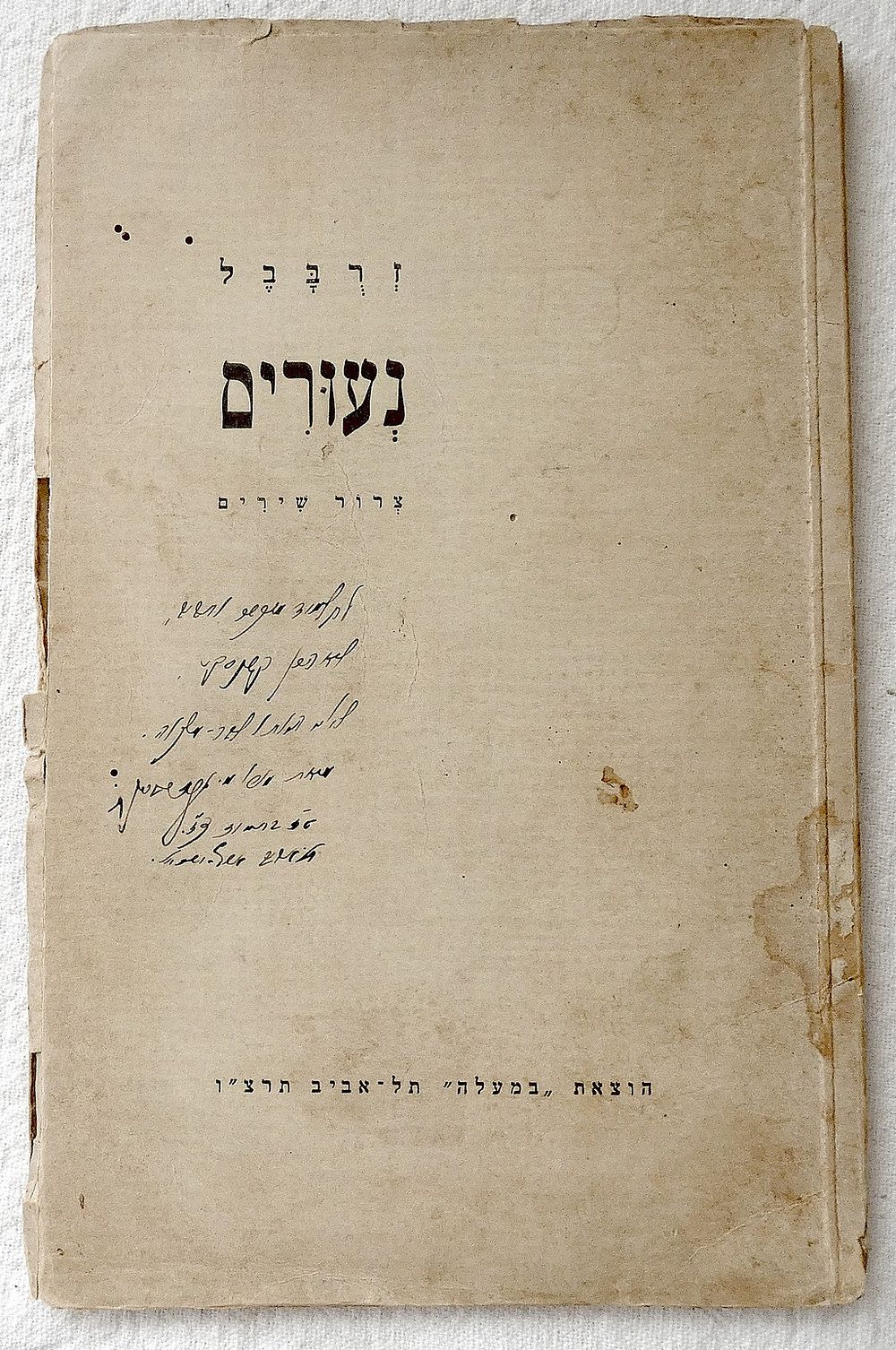
Gilad Zrubavel, Palmah commander and Author of Palmah Anthem, Autograph on his Poetry Book “Neurim” (Youth), 1936, in Hebrew - Gilad Zrubavel, Palmah commander and Author of Palmah Anthem, Orig. Autograph on his Poetry Book “Neurim” (Youth), 1936, in Hebrew Autograph / dedication of Teacher the Gershevsky(?). Ba-Maale, Tel-Aviv, 1936., 83 pp., soft cover, 22 x 14 cm. Condition: wear and staining to cover, edges chipped; tear to spine; couple of stains to title page and last page; several worm holes throughout the book. Weight130 gr. Zrubavel Gilad (Hebrew: זרובבל גלעד, also זרבבל גלעד; 9 December 1912 – 12 August 1988) was a Hebrew poet, editor and translator. Gilad was born in 1912 in Bender, Bessarabia (then part of the Russian Empire and now in Moldova), and his family (Bessarabian Jews) fled to Odessa during World War I. After the Russian Revolution, they moved to Mandate Palestine. In 1924, they settled in Ein Harod, where he lived until his death in 1988. He was one of the first children in the kibbutz.[1] Gilad began to publish stories in 1929 and poetry in 1931. He published articles in most newspapers and magazines in Israel. He was active in getting young members of the cooperative agricultural communities of the Jezreel Valley to participate in HaNoar HaOved VeHaLomed youth movement activities. He was Secretary of the Central Committee of the movement between 1933 and 1935. Many of his poems were published in the movement's newspaper Bamaale (Hebrew: Gilad Zrubavel, Palmah commander and Author of Palmah Anthem, Orig. Autograph on his Poetry Book “Neurim” (Youth), 1936, in Hebrew Autograph / dedication of G. Zrubavel on cover in Hebrew, 1936 Ba-Maale, Tel-Aviv, 1936., 83 pp., soft cover, 22 x 14 cm. Condition: wear and staining to cover, edges chipped; tear to spine; couple of stains to title page and last page; several worm holes throughout the book. Weight130 gr. Zrubavel Gilad (Hebrew: זרובבל גלעד, also זרבבל גלעד; 9 December 1912 – 12 August 1988) was a Hebrew poet, editor and translator. Gilad was born in 1912 in Bender, Bessarabia (then part of the Russian Empire and now in Moldova), and his family (Bessarabian Jews) fled to Odessa during World War I. After the Russian Revolution, they moved to Mandate Palestine. In 1924, they settled in Ein Harod, where he lived until his death in 1988. He was one of the first children in the kibbutz.[1] Gilad began to publish stories in 1929 and poetry in 1931. He published articles in most newspapers and magazines in Israel. He was active in getting young members of the cooperative agricultural communities of the Jezreel Valley to participate in HaNoar HaOved VeHaLomed youth movement activities. He was Secretary of the Central Committee of the movement between 1933 and 1935. Many of his poems were published in the movement's newspaper Bamaale (Hebrew: בַּמַּעֲלֶה). In November 1937, he was sent to Poland to work with the pioneering movement Hehalutz, returning home in 1939. Gilad was one of the first members of the Palmach, and one of its poets. He wrote the Palmah Anthem in 1941. In 1946, he participated in the Night of the Bridges at the Sheik Hussein Bridge, and was arrested two weeks later in the Black Shabbat, spending some time in British jails. Between 1950 and 1953, he worked on the Palmach Book, an anthology he edited with Matti Megged. It is considered one of the most important anthologies of the time.[3] He was the editor of the HaKibbutz HaMeuhad magazine Mebefnim(Hebrew: מבפנים) for many years and a senior editor in the movement's publishing house. In his later years, after the death of his first wife, he married the Israeli literary scholar and a translator Dorothea Krook-Gilead, who translated many of his poems into English. In 1990, his autobiography Maayan Gideon (”Gideon's Spring”) was published. Individual poems he wrote have been published in Danish, French, German, Hungarian, Russian, Serbo-Croatian and Spanish