Bidspirit auction | Otto Abeles, Austrian Writer, Perished
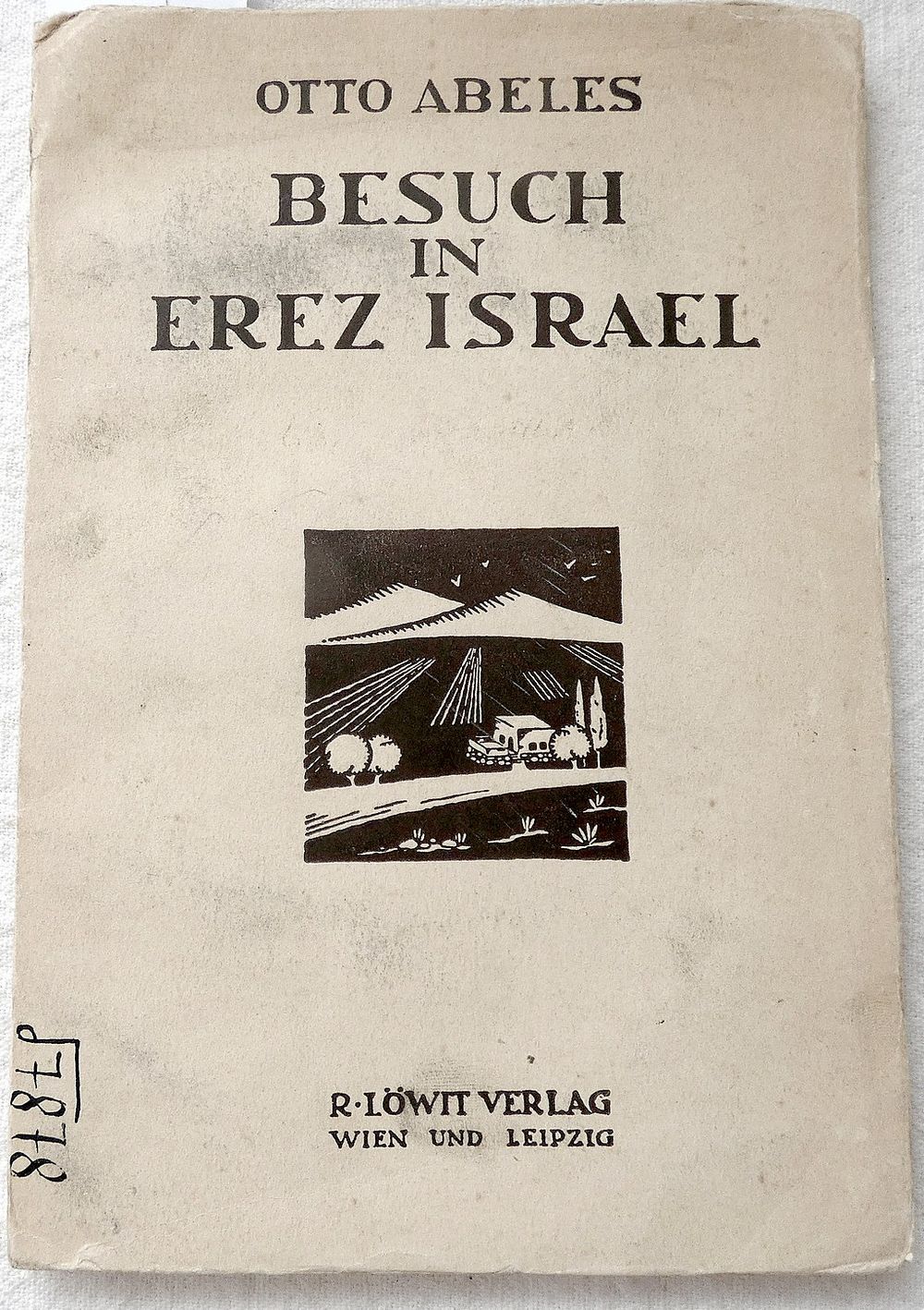
Otto Abeles, Austrian Writer, Perished in Holocaust, Autograph on his Book: “Besuch in Erez Israel”, illustr., First ed., 1926, in German - Otto Abeles, Austrian Writer, Perished in Holocaust, Autograph on his Book: “Besuch in Erez Israel”, illustr., First ed., 1926, in German. Ex Libris Autograph / dedication of the author on frontispiece in German, 1931 Wien und Leipzig. R. Loewitt Verlag, 1926., 102 pp., illustrated by many b/w photographic plates, lithographed Publisher’s Logo on Cover, Jewish ex libris (Memories of a trip to Israel) Soft cover, 20.5 x 14 cm. Condition: ex-library stamps; some wear and soiling to cover; corner of rear cover is missing and edges are shabby; part of spine is missing; Internally fair condition. Weight: 160 gr. Lawyer, journalist, founder with Robert Stricker of the first Zionist daily in German Wiener Morgenzeitung. Arrested in the Netherlands in 1944, deported, he died on May 25, 1945 of typhus in the Bergen-Belsen concentration camp one month after the liberation of the camp. Otto Abeles (* 1 May 1879 in Rohatetz, Moravia, Austria-Hungary; † 25 May 1945 in Troebnitz) was an Austrian journalist, writer, music critic and ZionistOtto Abeles, son of Siegmund and Rosa, née Schrager, attended high school in Vienna and then the University of Vienna, where he studied law and received his doctorate in law in 1905. While still a student, Abeles founded the first Zionist student organization ”Veritas” together with Robert Stricker, Berthold Feiwel and his brother-in-law Hermann Kadisch, because he had already experienced ”daily bitterness and humiliation, hopeless loneliness”[1] of the Jews during his school days. ”Since then I have witnessed the development of the Zionist movement, the good and the bad days. From Herzl's Faustian attempt to free the Jews from their undignified situation with a mighty move - to redeem the great masses of those transplanted to Palestine in practice and those who remained behind morally - to today's hopeful, wonderful, but modest, compared to the original, utopian program of the political Zionists, possibilities for conscious Jewish settlement work in the old Jewish land.” Until 1928 he worked as a lawyer for the Austrian Federal Railways. He also campaigned for the Zionist idea as an editor and journalist and was a co-founder of numerous committees in Bohemia and Moravia. He also supported the movement through his lectures and journalistic work in Jewish newspapers, especially in the first Zionist daily newspaper in German, the Wiener Morgenzeitung, which he and Robert Stricker founded in 1919. On the occasion of the upcoming election of the constituent national assembly on February 16, Abeles appealed in the first edition of the new newspaper in favor of the ”Jewish National Association for German Austria”: ”Only a Jew who enters parliament as a representative of his people has the strength and freedom to stand up for the real equality of Jews.”[3] After this newspaper was discontinued on September 16, 1927, he continued to work in the successor paper Die Neue Welt, but also published his work, as before, in the Jüdische Rundschau, the Selbstwehr, the Jüdische Volksstimme, the Neues Wiener Journal and other papers. From the mid-1920s, he traveled to Transylvania, Hungary, Eastern Galicia, Luxembourg and Czechoslovakia as a delegate of the Keren Hayessod. Abeles moved to the Netherlands in early September 1934 and became one of the most zealous and courageous members of the Amsterdam Jewish community. He was also director of the Dutch branch of Keren Hajessod. After the invasion of German troops during World War II, Abeles was also captured and interned in the Westerbork transit camp. In May 1944 he was deported to the Bergen-Belsen concentration camp. He died of typhus infection just over a month after his liberation from the concentration camp. With his wife Mina (née Dembitzer; married on November 15, 1908 in Vienna) he had a son Benjamin (1909 in Vienna –? in Jerusalem), who worked as a doctor in Israel. Part of his estate is in Jerusalem, namely in the Zionist Central Archives, the archives of Keren Hajessod, the Nathan Birnbaum Archive and the Jewish National and University Library. The revocation of the doctorate by the National Socialists in 1941 was reversed by a Senate resolution of the University of Vienna on 10 April 2003