Bidspirit auction | Die Darmstadter Pessach Haggadah, published
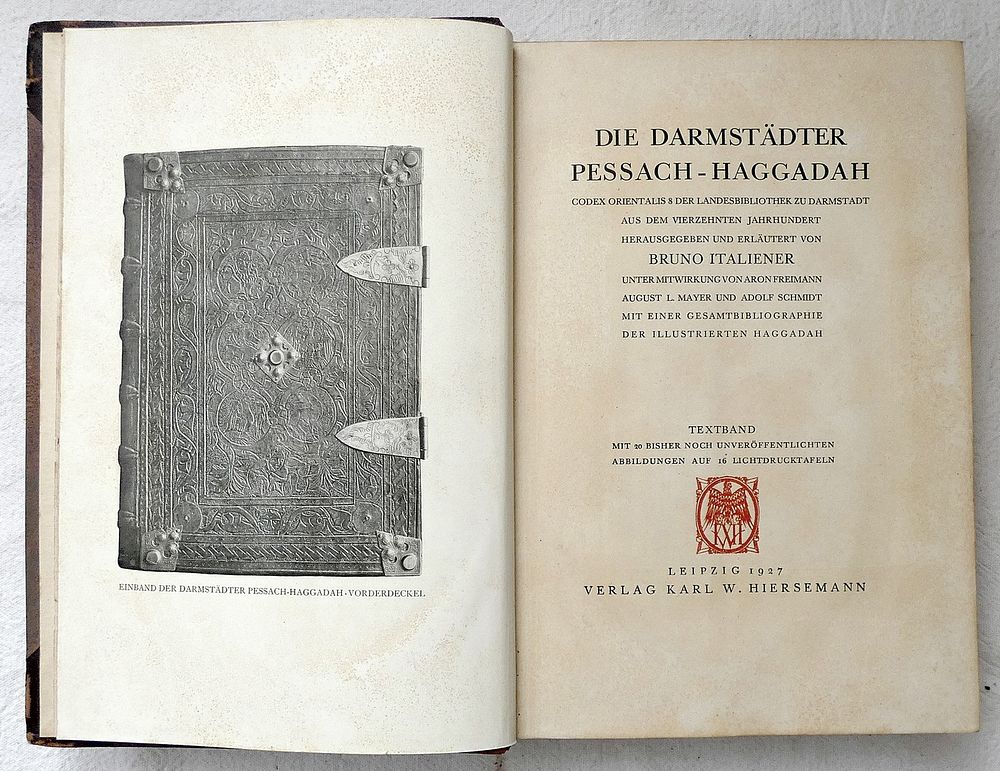
Die Darmstadter Pessach Haggadah, published and explained by Bruno Italiener, illustr., 1934, in German and Hebrew - Die Darmstadter Pessach Haggadah, published and explained Bruno Italiener, illustr., 1934, in German and Hebrew Codex Orientalis 8 der Landesbibliothek zu Darmstadt aus dem vierzehnten Jahrhundert herausgegeben und erlautert von Bruno Italiener. Leipzig: Verlag Karl W. Hiersemann, 1927. 313 pp A research book on the famous Darmstadt Haggadah written by Rabbi Israel ben Meir of Heidelberg around 1430. Includes 16 plates from the Haggadah (black and white). Half leather hard cover, 28 x 19 cm. Condition: rubbing to edges of cover; spine damaged – tears to hinges of spine, chipped to top and bottom; foxing stains to endpapers and ca. to 1/3 of pages Weight: 1440 gr Bruno Italiener (1881–1956), rabbi, author, and historian of Jewish manuscript illumination. Italiener, who was born in Burgdorf, Hanover (Germany), studied at the Jewish Theological Seminary in Breslau and Erlangen University. He served from 1907 to 1928 as rabbi of the Israelitische Religionsgemeinde in Darmstadt. During World War i, he was a German Army chaplain. He was the chief rabbi of the Temple Congregation in Hamburg from 1928 until 1939, when he left Germany because of the Nazi persecution. He settled in London and was rabbi of the Bernhard Baron Center from 1939 to 1941, when he was appointed rabbi of the West London synagogue of British Jews. Italiener continued his communal work after his retirement in 1951 and also continued his scholarly activity, contributing to many learned journals. He was very active in the work of the Reform movement in England. Italiener's main scholarly contribution was his publication of a facsimile edition of the Darmstaedter Pessach-Haggadah (1927), which contained a monograph of the history of illuminated Haggadot. This work is an important source for the history of Jewish manuscript art. He also contributed many articles and essays on various phases of Jewish letters, including the ” Mussaf-Kedusha ” (in huca, 26 (1955), 413–24) and Waffen im Abwehrkampf (1920), which was influential in the formulation of programs for the combating of antisemitism.