Bidspirit auction | Ernst Weiss “Hodin” 10 Lithographs
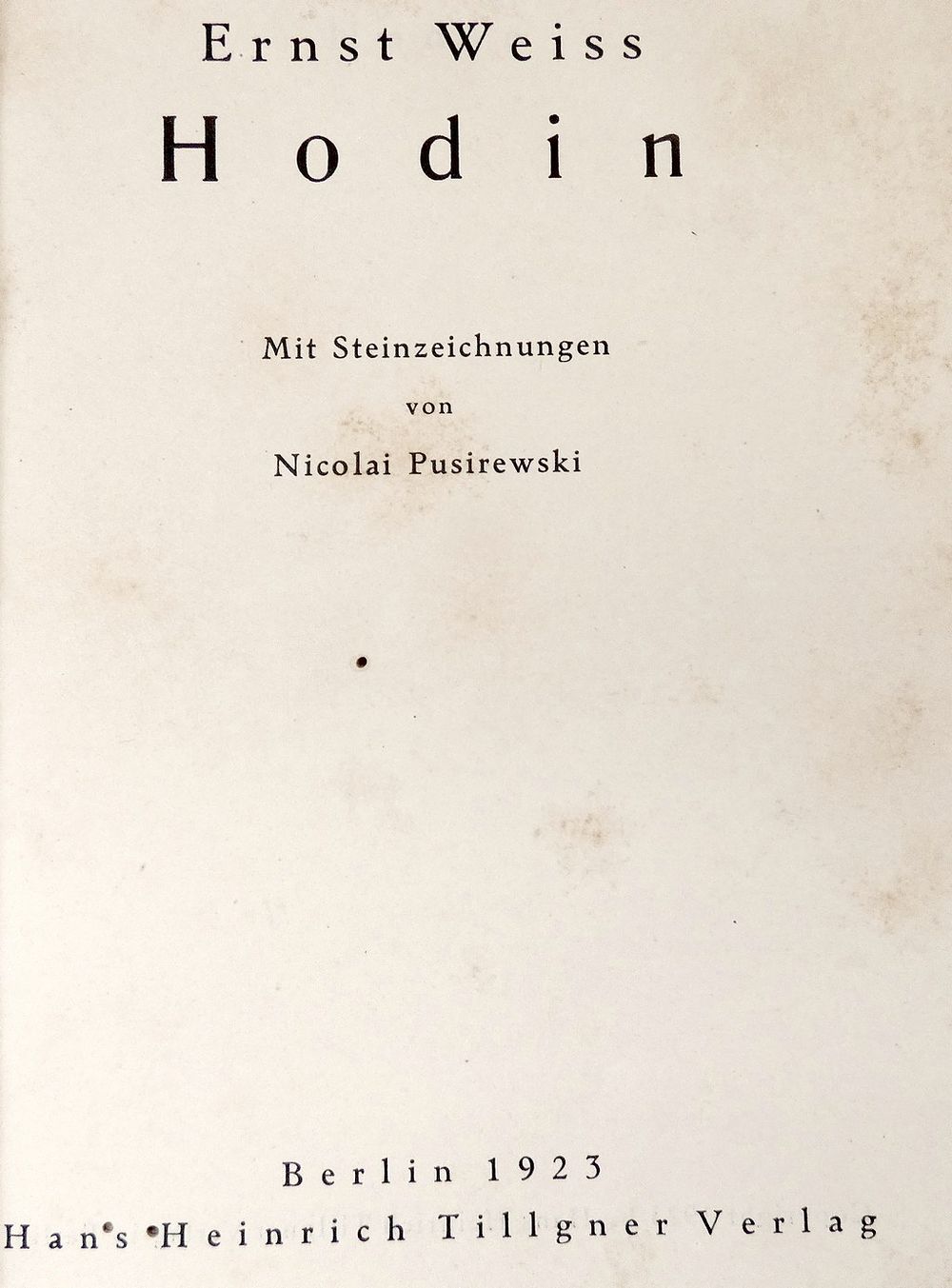
Ernst Weiss “Hodin” 10 Lithographs of Nicolai Pusirewski, 1st ed., 1923, Berlin, in German - Ernst Weiss “Hodin” 10 Lithographs of Nicolai Pusirewski, 1st ed., 1923, Berlin, in German Berlin, H. H. Tillgner, 1923. With 10 (4 full-page) original lithographs by Nicolai Pusirewski. 58 pp. 25 x 17.5cm. Condition: original cover is missing; some worm holes throughout the book; foxing stains to endpapers and some sporadic stains inside. Weight: 140 gr. ”This work is the first part of an unpublished novel. It was published in the summer of 1923 as the thirteenth volume in the series `Das Prisma` by Hans Heinrich Tilgner” (printer's note). - Lithographs printed by A. Ruckenbrod, Berlin. Dr Ernst Weiss (German: Weiß, August 28, 1884 – June 15, 1940) was a German-speaking Austrian physician and author of Jewish descent. He is the author of Ich, der Augenzeuge (The Eyewitness), a novel dealing with the Hitler period. Weiss committed suicide on June 14, 1940 when German troops invaded the city. His attempt to deal with poison in his hotel room did not succeed immediately, but he died as a result only in the following night in a Paris hospital. Nikolay Vladimirovich Puzyrevsky (April 15, 1895, Batum - 1957) - Russian graphic artist, participant in the First World War and the Russian Civil War (Whites), one of the first tankers of the Russian Army, staff captain, one of the founders of the Russian Cultural and Historical Museum in Prague. Biography He was born on April 15 (April 3, old style), 1895 in the city of Batum (according to other sources - in the Chernigov province) in a noble family, his father was a state councilor. Lived with his family in Riga. Graduated from the Riga Alexander Gymnasium, entered the shipbuilding department of the St. Petersburg Polytechnic Institute. On March 11, 1916, he was called up by mobilization by the Petrograd district military commander. Promoted to junior non-commissioned officer. Graduated from the ensign school. By order No. 325 of July 20, 1916, he was promoted to ensign in the Petrograd Military District. He served in the 34th Siberian Reserve Regiment. He did not accept the October Revolution. He fought in the Northern Corps in the 3rd Talabsk Rifle Regiment. For his military distinctions, he was promoted to second lieutenant. As he had an incomplete higher technical education, he was transferred to the Separate Tank Battalion. Staff Captain. After the war, he returned to Riga. In the 1922-1923 academic year, he studied at the Latvian Academy of Arts in the class of Professor J.-R. Tilberg, and in 1924-1926, at the Berlin Academy of Arts under Professor E. Orlik. During his studies, he met the Russian graphic artist and writer V. N. Masyutin, and under his guidance he became interested in and took up xylography. He created etchings for Masyutin’s story “The Dangers of the Green Island” (Munich, 1924). In the 1930s, he worked in easel graphics and watercolors. He painted landscapes of Riga, fantasies on historical themes: “Filibusters”, “Dream”, “Riga Castle in the 7th Century”, “Riga in the 8th Century”, etc. He was a member of the Riga Graphic Artists’ Society. He took part in group exhibitions in Riga, Kaunas, Prague, Krakow, Warsaw, Oslo, Koenigsberg, Berlin, Paris, and Florence. In 1934, N. V. Puzyrevsky's works were presented in Moscow and Leningrad at the Exhibition of Contemporary Latvian Art. He was one of the founders of the Russian Cultural and Historical Museum in Prague, for which he published a single copy of the graphic album ”Latvian Folk Songs” and the album ”Xylographs of N. V. Puzyrevsky”, published in 1937 and 1938 in Riga. After 1945, the exhibits and funds of the RKIM were taken to the USSR and distributed among museums and archives, including the State Tretyakov Gallery, the State Russian Museum, the State Museum of Fine Arts, and the State Historical Museum. He died in Germany in 1957.