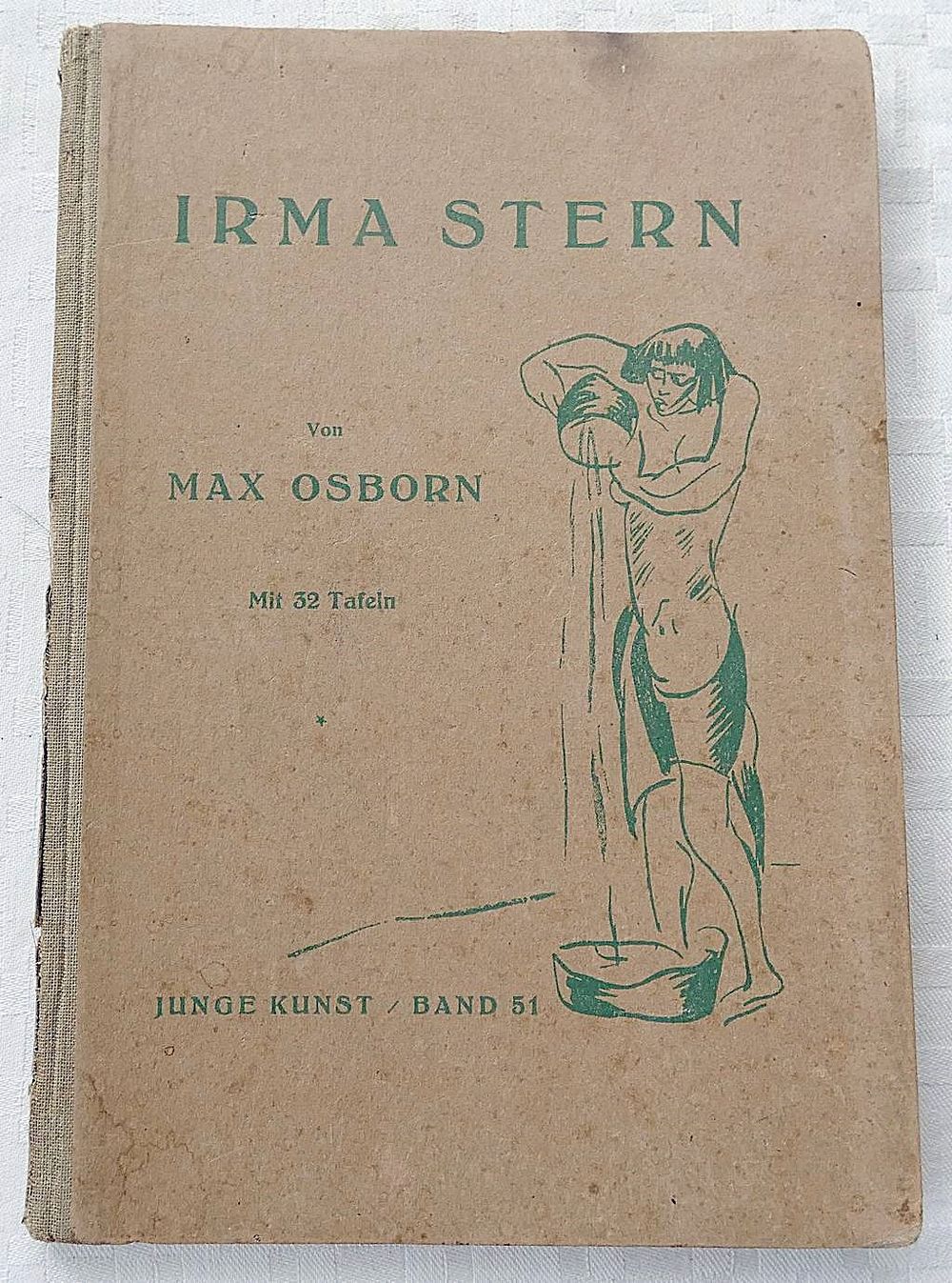
Bidspirit auction | Irma Stern von Max Osborn.
Irma Stern von Max Osborn. Junge Kunst / Band 51 illustr., litho cover, 1927, Leipzig, in German - Irma Stern von Max Osborn. Junge Kunst / Band 51 illustr., litho cover, 1927, Leipzig, in German Mit Einem Auszug aus Dem ”Tagebuch Einer Malerin” und 32 Bildern Verlag Klinkhardt en Biermann Leipzig 1927. Junge Kunst / Band 51. 29 pages, 2 drawings in text and 32 pages of illustrations Hard lithographed cover, 20.5 x 14 cm. Condition: some foxing, stain to cover and endpapers; spine damaged; several pages with some foxing. Irma Stern (2 October 1894 – 23 August 1966) was a South African artist who achieved national and international recognition in her lifetime. Stern was born in Schweizer-Reneke, a small town in the Transvaal, of German-Jewish parents. Her father was interned in a concentration camp by the British during the Second Boer War because of his pro-Boer leanings. Irma and her younger brother, Rudi, were thus taken to Cape Town by their mother. In 1901, the family returned to Germany and later would constantly travel between South Africa and Germany. This travel also influenced Irma's development as an artist. In 1913 Stern studied art in Germany at the Weimar Academy, in 1914 at the Levin-Funcke Studio[1] and notably from 1917 with Max Pechstein, a founder of the Novembergruppe. Stern was associated with the German Expressionist painters of this period.[2] She held her first exhibition in Berlin in 1919. In 1920 Stern returned to Cape Town with her family, where she was first derided and dismissed as an artist before later becoming an established artist by the 1940s. In 1926 Stern married Johannes Prinz, her former tutor, who subsequently became professor of German at the University of Cape Town. They were divorced in 1934. Irma Stern travelled extensively in Europe and explored southern Africa, Zanzibar and the Congo region. These trips provided a wide range of subject matter for her paintings and gave her opportunities to acquire and assemble a collection of artifacts. Stern's intention was to travel extensively in her lifetime: in 1931 to Madeira, in 1937 and 1938 to Dakar, Senegal, 1939 and 1945 Zanzibar, the Congo region in 1942, 1946 and 1955, 1952 Madeira, 1952 Israel, 1955 Turkey, 1960 Spain and 1963 France. Stern also travelled extensively in South Africa, for example in 1926 to Swaziland and Pondoland, in 1933 to Namaqualand, in 1936 generally, and in 1941 to the Eastern Cape. Stern refused to either travel or exhibit in Germany during the period of the Nazi regime from 1933 to 1945. These expeditions resulted in a wealth of artistic creativity and energy as well as the publication of two illustrated journals: Congo, published in 1943 and Zanzibar in 1948. Max Osborn (1870-1946) Art critic, journalist, and prolific author with expertise in modern art and architecture, German literature and theater, and Berlin’s history and architecture. He used the pseudonym Heinrich Garbel. Max Osborn was born in Cologne, Germany in 1870 to a father who was a banker and Clotilde Cohn (Osborn). Osborn studied in Cologne at Apostelgymnasium. In 1881, he moved with his family to Berlin, where he continued his studies at Wilhelms-Gymnasium. He received his abitur there in 1888. From 1889-1893, Osborn studied German literature and art history in Heidelberg, Munich, and Berlin under Herman Grimm. He completed his Theatrum Diabolorum dissertation in literature in 1893 under the tutelage of Erich Schmidt (1853-1913), a pioneer in the field of the history of German literature. From 1894-1914, his primary occupations were working as a co-editor of the Jahresberichte für neuere deutsche Literaturgeschichte, which reported on new published German literature, and as a contributor to the Magazin für Literatur und dem Deutschen Reichsanzeiger, which served much the same purpose. In 1896, he married Martha Boas. He started working as an editor on the major pieces featured in the Berliner Nationalzeitung in 1900. Osborn’s most notable piece of literature was published in 1910, Geschichte der Kunst. Eine kurzgefaßte Darstellung ihrer Hauptepochen. Transitioning to a role at Ullstein Publishing House, one of Germany’s largest publishing establishments at the time, Osborn wrote editorial pieces as a theater critic for the B.Z. am Mittag. He accepted an offer to work as an art critic for Vossische Zeitung in 1914. He remained in this position until 1933, and his most important work over this period of his life was most probably done as correspondent to the front lines of World War I. He chaired the Association of German Art Critics after his return from chronicling the experience of German soldiers in World War I. After his work with Vossische Zeitung, he co-founded and was a staff member of Kulturbund Deutscher Juden (later named Jüdischer Kulturbund Berlin), an organization to celebrate the unique talents of Jewish artists. Through this organization, he advised younger Jewish artists, gave lectures,