Bidspirit auction | Moise Kisling von Carl Einstein.
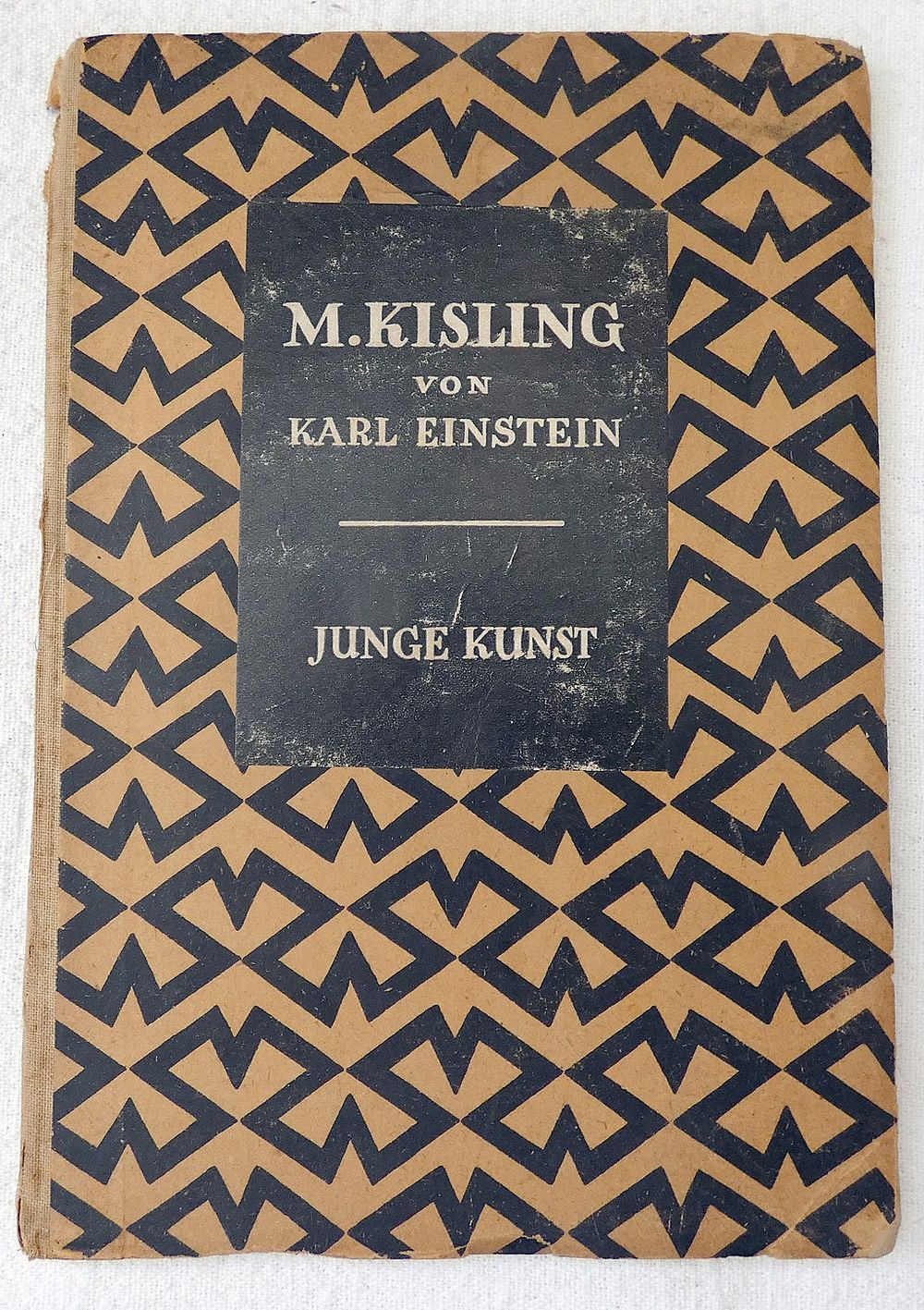
Moise Kisling von Carl Einstein. Junge Kunst Band 31, illustr., Avant-Garde litho. Cover, 1922, Leipzig, in German - Moise Kisling von Carl Einstein. Junge Kunst Band 31, illustr., Avant-Garde litho. Cover, 1922, Leipzig, in German Verlag: Leipzig: Klinkhardt & Biermann., 1922., 16 pp., 32 plates including color plate – frontispiece Hard Avant-garde lithographed cover, 20.5 x 14.5 cm. Condition: some wear and crack to corner of cover; spine damaged; foxing to endpapers; some foxing to last leaf with text and ca. to half of plates Moise Kisling (born Mojzesz Kisling; 22 January 1891 – 29 April 1953) was a Polish-born French painter.[1][2] Born in Kraków, then part of Austria-Hungary, to Jewish parents, Kisling studied at the Academy of Fine Arts. He left for Paris in 1910 at the age of 19. After moving to Montmartre, Kisling became a member of the Parisian avant-garde known also as the School of Paris, and developed close professional relationships with painters Amedeo Modigliani and Jules Pascin, among others. Kisling gained recognition for portraying the female form and completed numerous nudes and portraits during his career. Carl Einstein, born Karl Einstein, also known by pseudonym Savine Ree Urian (26 April 1885 – 5 July 1940), [1] was a German writer, art historian, anarchist, and critic. Einstein spent 1936-1938 fighting in the Spanish Civil War; returning to France where in 1940, he was arrested and interned along with the other German émigrés until his liberation later in the spring of 1940 as a result of chaotic circumstances in the face of the rapidly progressing German invasion. Although able to escape the German occupation of Paris during the Fall of France and flee to the south, he was left trapped on the French border with Francoist Spain. Seeing no alternatives, Einstein committed suicide in the Pyrenees town of Lestelle-Betharram on 5 July 1940