Bidspirit auction | Alfred Gruenewald, Perished in Holocaust,
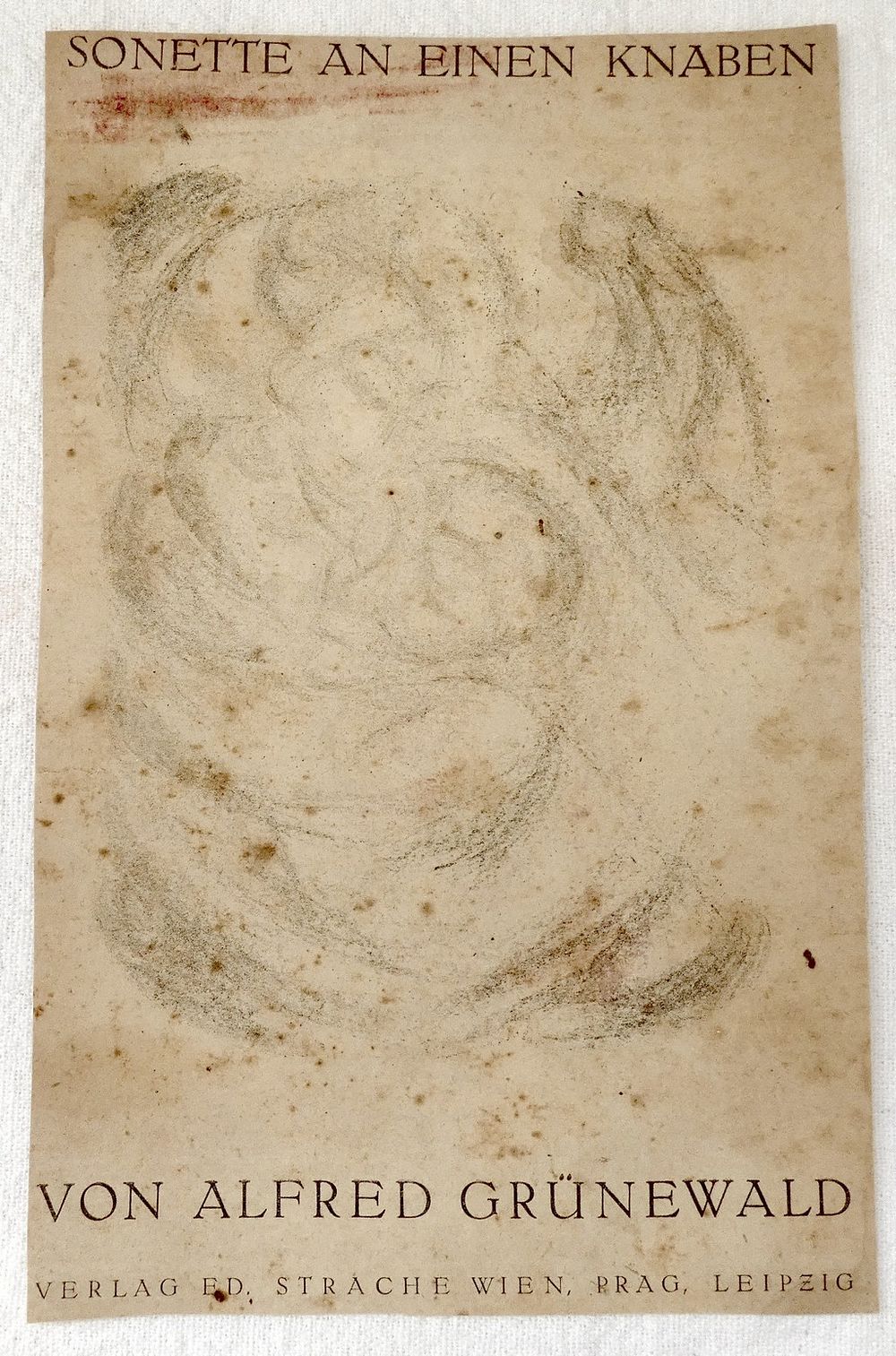
Alfred Gruenewald, Perished in Holocaust, “Sonette an einen Knaben” 3 Lithographs by Georg Ehrlich, 1st ed., 1920, in German - Alfred Gruenewald, Perished in Holocaust, “Sonette an einen Knaben” 3 Lithographs by Georg Ehrlich, 1st ed., 1920, in German Sonnets to a Boy Vienna, Prague, Leipzig, Verlag Ed. Strache, 1920., 28 pp. with 3 Lithographed plates by Georg Ehrlich. Hardcover, DJ is missing, only part of printed paper cover - illustration of the first plate from the contents. Size: 23 x 16.5 cm. Condition: cover worn, damped, discolored; tears to spine; yellow/ light brown paper; light damping near right edge; foxing stains to cutting of DJ Alfred Grünewald (* March 17, 1884 in Vienna; † September 9, 1942 in Auschwitz)[1] was an Austrian writer. Alfred Grünewald was the son of a merchant. He graduated from the Faculty of Civil Engineering and Architecture at the Vienna University of Technology. Initially, he worked as an architect and collaborator with Adolf Loos, then lived as a freelance writer in Vienna. Grünewald was close to Expressionism. On March 11, 1938, the eve of the Nazi invasion of Austria, Grünewald attempted suicide (Grünewald was Jewish and homosexual[2][3]). After the November pogroms, he was taken to the Dachau concentration camp on November 14, 1938, but released again in January 1939. He fled via Switzerland to southern France; after the outbreak of war, he was interned in the Fort-Carré in Antibes and in the Les Milles camp, living in Nice until late summer 1942. There he was arrested by the Vichy regime police and handed over to the SS. He was murdered in Auschwitz on September 9, 1942.[4] Georg Ehrlich ARA (22 February 1897 – 1 July 1966) was an Austrian sculptor. He lived in London from 1938 and became a British citizen in 1947. Ehrlich was born in Vienna. From 1912 until 1915 he studied at the Kunstgewerbeschule, or school of arts and crafts, of Vienna, [2] under the architect Oskar Strnad.[1]: 200 During the First World War he was called up and served in the Austrian Army 1915–1918.[1] After the war he worked in lithography and etching. Because of the post-War economic depression in Austria he moved to Munich (1919–21) and then to Berlin (1921–23). He returned to Vienna in 1924, and his interest turned almost exclusively to sculpture.[3] On November 27, 1930 he married the artist Bettina Bauer, [3] who like him, was Jewish. After the Nazi Anschluss in March 1938 it was too dangerous for them to be in Austria. He stayed in London, where he was at the time; his wife joined him there in July 1938, bringing many of his works.[3] He became a British citizen in 1947.[3] He was elected an Associate of the Royal Academy in 1962.[1] From 1951 Ehrlich suffered from heart problems. He moved to Italy in 1963, and then to Switzerland. He died in Lucerne on July 1, 1966 and was buried in Vienna