Bidspirit auction | Adolf Strausz, Autograph on his
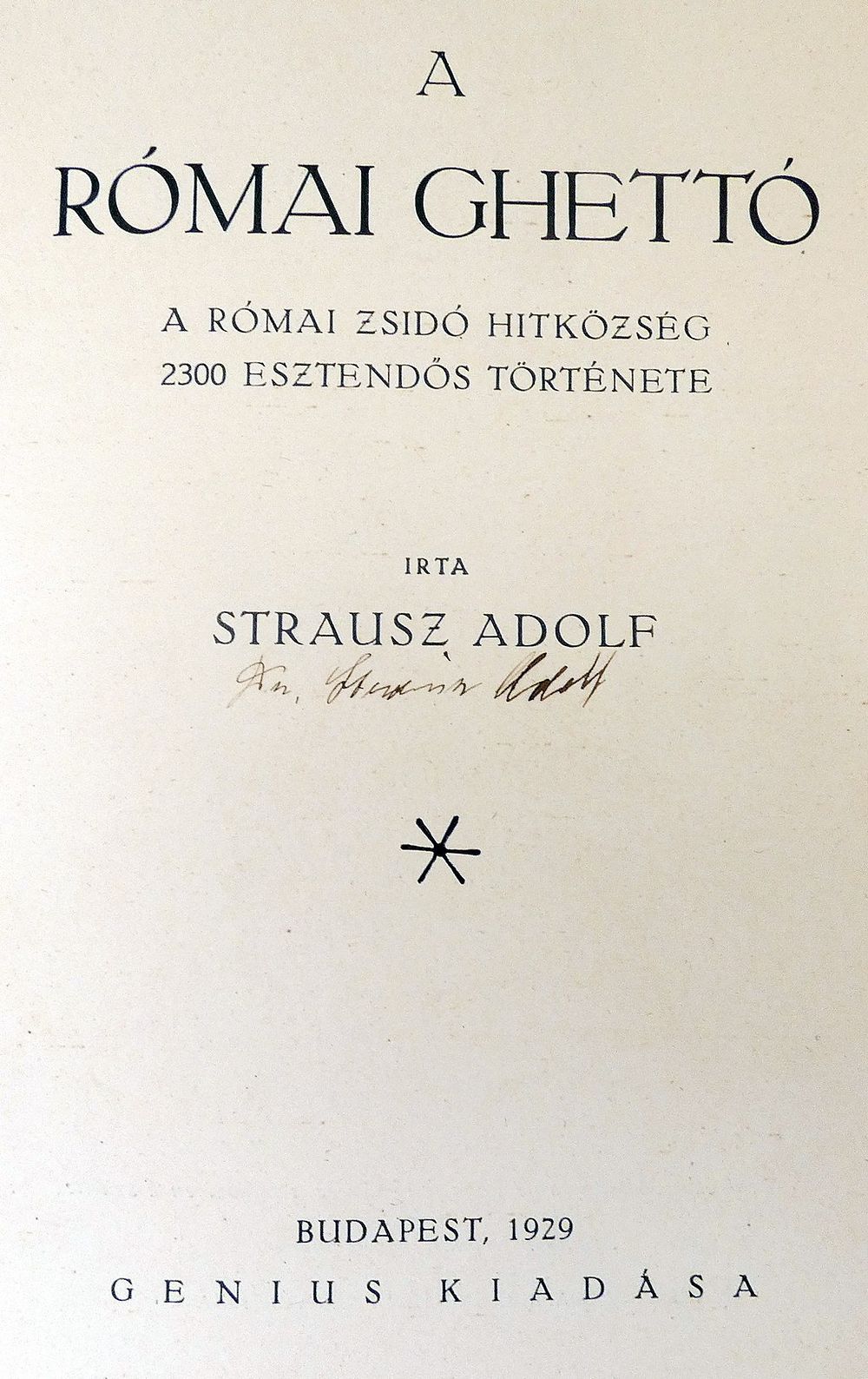
Adolf Strausz, Autograph on his Book: A romai Ghetto. A romai zsido hitkozseg 2300 esztendos tortenete The Roman Ghetto. (The 2300-year history of the Roman Jewish community), 1st ed., illustr., 1929, in Hungarian - Adolf Strausz, Autograph on his Book: A romai Ghetto. A romai zsido hitkozseg 2300 esztendos tortenete The Roman Ghetto. (The 2300-year history of the Roman Jewish community), 1st ed., illustr., 1929, in Hungarian Autograph on title page of his Book. Budapest, Genius Kiadasa, 1929, 287 pp., many b/w illustrations, ex libris Hard cover, size: 24 x 18 cm. Condition: some wear, discoloring to cover, corners rubbed; spine is missing; binding is still tight; some small tracks of moth in the middle near spine to rear cover Weight: 940 gr. Adolf Strausz, (1853–1944), Jewish Ethnographer, Writer, and Journalist Strausz Adolf, ethnographer, writer, and journalist. Born in Czecze (Cece, Hungary), May 15, 1853; died in Budapest (Hungary), March 1, 1944; mos. After attending high school in Székesfehérvár, he studied law at the University of Pest and classical philology in Vienna in 1875. In the same year, he was drafted into the Hungarian Landwehr. From 1877 to 1878, he graduated from the Ludovika Academy in Budapest. In 1879, he became a Lieutenant in the Reserve. He left the army in 1886. As early as 1878, S. had participated in the occupation of Bosnia-Herzegovina as a war correspondent. He later returned to the region several times and reported on it in various newspapers, including the “Neue Freie Presse” and “Pesti Napló”. As a retired member of the Hungarian government, he repeatedly traveled to the Balkans on behalf of the Hungarian government. From 1892 onwards, S. taught ethnography and commercial geography at the newly founded Oriental Commercial Academy, and from 1921 at the Economic University, in Budapest. Retired in 1925, S. was, among other things, co-founder and editor of the French-language political journal “Revue de l’Orient” in 1886 and, from 1898, editor of the ethnographic MS “Die Donauländer”. After his first publication on Bulgaria, “Bulgarian Industry”, appeared in 1886, he published his first book on Bulgaria. He published the first comprehensive account of folk beliefs and customs in Bulgaria, ”Bolgár néphit” (1897), as well as the collection ”Bulgarian Folk Poems” (Hungarian 1892, German 1895). This was followed by a Bulgarian grammar (coauthored with Imre Dugovich, Hungarian 1893, German 1895) and ”The Bulgarians: Ethnographic Studies” (Hungarian 1897, German 1898). S. maintained close contacts with several foreign ministries, including the Bulgarian and Austro-Hungarian ministries, for whose literary bureau he worked (1900–14). From 1904–11 he wrote reports on the Balkans and the Ottoman Empire for the Japanese foreign ministry. In 1880, S. became a member of the Kisfaludy Society and in 1889 a founding member of the Hungarian Society for People's Affairs (Magyar Néprajzi Társaság). S. actively participated in Jewish community life, became committed to Zionism after World War I, and became honorary president of the Hungarian Zionist movement, founded in 1903. On behalf of the World Zionist Organization, he undertook a trip to Palestine in 1922. S., who claimed to have authored 30 books and 6,000 articles, died a few days before the persecution of the Jews began in Hungary.