Bidspirit auction | Josef Schrattenholz. Antisemiten-Hammer. Eine Anthologie
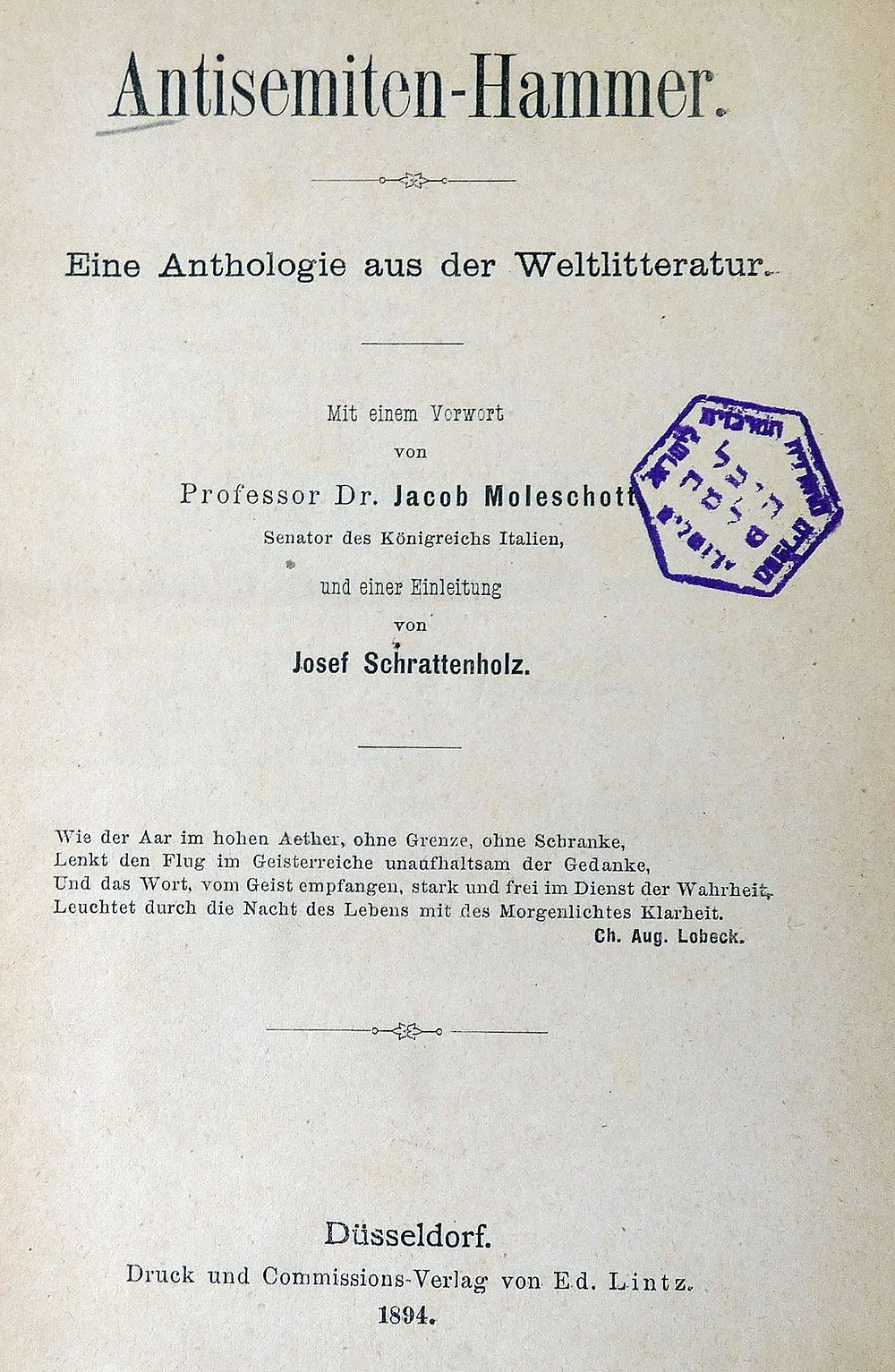
Josef Schrattenholz. Antisemiten-Hammer. Eine Anthologie aus der Weltliteratur, 1st ed., Duesseldorf, in German - Josef Schrattenholz. Antisemiten-Hammer. Eine Anthologie aus der Weltliteratur, 1st ed., Duesseldorf, in German, Jewish Ex Libris. Antisemiten-Hammer. Eine Anthologie aus der Weltliteratur, herausgegeben und mit einer Einleitung versehen, mit einem Vorwort von Jakob Moleschott, Düsseldorf: Eduard Lintz, 1894., 648, XVIII pp., Hard cover, 22.5 x 14.5 cm. Condition: ex-library stamps; cover rubbed to edges and corners; covers almost detached, spine is missing but binding is tight; yellow /light brown paper internally. Weight: 860 gr. Antisemitic Hammer. An Anthology of World Literature. With a foreword by Professor Dr. Jacob Moleschott, Senator of the Kingdom of Italy, and an introduction by Josef Schrattenholz. RARE 19th-century anthology, featuring various texts and fragments that preach tolerance, especially towards Jews and Judaism, and discuss the ideal of the ”Citizen of the World.” Published by Josef Schrattenholz as a response to the nascent modern antisemitic ideologies. With an introduction by the Jewish Dutch-Italian scientist and statesman Jacob Moleschott (1822-1893). Johann Josef Schrattenholz, also known as Joseph Schrattenholz (* October 19, 1847 in Hoholz near Bonn; † May 22, 1909 in Berlin), was a journalist, music writer, and biographer who campaigned against anti-Semitism. His parents were the teacher, poet, writer, and composer Wilhelm Schrattenholz (* June 28, 1815 in Birlinghoven near Bonn; † December 4, 1898 in Cologne) and his wife Maria Helena Franziska Schrattenholz, née Schreiner (* September 15, 1814 in Birlinghoven near Bonn; † December 29, 1882 in Bonn).[1] Josef Schrattenholz received private academic and musical instruction, particularly from his brother, the pianist Max Schrattenholz. From 1863 to 1868, Josef Schrattenholz worked as a music teacher in Cologne. He then continued his studies in Berlin and Bonn, where he was editor of the Bonner Zeitung from 1870 to 1873. He then lived in Düsseldorf and published a collection of sayings by the composer Robert Schumann in 1874. Josef Schrattenholz corresponded with important musicians of his time, including the composers Robert Franz, Clara and Robert Schumann, and the conductor Hans von Bülow. He also wrote articles and reviews for the Didaskalia from Heidelberg[2][3][4], the Würzburger Presse[5], the Allgemeine Zeitung from Munich[6], and the Allgemeine deutsche Musikzeitung, in which he exchanged blows with Hugo Riemann, among others.[7][8][9][10] In 1891, his biography of the Düsseldorf painter Eduard Bendemann (1811–1889) was published. Josef Schrattenholz was a Catholic[11] and addressed the increasing hostility towards Jews in the second half of the 19th century. From 1890 onwards, he published a series of books that sought to combat anti-Semitism, including the 1894 anthology *Antisemiten-Hammer*, whose title is based on the late medieval work on witch hunts *Witches Hammer* by the Dominican Heinrich Kramer. *Antisemiten-Hammer*, with a foreword by the natural scientist Jakob Moleschott, collects quotations from non-Jewish writers of world literature as well as from non-Jewish contemporaries against anti-Semitism or in defense of the Jews.[11] From 1895 onwards, Josef Schrattenholz lived in Kessenich near Bonn and from 1898 until his death in 1909 in Berlin. In 1876 he became engaged to Elsa Schneider, a daughter of the director of the Cologne Conservatory, [12][13] whom he probably married afterwards.[14] Together the couple founded a music school in Bonn in 1878, where Adolf Blomberger and Luigi Borghetti also taught.[15] Later he married Anna Margarethe Jernberg (* 22 May 1862 in Düsseldorf; † 4 March 1916 in Berlin), a daughter of the painter August Jernberg.[16] Together they had 7 sons and 7 daughters.