Bidspirit auction | Mendel Mann, Autograph on his
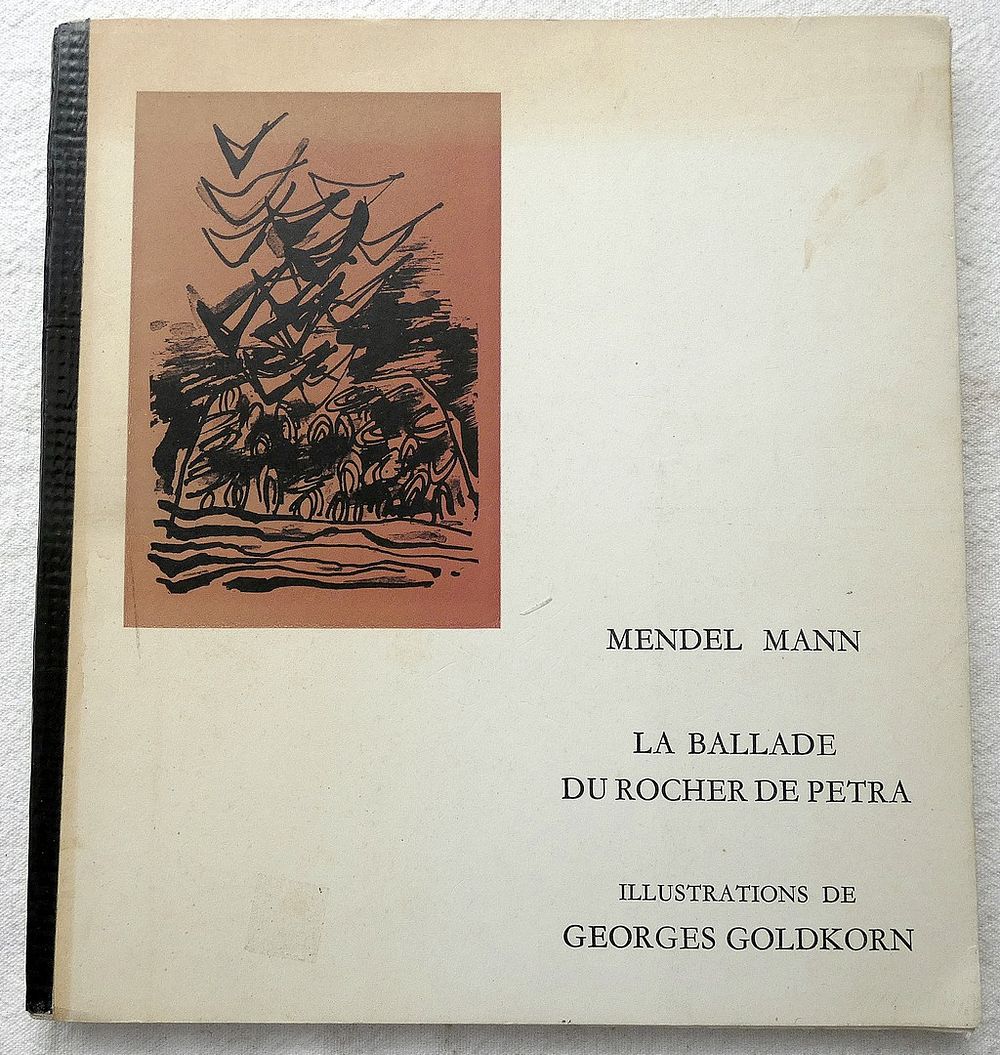
Mendel Mann, Autograph on his Book: La Ballade du Rocher de Petra, illus. G. Goldkorn 1965, in French - Mendel Mann Autograph on his Book: La Ballade du Rocher de Petra, illus. by G. Goldkorn 1965, in French Mendel Mann Autograph on frontispiece of his book, 1970: La ballade du rocher de Petra, illus. G. Goldkorn 1965 in French Editions Bernard Neyrolles 1965. In-4 paperback under cover with flap cover. 55 pages in 24.5 x 27 cm format. Cover & superb illustrations on plates by Georges Goldkorn on this text by Mendel Mann, translated from Yiddish by Rachel Ertel. Condition: some wear and discoloring to cover; couple of worm holes to rear cover and last pages Mendel Mann (Hebrew: מנדל מן or Yiddish: מענדל מאן; also Mendl Man or Mendel Man; born December 9, 1916, in Płońsk, Poland; died September 1, 1975, in Paris) was a Polish writer, journalist, illustrator, and painter. As a collector, editor, and author of songs and poems, he was committed to Yiddish-speaking culture throughout his life and published primarily in Yiddish. His works have been translated into nine languages. Mendel Mann was born in 1916 in the small Mazovia town of Płońsk. Already in his youth, he was interested in art and began drawing. His literary career began in 1935 in Warsaw as an author and translator of children's literature; he published his first poems in Yiddish-language magazines. After the outbreak of World War II, he managed to escape the German occupiers to the Soviet Union. As a Red Army soldier, he took part in the defense of Moscow and the capture of Berlin, and was an eyewitness to the Warsaw Uprising. Mendel Mann processed his war experiences in a novel trilogy: Bay di Toyern fun Moskve (”At the Gates of Moscow”, 1956), Bay der Vaysl (”On the Vistula”, 1958), and Dos Faln fun Berlin (”The Fall of Berlin”, 1960). After the war, he returned to Poland, where he headed the schools department of the Central Committee of Jews. In the summer of 1946, after the Kielce pogrom, he left Poland for Israel via Germany. In 1954, he became editorial secretary of the magazine Di goldene kejt (”The Golden Chain”), published by Abraham Sutzkever. In 1961, he went to Paris, where many of his works were translated into French, partly thanks to the support of Manès Sperber. He wrote for numerous Yiddish-language magazines and became editor-in-chief of the daily newspaper Unzer Wort. Mendel Mann died after a short, serious illness at the age of 59. Georges Goldkorn, born April 3, 1905[1] in Szydłowice (Silesian Province, Kingdom of Prussia, now in Poland) and died July 10, 1977[2] in the 13th arrondissement of Paris, was a French painter of Polish origin. Abram Georges Goldkorn was born on April 3, 1905 in Poland. He was the son of Bereck Goldkorn and Rachel Ehrlich. Georges Goldkorn grew up in a Hasidic family and continued his religious studies until the age of 15 in a yeshiva. He then left Talmudic school, entered high school, and after graduating from high school, on the advice of the Expressionist painter Henryk Gotlib, he applied, despite his parents' opposition, to the Academy of Fine Arts in Krakow. In 1927, the young Goldkorn entered the Royal Academy of Brussels. A year later, he studied under Professors Isidore Opsomer and Rik Wooters at the Higher Institute of Fine Arts in Antwerp. In 1940, the invasion of Belgium forced him to exile in France, where he settled permanently. He married Andree Yvonne Doris and lived in Paris, on Rue Notre-Dame-des-Champs. Georges Goldkorn died on July 10, 1977, in Paris, at the Salpêtrière Hospital. He is buried in the Père-Lachaise Cemetery