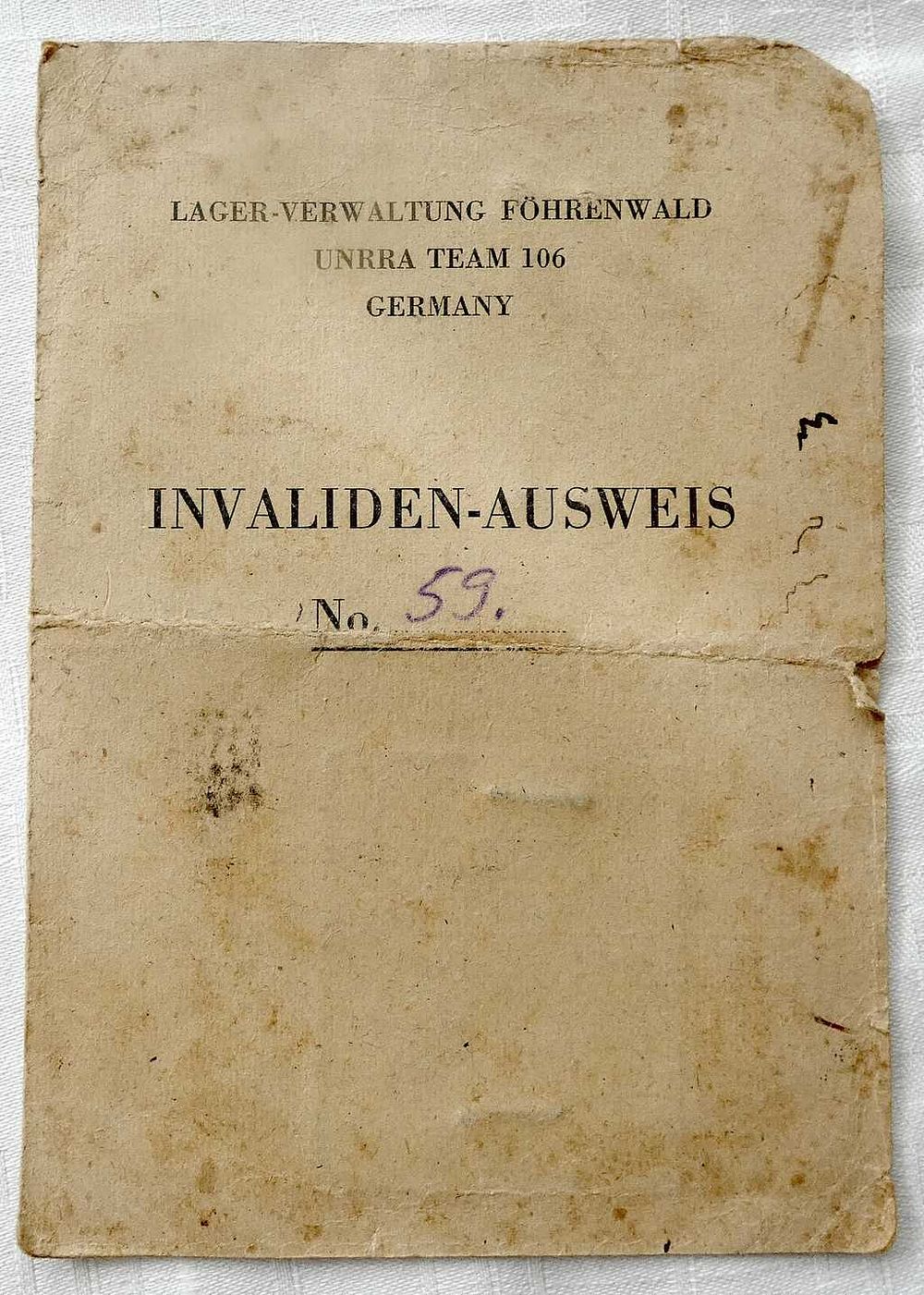
Bidspirit auction | She'erit Ha-Pleita. Disability Certificate of
She'erit Ha-Pleita. Disability Certificate of Wilhelm Hauptmann, UNRRA Foehrenwald Jewish DP Camp, Germany, 1946, Photo, English and German - She'erit Ha-Pleita. Disability Certificate (Invaliden-Ausweis) of Wilhelm Hauptmann, UNRRA Foehrenwald Jewish DP Camp, Germany, 1946, Photo, English and German Disability Certificate issued by the Foehrenwald camp administration (UNRRA Team 106) after World War II. Size: 15 x 10.5 cm. (5.9 x 4.1 inches) Condition: Some age and use wear; stains; bend across; small tears to ends of spine LAGER-VERWALTUNG FOEHRENWALD. UNRRA TEAM 106 — GERMANY INVALIDEN-AUSWEIS, No. 59 CERTIFICATE No. 59 Left side in English, right side in German This is to certify that: Name: HAUPTMANN, Wilhelm Born: 1911 Place of birth: Lemberg Country of origin: Poland Identification Card No.: 058029 has been recognized on: 16.7.46 as 33% Invalid from the Medical-Invalid Commission. All organisations and authorized persons are requested to give aid to the above mentioned. Signatures and cachets: Dr. I. PERLMUTTER, Medical Officer, UNRRA Team 106 Welfare officer / Amt fuer soziale Fuersorge Owner's signature: Hauptmann Wilhelm Cachet near photograph: Committee Camp Foehrenwald This document is a rare example of official disability status awarded by an international organization to a war survivor, possibly a victim of Nazism. Such certificates provided the right to: special food rations exemption from labor service in the camp medical care priority in emigration queues (to Canada, the USA, Palestine) Foehrenwald was one of the largest DP camps (Displaced Persons camp) established in occupied post-war Germany. It was located near the town of Wolfratshausen in Bavaria, south of Munich. Establishment: Originally built in 1939–1940 as a housing settlement for workers of the rocket factory (IG Farben). Post-war (since 1945): The camp was converted into a reception center for refugees who had survived the Holocaust. 1946–1957: The camp was under the control of the American military administration and later the Bavarian government. From then on, it became a Jewish DP camp, housing up to 5,000 Jewish survivors of concentration camps and ghettos. The camp had synagogues, schools, a Jewish police force, newspapers, and cultural and political organizations. 1957: The camp was officially closed and its area was integrated into the civilian residential area, which has been called ”Waldstadt” since the 1960s.