Bidspirit auction | WWII PC Letter of a
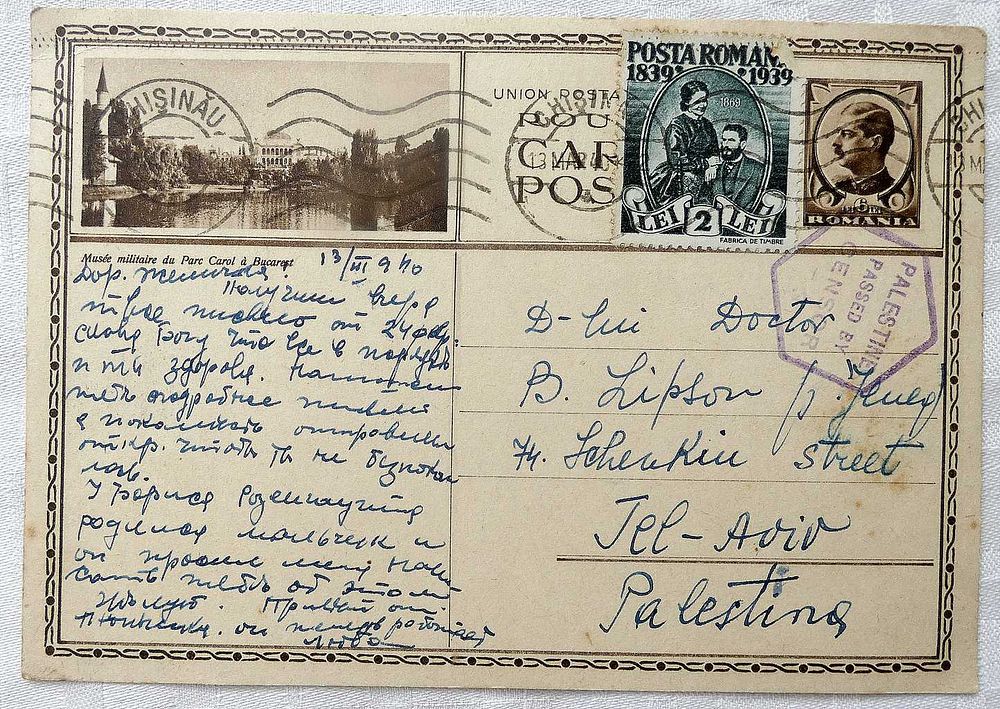
WWII PC Letter of a Jewish Family, Chisinau (Kishinev), Romania sent to Palestine, 1940, British Censorship, in Russian - WWII PC Letter of a Jewish Family, Chisinau (Kishinev), Romania sent to Palestine, 1940, British Censorship, in Russian Letter was on 13.III. 1940 Almost all Jews of Kishinev perished in Holocaust JEWS OF CHISINAU IN WORLD WAR II: THE FULL STORY Before the war (before 1940) By the beginning of the 20th century, Chisinau was one of the largest Jewish centers in Eastern Europe. According to the 1930 census, about 50-60 thousand Jews lived in the city — about 40% of the population. Jews played a significant role in the city's economy, culture, trade and crafts. The following operated here: dozens of synagogues and prayer houses; Jewish schools (including Hebrew and Yiddish); Zionist and socialist organizations; newspapers, theaters, literature. But the city was also an arena of anti-Semitism. The largest pogrom took place back in 1903 and went down in history as the Kishinev pogrom — mass violence that took dozens of lives. This tragic episode left a mark on Jewish memory and increased emigration to Palestine and America. Soviet occupation of Bessarabia (June 1940 – June 1941) In June 1940, after the USSR’s ultimatum to Romania, Bessarabia (including Chisinau) was annexed to the Soviet Union. For part of the Jewish population, this was a duality: On the one hand, the end of official Romanian anti-Semitism, the closure of right-wing parties. On the other hand, arrests, deportations and repressions began. The NKVD arrested not only former officials and military personnel, but also representatives of the Jewish intelligentsia, entrepreneurs, rabbis and activists. Many families were deported to Kazakhstan, Siberia and Central Asia. Some Jews, especially young people, joined the Komsomol or the Red Army. Nazi-Romanian invasion and disaster (June–August 1941) On June 22, 1941, Germany and its allies, including Romania, attacked the USSR. In early July, German and Romanian troops entered Chisinau. The Soviet authorities and part of the population managed to evacuate, but many did not. Immediately after the capture of the city, a wave of mass murder and violence against Jews began: hundreds were shot on the spot; brutal pogroms took place, often under the pretext of ”revenge for Bolshevism”; the Romanian army and gendarmerie carried out mass arrests, women were raped, children were killed. Ghetto in Chisinau (August–October 1941) The surviving Jews were driven into a ghetto created by the Romanian authorities. It was located in the area of the former Jewish quarters. The conditions were appalling: overload, hunger, disease; systematic beatings, murders; prohibition of leaving the boundaries. From the ghetto, mass deportations were carried out to Transnistria - the region between the Dniester and the Southern Bug, occupied by Romania and turned into a zone of camps and death camps. Deportations and genocide in Transnistria (autumn 1941 - 1944) From October 1941 to March 1942, tens of thousands of Jews from Chisinau and other cities in Bessarabia were sent on ”death trains” - in columns on foot and in carts. It is believed that out of 60,000 Jews in Chisinau, at least 50,000 died.