Bidspirit auction | Extremely rare! Early antique woodcut
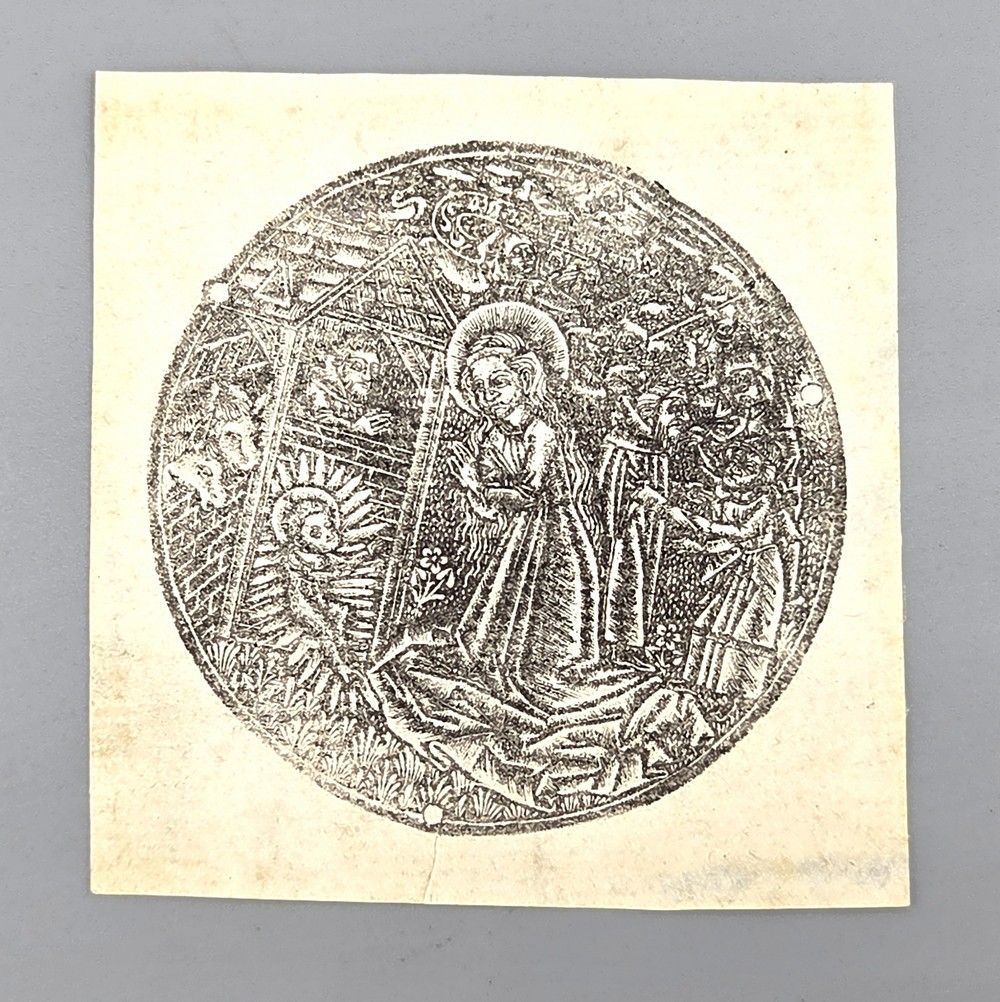
Extremely rare! Early antique woodcut - ”The Nativity” - Extremely rare! Early antique woodcut - ”The Nativity”, Southern Germany/Strasbourg, circa late 15th century, in an unusual tendo (round) format, depicting the Nativity (birth) of Christ with the Virgin Mary kneeling next to the radiant baby Jesus, surrounded by Joseph, shepherds and other symbolic details. These circles of this size and style are extremely rare, a similar smile is now held in the collections of the British Museum and the Morgan Museum Library. The cuts held in the collections differ slightly in the decorations in their upper part from the one in our hands, and there is a note in the inscriptions that it is known that there are other similar cuts from the period that are not in their hands. The diameter of the cut itself: 7.7 cm, page dimensions: 9.2X8.8 cm. In very good condition (it should even be said excellent) in relation to its age, there is general wear, a few stains. * Evidence for early dating (1470–1490): 1. Pre-Renaissance graphic style The engraving reflects a ”flat” graphic style, devoid of depth, perspective or an attempt at complex shading - elements that indicate a very early period in the history of wood engraving. Unlike the late Renaissance generation (such as Albrecht Dürer and his students), who dealt with shadow, texture and complex composition, the current engraving shows relatively rough lines, without uniformity or dynamics - clear evidence that this is a first generation of artists in the field of printing. 2. The lack of perspective and architectural structures While after 1500 it is common to use Renaissance architecture as a background (arches, columns, three-dimensional spaces), here a background devoid of depth or structure is evident. The space is not defined, and the figures are placed at the front of the picture without a constructive relationship between them. This is a typical feature of images before the spread of the principles of linear perspective in Europe. 3. Use of a rare round format (”tondo”) Round engravings were created in extremely limited numbers, and almost exclusively between 1470 and 1490. The format was almost completely forgotten after 1500 in favor of horizontal and vertical rectangles. A circular engraving with a diameter of 7.9 cm is a clear statistical rarity, which strengthens the validity of the dating. 4. Early wood cutting technique The cutting was done roughly, with an uneven depth in the engraving, which indicates relatively primitive tools (knives and flat cutters) and not advanced cutting tools that appeared only at the beginning of the 16th century. 5. laid paper The paper bears clear chain marks, the texture corresponds to sheets of paper produced in Germany or France in the 15th century, which were handmade within a classic rope network. Similar comparisons and documentation in museums: Similar images are found in the world's leading collections, supporting the authenticity and period style of the engraving: 1. New York Metropolitan Museum Early German wood engraving, circa 1470–1480 🔗 https://www.metmuseum.org/art/collection/search/337751 2. The National Gallery of Art in Washington Round wood engraving in late Gothic style 🔗 https://www.nga.gov/collection/art-object-page.3876.html 3. Cleveland Museum Early round images on religious figures - Germany, late 15th century 🔗 https://www.clevelandart.org/art/1959.99.10 4. Morgan Library, New York A rich collection of early prints from the second half of the 15th century, including unsigned circular engravings. Rarity and Authenticity: The engraving represents a closed circle of early wood patterns in Germany - before the transition to mass production of illustrated prayer books. Its mere existence on original paper from the period, without signs of a reprint, is a strong confirmation of originality. We have no evidence of a late publication of this engraving, and no modern version of it is known, indicating that it is one of the few original copies that have survived. Summary: This circular woodcut is a rare, early and authentic item that embodies an important transitional phase in the history of art and printing. Its stylistic features, materiality and unusual format - all together indicate a certain dating to the region 1470-1490, in southern Germany