Bidspirit auction | Reizl (Ruz'ka) Korczak, Holocaust Survivor,
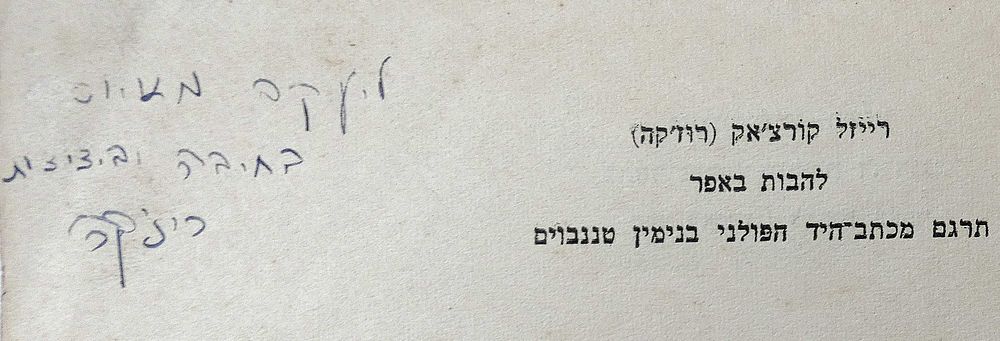
Reizl (Ruz'ka) Korczak, Holocaust Survivor, Orig. Autograph on her Book: “Flames in Ash”, illust., 1st Hebrew Ed., 1946, in Hebrew - Reizl (Ruz'ka) Korczak, Holocaust Survivor, Orig. Autograph on her Book: “Flames in Ash”, illust., 1st Hebrew Ed., 1946, in Hebrew Orig. Autograph / dedication of the author on frontispiece of her Book, in Hebrew. Eretz Israel, 322 pp., Avant-garde photo montage photos orig. photos, documents, tables. Half cloth hard cover with gold ornament, size: 23 x 16.5 cm. Condition: wear, stains chipping to cover, light brown paper to endpapers, several sporadic foxing stains Weight: 490 gr. “We did not have the privilege of choosing between converting to Christianity and sacrificing ourselves to sanctify the name of God—in this we differed from our ancestors. … We did have a choice of the manner in which to live to the very end as free Jews and die as liberated people.” Thus, in 1982, Korczak-Marla referred to the choice made by members of Halutz movements in the Vilna Ghetto. Rozka Korczak was born in April 1921 in Bieslko, a small riverside village, near the Visla (Vistula), which had only forty Jewish families. Her father Gedaliah (d. 1940) was a cattle dealer, a tradition-respecting Jew and aspiring Zionist. Two younger sisters, Teibel (b. 1924) and Rachel (b. 1927) perished together with their mother Hinda in c.1942. Since there was no Jewish school in her village, Korczak studied at a Polish school. In the eighth grade she organized a strike of Jewish pupils in protest against the principal’s antisemitic remarks. At the same time, she also studied the scriptures and the Talmud in a heder, seated at a side table, not around the central one, which was reserved for boys. With the decline of their financial situation, the family moved to Plock (94 kilometers north of Lodz) in 1934. Despite her craving for learning, fourteen-year-old Rozka decided to work due to the shortage of money in the family. She acquired knowledge by attending evening classes and by reading books. “These were my universities, ” she said. Having readAutoemancipation (1882) by Leon Pinsker (1821–1891), she found her way to Ha-Shomer ha-Za’ir, where she became an instructor and a member of the leadership. Her loyalty to the socialist movement soon led to conflict with the traditional way of life at home. Korczak, true to her promise, went out on a trip with her group on Yom Kippur, but she also observed the fast! Upon the outbreak of WWII and the German invasion of Plock, she witnessed acts of violence and humiliation against Jews. Soon thereafter, she informed her parents that she was leaving to join her comrades in the “movement.” In Warsaw, in November 1939, she met Tosia Altman (1918–1943), who informed her about the gathering of movement members in Vilna (Vilnius). There she learned of her father’s death and her family’s deportation to Piotrkow Trybunalski (45 km SSE of Lodz). She joined the commune and worked, together with Vitka Kempner and others, rinsing pig bristles for the brush manufacturing industry. Ha-Shomer ha-Za’ir went underground after the incorporation in July 1940 of Lithuania, and with it Vilna, into the Soviet Union. In addition to working, Rozka Korczak attended an evening high school to improve her knowledge of Yiddish and Jewish culture. On June 24, 1941, two days after invading the Soviet Union, the Germans occupied Vilna. Korczak and her comrades decided to escape to the East and join the Red Army, but the German army overtook them. In July, the Germans and Lithuanian volunteers rounded up five thousand Jewish men, taking them to Ponary (12 kilometers from Vilna), where they were murdered. That was the first, but not the last mass murder in Ponary. The members of the movement tried to save themselves with forged documents. On September 6, 1941, two ghettos, for 28,000 Jews who escaped the killing, were established in Vilna. Ghetto No. 2 included the “superfluous” population, destined for extermination. As the horrible truth about the mass murders reached the remaining people in the ghetto, the movement members argued constantly about their ultimate commitment: should they stay with the community in Vilna or find their way to another “safe” ghetto? Rozka Korczak was among those gathered for the historical meeting on the eve of December 31, 1941, at which Abba Kovner (1918–1988) read aloud a manifesto which stated, in part: “Hitler plans to kill all the Jews of Europe. … Let us not go like sheep to the slaughter.” On January 21, 1942, a Jewish combat organization was established, the Fareynegte Partizaner Organizatsye (United Partisan Organization; FPO). Korczak, who documented this gathering in her book Flames in the Ashes, insisted both in 1945 and in 1988: “You may by no means say that whoever supported the uprising became a hero, and whoever objected to it was a coward. It was not divided like that.