Bidspirit auction | Lehranstalt fuer die Wissenschaft des
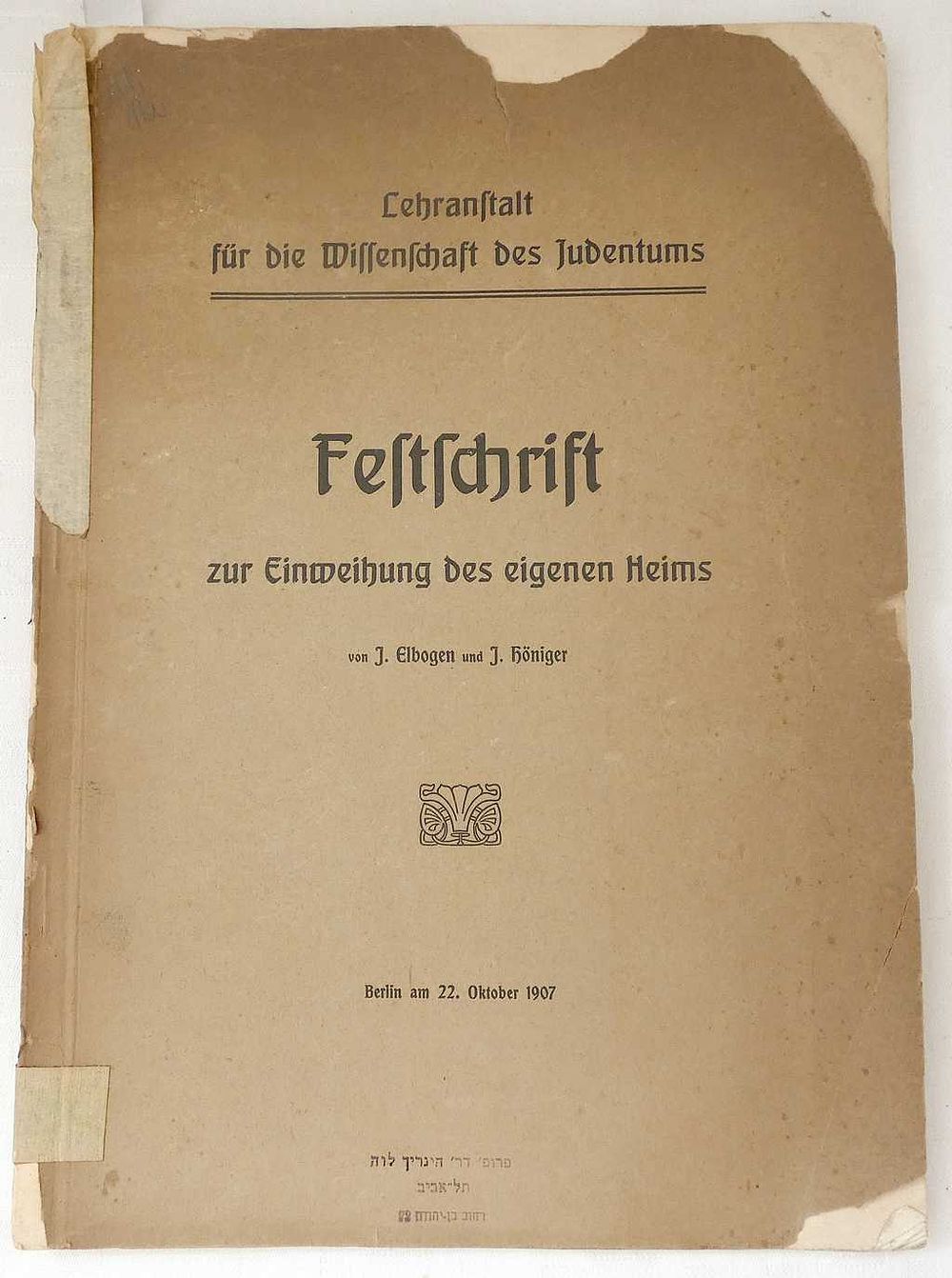
Lehranstalt fuer die Wissenschaft des Judentums. Festschrift zur Einweihung des eigenen Heims von I. Elbogen und I. Hoexter , illustr., 1907, Berlin, in German - Lehranstalt fuer die Wissenschaft des Judentums. Festschrift zur Einweihung des eigenen Heims von I. Elbogen und I. Hoexter , illustr., 1907, Berlin, in German, Art Nouveau design Festschrift zur Einweihung des eigenen Heims am 22. Oktober 1907 von I. Elbogen, Holocaust survivor und I. Hoexte , 105 pp. and 4 plates illustrations Soft cover, size: 27 x 19.5 cm. Condition: cover worn, discolored, chipped to edges; spine damaged, over taped; some foxing to last pages Weight: 330 gr. Hochschule fuer die Wissenschaft des Judentums, or Higher Institute for Jewish Studies, was a rabbinical seminary established in Berlin in 1872 and closed down by the Nazi government of Germany in 1942. Upon the order of the government, the name was officially changed (1883–1923 and 1933–42) to Lehranstalt für die Wissenschaft des Judentums. Abraham Geiger, who had been active in establishing Reform Judaism, wanted a university for Jewish studies in Berlin. Unable to become part of the University of Berlin, he was involved in 1870 in creating a separate institution. Also involved were David Cassel, Israel Lewy, Moritz Lazarus and Heymann Steinthal, the Jewish ”intellectuals” and professors at the University of Berlin. Geiger's ”General Introduction to the Science of Judaism, ” ”Introduction to the Biblical Writings” and ”Lectures on Pirḳe Abot” were originally delivered as lectures at the seminary. Some of the best German-Jewish teachers taught there in the spirit of the Wissenschaft des Judentums movement: Hanoch Albeck, Ismar Elbogen, Julius Grünthal, Julius Guttmann, Franz Rosenthal, Harry Torczyner, and Leo Baeck. Moritz Steinschneider referred to the Hochschule as a ”new ghetto of Jewish learning, ” which he felt could ultimately not produce the standards of scholarship achieved in the university setting. Officially the institution was not affiliated with a movement or denomination. It sought free inquiry and research without any restrictions. It stood for a conservative Judaism, but its main object was the scientific study of things Jewish, freed as far as possible from denominational disputes. There was no religious test for professors but it was assumed that all of the faculty lived according to the Jewish tradition and were fluent in Hebrew. As the school was never dependent on any religious or public organization, the board was constantly engaged in raising money from wealthy contributors, sponsors of scholarly ”chairs” and scholarships. In 1872, the first year, there were only 12 students, including four women. In 1921, there were 63 full-time and 45 part-time students enrolled in the Hochschule. Many of the students came from Eastern European countries, notably Poland, as graduates of Orthodox Yeshivot. By 1930–33 the school had achieved so great a reputation that many non-Jews, especially Christian clergy, enrolled. Ismar Elbogen (September 1, 1874 – August 1, 1943) was a German rabbi, scholar and historian. Yitzhak Moshe (Itamar) Elbogen was born in Posen.[1] He was taught by his uncle, Jacob Levy, author of the ”Neuhebräisches Wörterbuch”, and then attended the gymnasium and the Jewish Theological Seminary in Breslau.[2] He earned his doctorate from the Breslau University and was ordained as a rabbi in 1899. Elbogen served as a lecturer on Biblical exegesis and Jewish history at the Collegio Rabbinico Italiano in Florence. In 1902 he became privat-docent at the Lehranstalt für die Wissenschaft des Judentums in Berlin. He fled Nazi Germany in 1938, and taught at the Jewish Institute of Religion in New York, the Jewish Theological Seminary and Hebrew Union College. He is the author of Jewish Liturgy: A Comprehensive History. Originally published in German in 1913, this book was updated in a number of subsequent Hebrew editions. The latest Hebrew edition was translated into English by Raymond P. Scheindlin, and published by the Jewish Publication Society in 1993. This work covers the entire range of Jewish liturgical development, beginning with the early cornerstones of the siddur; through the evolution of the medieval piyyut tradition; to modern prayerbook reform in Germany and the United States. It is the most thorough academic study of the Jewish liturgy ever written. Joseph Höxter (1864–1938), German-Jewish rabbi, scholar, and educator Joseph Höxter was a prominent figure in the Wissenschaft des Judentums movement (Science of Judaism) in early 20th-century Germany. Born on December 23, 1864, in Holstein, Germany, he pursued rabbinical and academic studies, eventually becoming a respected teacher and scholar. He taught at the Lehranstalt für die Wissenschaft des Judentums (Institute for the Study of Judaism) in Berlin, where he played a key role in training future rabbis and scholars. His academic focus included Jewish liturgy,