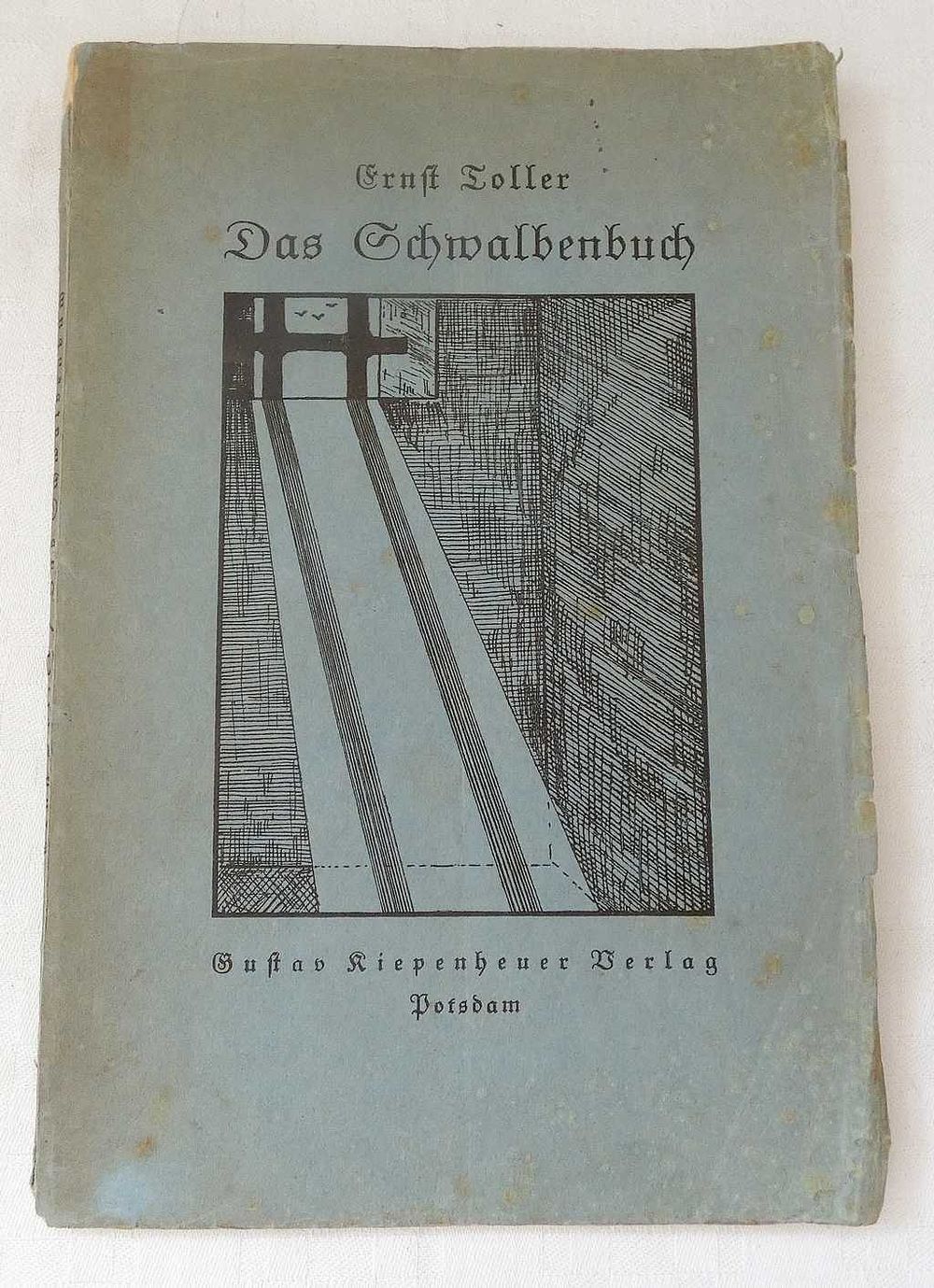
Bidspirit auction | Ernst Toller. Das Schwalbenbuch. Bauhaus
Ernst Toller. Das Schwalbenbuch. Bauhaus Litho Cover by Eugen Maria Karpf, 1924, in German, Potsdam - Ernst Toller Das Schwalbenbuch. Bauhaus Litho Cover by Eugen Maria Karpf, 1924, in German, Potsdam Gewachsen 1922 Geschrieben 1923. Festungsgefaengnis Niederschoenenfeld. Potsdam Kiepenheuer, 1924. 55 (3) pp. Mit dem Zensurzettel. (With the censorship slip): Die Drucksachen zum „Schwabenbuch“ sind vom Beschluß nur unvollstaendig geprueft worden. Die Wiederhofenfeld'sche Festungsverwaltung hat die hier gedruckte Fassung bestaetigt, da sie keine Reihe von Stellen enthält, deren Verbreitung dem Strafgesetzbuch widersprechen wuerde. The printed materials relating to the ”Swabian Book” were only partially reviewed by the court. The Wiederhofenfeld Fortress Administration has approved the version printed here, as it does not contain any passages whose distribution would contravene the Penal Code. Orig. litho soft cover, size: 20 x 13.5 cm. Condition: ex-owners name on title page; some wear, staining to cover, right edge shabby; spine slightly damaged to top and bottom; some sporadic foxing stains Ernst Toller (1 December 1893 – 22 May 1939) was a German author, playwright, left-wing politician and revolutionary, known for his Expressionist plays. He served in 1919 for six days as President of the short-lived Bavarian Soviet Republic, after which he became the head of its army. He was imprisoned for five years for his part in the armed resistance by the Bavarian Soviet Republic to the central government in Berlin. While in prison Toller wrote several plays that gained him international renown. They were performed in London and New York City as well as in Berlin. In 1933 Toller was exiled from Germany after the Nazis came to power. He did a lecture tour in 1936–1937 in the United States and Canada, settling in California for a while before going to New York. He joined other exiles there. He committed suicide in May 1939. Life and career Toller was born in 1893 into a Jewish family in Samotschin, Germany (now Szamocin, Poland). He was the son of Ida (Kohn) and Max Toller, a pharmacist. His parents ran a general store. At the outbreak of World War I, he volunteered for the German Army. After serving for 13 months on the Western Front, [2] he suffered a complete physical and psychological collapse. His first drama, Transformation (Die Wandlung, 1919), was wrought from his wartime experiences.[citation needed] Ernst Toller (center) and Max Weber (foreground, bearded) in May 1917 at the Lauensteiner Tagung Together with leading anarchists, such as B. Traven and Gustav Landauer, and Toller's party, the Independent Social Democratic Party of Germany (USPD), Toller was involved in the short-lived 1919 Bavarian Soviet Republic. The communists were against the founding of a communist republic at this point.[3] He served as president from 6 April to 12 April.[2] Communists agitated against Toller and his councils and sent speakers into soldiers barracks to announce that the Council Republic did not deserve to be defended.[4] He issued numerous decrees, almost all of which remained unrealised:[5] the press was to be socialised, the mining industry was to be socialised, and the eight-hour working day made legally binding. He decreed that citizens could withdraw only 100 marks per day from the banks, and issued reassurance to the workers that these measures were directed against the major capitalists who were attempting to take money abroad. A decree was made against exorbitant rents.[6] His government members were not always well-chosen. For instance, the Foreign Affairs Deputy Dr. Franz Lipp (who had been admitted several times to psychiatric hospitals) informed Vladimir Lenin via cable that the ousted former Minister-President, Johannes Hoffmann, had fled to Bamberg and taken the key to the ministry toilet with him. On April 13, 1919 the Communist Party seized power, with Eugen Leviné as their leader.[7] In May 1919, the republic was defeated by the Freikorps.[8] Ernst Toller during his imprisonment in the Niederschönenfeld fortress (early 1920s) The noted authors Max Weber and Thomas Mann testified on Toller's behalf when he was tried for his part in the revolution. He was sentenced to five years in prison and served his sentence in the prisons of Stadelheim, Neuburg and Eichstätt. From February 1920 until his release, he did most of his time in the fortress of Niederschönenfeld, where he spent 149 days in solitary confinement and 24 days on hunger strike.[9] Karlheinz Martin's production of Transformation in Berlin with Fritz Kortner as the war returnee, 30 September 1919 Toller was unable to see the plays he had written in prison performed until after his release in July 1925. The most famous of his later dramas, Hoppla, We're Alive! (Hoppla, wir Leben!), directed by Erwin Piscator, premiered in Berlin in 1925. It tells of a revolutionary discharged from a mental hospital after eight years,