Bidspirit auction | Complete Russian-Jewish-German Dictionary ed. by
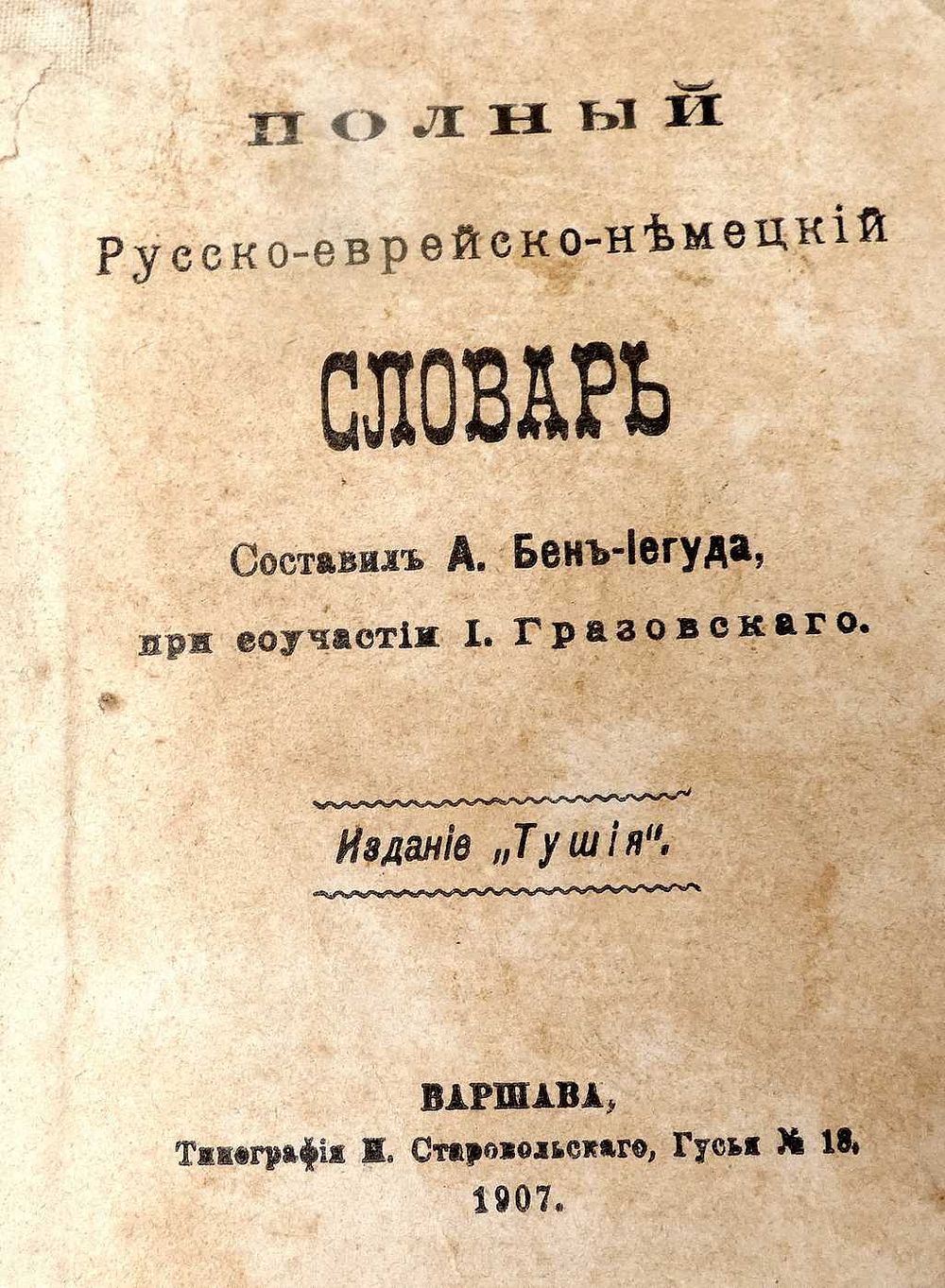
Complete Russian-Jewish-German Dictionary ed. by E. Ben-Yehuda and I. Grazovsky, 1907, Warsaw, ”Tushia” - Complete Russian-Jewish-German Dictionary, ed. by E. Ben-Yehuda and I. Grazovsky, 1907, Warsaw, ”Tushia” Compiled by E. Ben-Yehuda with the participation of I. Grazovsky. Published by ”Tushia”, Warsaw, Printing house of M. Starovolsky, 1907, 2256 columns (each page has 2 columns), the dictionary ends on the article of letter Ю (YU), not complete, the article of letter Я (YA) is missing Hard cover, size: 14.5 x 11 x 7 cm. Condition: cover worn, rubbed, tears to hinges, rubbing to edges of cover; foxing stains to many pages; the lower right corner is filled with ink, 2/3 of the pages, the text is not affected Weight: 780 gr. Eliezer Ben Yehuda[a] (born Eliezer Yitzhak Perlman;[b] 7 January 1858 – 16 December 1922)[1] was a Russian–Jewish linguist, lexicographer, and journalist who immigrated to Jerusalem in 1881, when the Ottoman Empire ruled it.[2][3] He is renowned as the lexicographer of the first Hebrew dictionary and also as the editor of Jerusalem-based HaZvi, one of the first Hebrew newspapers published in Palestine. Ben-Yehuda was the primary driving force behind the revival of the Hebrew language. Yehuda Gur (Hebrew: יְהוּדָה גוּר; 31 December 1862 – 21 January 1950), born Yehuda Leib Grozovski (Hebrew: Complete Russian-Jewish-German Dictionary, ed. by E. Ben-Yehuda and I. Grazovsky, 1907, Warsaw, ”Tushia” Compiled by E. Ben-Yehuda with the participation of I. Grazovsky. Published by ”Tushia”, Warsaw, Printing house of M. Starovolsky, 1907, 2256 columns (each page has 2 columns), the dictionary ends on the article of letter Ю (YU), not complete, the article of letter Я (YA) is missing Hard cover, size: 14.5 x 11 x 7 cm. Condition: cover worn, rubbed, tears to hinges, rubbing to edges of cover; foxing stains to many pages; the lower right corner is filled with ink, 2/3 of the pages, the text is not affected Weight: 780 gr. Eliezer Ben Yehuda[a] (born Eliezer Yitzhak Perlman;[b] 7 January 1858 – 16 December 1922)[1] was a Russian–Jewish linguist, lexicographer, and journalist who immigrated to Jerusalem in 1881, when the Ottoman Empire ruled it.[2][3] He is renowned as the lexicographer of the first Hebrew dictionary and also as the editor of Jerusalem-based HaZvi, one of the first Hebrew newspapers published in Palestine. Ben-Yehuda was the primary driving force behind the revival of the Hebrew language. Yehuda Gur (Hebrew: יְהוּדָה גוּר; 31 December 1862 – 21 January 1950), born Yehuda Leib Grozovski (Hebrew: יְהוּדָה לֵיבּ גְרָזוֹבְסקי) was a Russian-born Israeli linguist, educator, writer, and translator. He received the Bialik Prize for Jewish Thought in 1946. The Tushiya Publishing House. [Tushiya is a publishing house that played a prominent role in the development of Jewish literature. It was founded in 1897 by A. L. Shalkovich (see Ben-Avigdor) in Warsaw. From the first year of its foundation, the publishing house, in addition to a library for adults (see Biblioteka Iwrit, ib., 493), began publishing manuals and textbooks for school-age children. The publishing house also released several series of books for children: Nizonim - 100 issues, Perachim - 250, Bikurim - 200, Bibliotekah li-Bnei ha-Neurim - 300. In 1910, it began publishing ”Bibliotekah gedolah” (50 issues per year), which includes works by both medieval and modern authors. So far the following have been republished: poems by Samuil Ganagid, articles by Geiger, works by S. Rubin, parables by Sirach, stories by Brandstetter, etc.; published: collections of poems and verses by K. Shapiro, Yegalel, I. Katsenelson, D. Shimanovich, Fikhman; works by Berdichevsky, Klausner, Gorodetsky, S. Rosenfeld, etc. In 1911, Tushiya and other publishing houses (Progress, Shreberk, Shimin, Gashahar, etc.) united and founded the joint publishing house ”Central”.