Bidspirit auction | Max Eisler (Jewish Art Historian)
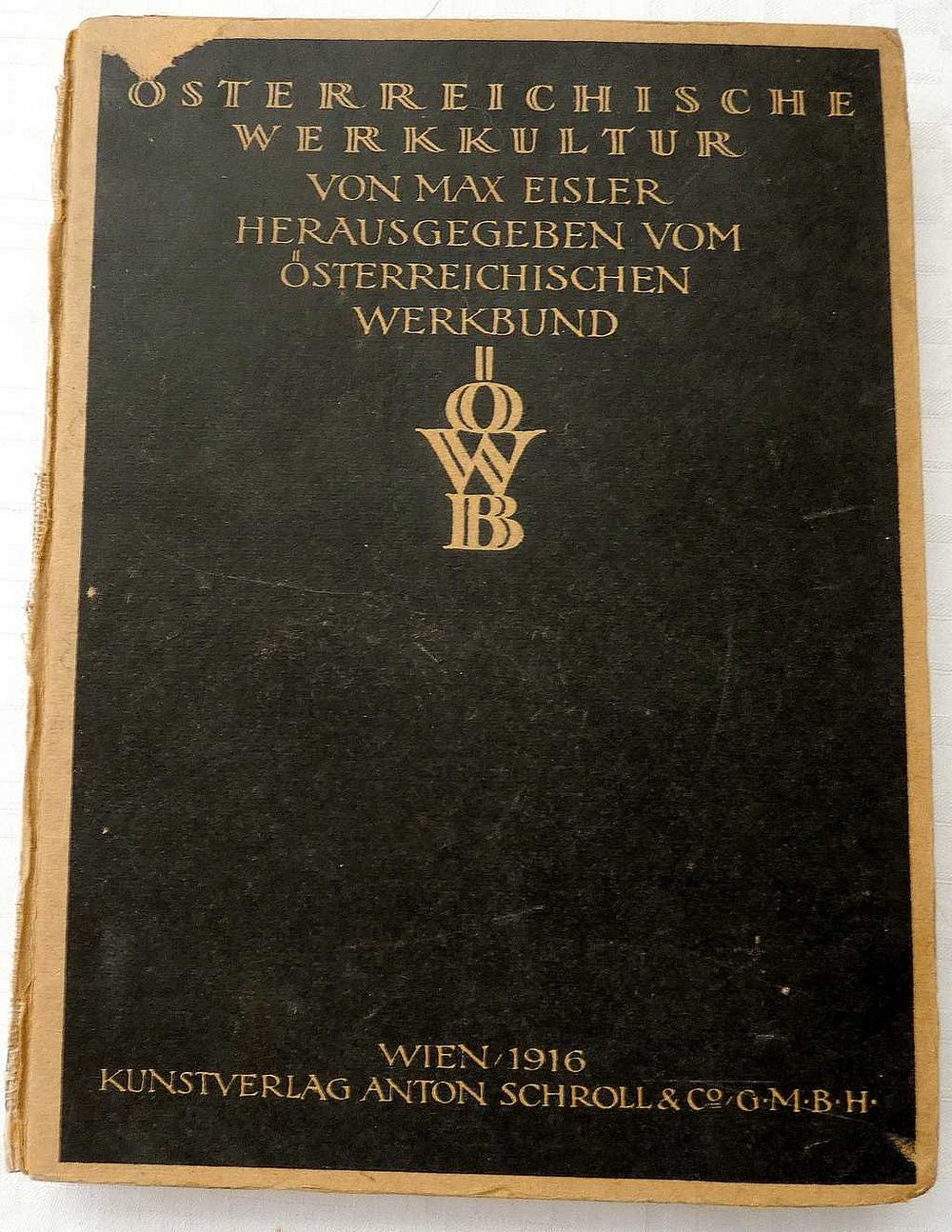
Max Eisler (Jewish Art Historian) “Oesterreichische Werkkultur”, illustr., 1st ed., 1916, Wien, in German - Max Eisler (Jewish Art Historian) “Oesterreichische Werkkultur”, illustr., 1st ed., 1916, Wien, in German Hrsg. (edited) vom Oesterreichischen Werkbund. Wien, Anton Schroll, 1916. 1. Aufl. 262 pp., throughout with b/w illustrations. Mit der Liste der Mitglieder des Oesterreichischen Werkbundes (With List of members of the Austrian Werkbund) Hard cover, size: 25.5 x 19 cm. Condition: covers detached, rubbed and stained, spine is missing; binding is loose – detached to several blocks. Weight: 990 gr. Max Eisler (1881 - 1937): A Forgotten Viennese Jewish Art Historian Max Eisler grew up in Boskowice . He studied art history in the Netherlands and in Vienna, as a student of Josef Strzygowski, and taught in a High School in Jihlava. From 1914 he taught art history at the University of Vienna. In many articles and publications Eisler wrote about Dutch painting, art history and architecture of Vienna, Oskar Strnad and Anton Hanak. His book on Gustav Klimt was translated into English. Eislers book Von juedischer Kunst (Josef Israels) deals with the definition of “Jewish Art”. In 1924/25 Eisler edited with Eugen Hoeflich and Josef Hahn the monthly Das Zelt. He wrote regularly for the journal Menorah about Jewish artists like Jehudo Epstein and Abel Pann, and new synagogues in Amsterdam, Plauen, Zilina and Hietzing. In 1936 he travelled to Palestine; he visited Meir Dizengoff and published his impressions. In his younger years Eisler was close to the Agudah. He wrote for Die jüdische Presse, and was a board member of the Jewish orphanage in Baden near Vienna. He also was an active member of the B’nai B’rith and of the historical commission of the Viennese Jewish community; nevertheless he critized its cultural policy. Eisler’s personality was unique in the combination of his orthodox conviction, his social commitment and his high achievements in his research area. He left no personal papers. His only son Martin was an architect in Argentinia. The Austrian Werkbund (OWB), founded in 1912 at the 5th annual meeting of the German Werkbund in Vienna, was an economic and cultural association of 178 artists, architects, entrepreneurs, and craftsmen. The German Werkbund served as its model, and its statutes were adopted almost entirely.[2] The goal of the Werkbund movement was the collaboration of the fine arts, architecture, and crafts, as well as the promotion of quality craftsmanship. The first general meeting took place on April 30, 1913. The first president was Adolf Freiherr Bachofen von Echt (1864–1947).[3] Alexander Pazzani, the general director of the Bohemian steelworks Poldihütte, became vice president. Among the co-founders of the ÖWB was Josef Hoffmann, who, however, only remained a member of the ÖWB until 1920.[4] He built the Austrian House at the large Cologne Werkbund Exhibition in 1914, which marked the first time the ÖWB exhibited.[5] Its inner courtyard and several exhibition rooms were designed by Oskar Strnad. Other founding members were Gustav Klimt, Koloman Moser, and Otto Prutscher, and from the younger generation, Josef Frank, Hugo Gorge, and Ernst Lichtblau, as well as state institutions such as the Ministry of Public Works and the Vienna School of Applied Arts, and companies such as J. & L. Lobmeyr and Johann Backhausen. A specially installed shop in the Grand Hotel served as a sales outlet for all members' products.[6] After the First World War in 1918, the Austrian Werkbund (ÖWB) was committed to social housing in Vienna. In 1920, tendencies towards division emerged, and the Werkbund Vienna was founded, in which Josef Frank participated, and in 1923 the Styrian Werkbund. In 1928, the association reunited with the Vienna Werkbund.[3] From 1930 to 1932, the Werkbundsiedlung Vienna was built under the direction of Josef Frank. The disintegration of the Austrian Werkbund began shortly after the Building Exhibition. In the course of the final split in 1934, the politically right-wing, conservative, and at times even latently anti-Semitic ”New Werkbund” was founded under the leadership of Clemens Holzmeister as a counterpoint to the existing, politically left-leaning Werkbund association under Josef Frank. In the same year, Josef Frank went into exile in Sweden. This marked the end of the ”old” Werkbund, before it was dissolved under the National Socialists in 1938.[7][8] After the war, there were attempts at a revival; several exhibitions took place in the 1950s, but a permanent reactivation of the Austrian Werkbund failed to materialize.