Bidspirit auction | 1913. Schauspiel in drei Aufzuegen
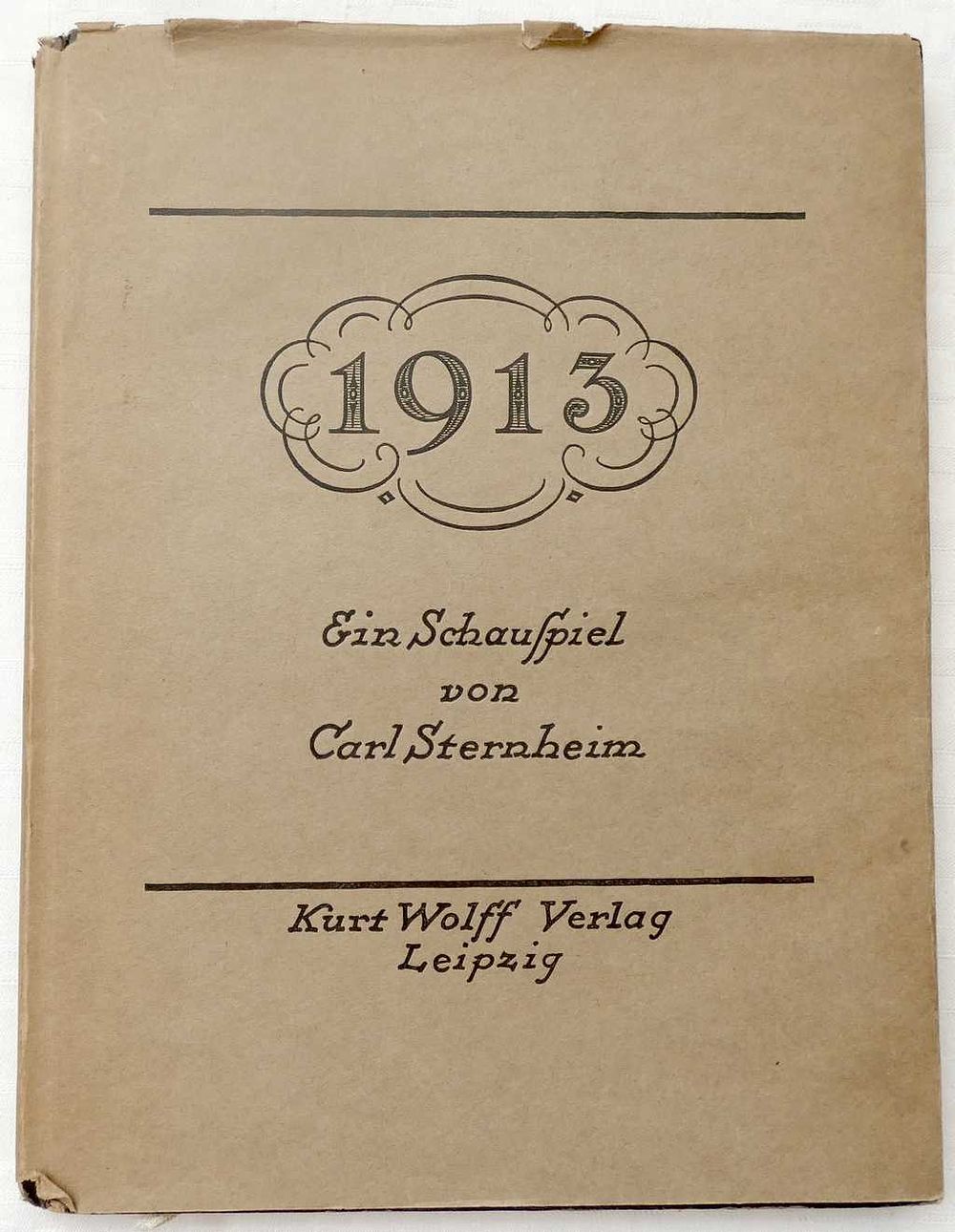
1913. Schauspiel in drei Aufzuegen von Carl Sternheim (Perished in Holocaust), illustr. by Ernst Stern, 1st ed., 1915, in German - 1913. Schauspiel in drei Aufzuegen von Carl Sternheim (Perished in Holocaust), illustr. by Ernst Stern, 1st ed., 1915, in German 1913. Play in three acts. Leipzig, Kurt Wolff, 1st ed., 1915., 100 pp., with drawings of Ernst Stern. Schwarzer Orig.-Halblederband mit Goldprägung. Hard cover, Black original binding with gold embossing, DJ, 26 x 20 cm. Condition: some discoloring to DJ, tears to edges; tear to front hinge of cover; good condition Weight: 450 gr. Carl Sternheim (1 April 1878, Leipzig – 3 November 1942, Brussels) was a German playwright and short story writer whose work is considered expressionist. Like Frank Wedekind, his works sharply criticized and ridiculed the moral principles that prevailed in Germany on the eve of World War I. Carl Sternheim was born into a family of a banker and a newspaper magnate, and grew up in Hanover and Berlin. From 1897 to 1902, he studied philosophy, psychology and law in Munich, Göttingen and Leipzig, but did not complete his education. After university, he led a restless life with many women and suffered from nervous disorders. Sternheim began his writing career in 1900 in Weimar, where he married Eugenie Hauth. Their marriage broke up in 1906, after which Karl married Thea Löwenstein, née Bauer, who bore him two children. Thea was the daughter of a wealthy manufacturer and helped her husband build the Bellemaison Palace in Munich. Here, in a house decorated with works of art from his own collection, Sternheim worked in the company of such creative people as Mechtilde Lichnowsky, Max Reinhardt and Frank Wedekind. From 1908, Sternheim published the magazine Hyperion together with Franz Blei. In 1912, Sternheim moved to Belgium, and in 1918, fleeing World War I, to St. Moritz and Uttwil in Switzerland. In 1927, Karl and Thea divorced. Sternheim's third wife was Frank Wedekind's daughter, actress and singer Pamela Wedekind; their marriage lasted from 1930 to 1934. And from 1935 he lived with Henriette Carbonara in exile in Belgium, where in 1936 he published his memoirs under the title Vorkriegseuropa im Gleichnis meines Lebens ( Sternheim's works were banned by the Nazis. The reason for this was not only his Jewish origin, but also the merciless ridicule of the moral decay of the German bourgeoisie in his works. On November 3, 1942, after the German occupation of the Netherlands and Belgium, Sternheim committed suicide. He is buried in the Ixelles cemetery in the suburbs of Brussels. Sternheim's circle of friends included Gottfried Benn, Karl Einstein, Franz Pfemfert, Walther Rathenau, Ernst Stadler, Hugo von Tschudi, Fritz von Unruh and Otto Vrieslander. For a time, Sternheim was close to the expressionists who published the magazine Die Aktion. In 1915, Sternheim donated the money from the Fontana Prize awarded to him to the then unknown Franz Kafka.Ernst Stern (1 April 1876 – 28 August 1954) was a Romanian-German scenic designer who, through his collaborations with most of the prominent German directors of the early 20th century, helped define the aesthetic of expressionism in both the theatre and the cinema. Born in Bucharest, Romania, to Jewish parents of Russian, German and Hungarian origin, Stern studied under Nikolaos Gyzis and Franz Stuck at the Academy of Fine Arts, Munich beginning in 1894. Drawing by Ernst Stern for the scene ”Before the harem” in Sumurûn from Friedrich Freksa to Kammerspiele in 1910 Stern moved to Berlin in 1905, where Max Reinhardt hired him the next year as a set designer for the Deutsches Theater. He remained Max Reinhardt's main design collaborator until the director's departure in 1921 and designed roughly ninety shows during that time, with notable works including adaptations of William Shakespeare's Twelfth Night (1907), Hamlet (1909), and A Midsummer Night's Dream (1913), Karl Vollmöller's The Miracle (1911), Reinhard Sorge's The Beggar (1917), and Henrik Ibsen's John Gabriel Borkman (1917). Under Reinhardt, the Deutsches Theater became a center of German Expressionist Theater, so Stern designed many sets in that style. As Stern's design aesthetics tended towards serenity and realism, however, this pairing was not always successful. Perhaps his most noteworthy expressionist work was Paul Leni's 1924 silent film Waxworks (1924), for which he designed the costumes. Stern collaborated at some point with nearly all the important German film directors of the period, including F.W. Murnau, Ernst Lubitsch, Richard Oswald, Carl Froelich, and William Dieterle. In 1924, Stern moved on to the Großes Schauspielhaus, where he designed for a number of musical revues and the popular musical The White Horse Inn (1930). In the late 1920s, Stern also began spending considerable time in London,