Bidspirit auction | Collection of 8 old Books
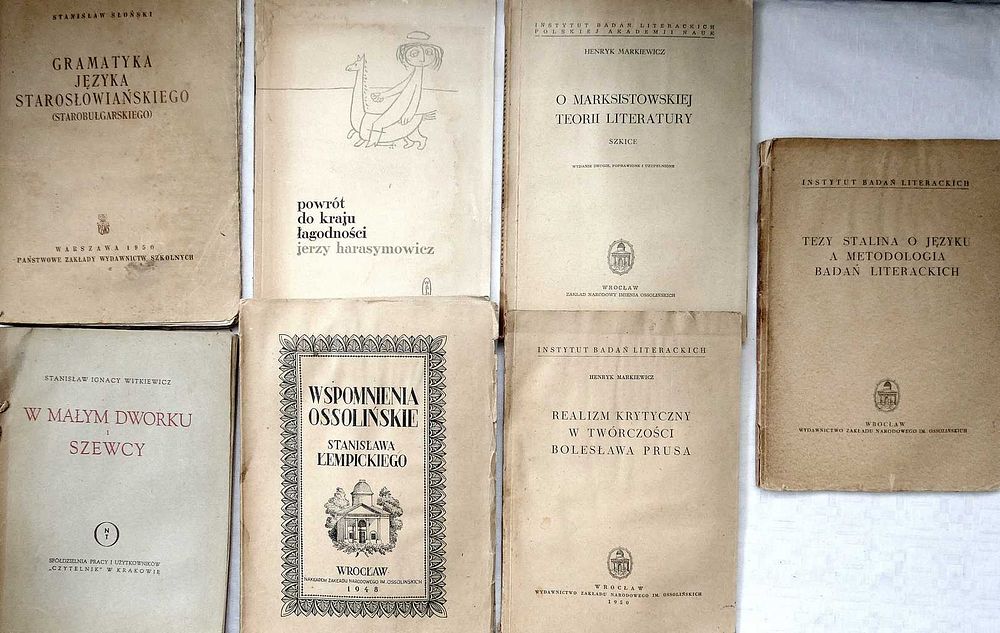
Collection of 8 old Books in Polish, Book of St. Slonski with his dedication, illustr., 1940-1950’s - Collection of 8 old Books in Polish, Book of St. Slonski with dedication, illustr., 1940-1950’s Stanistaw Slonski, his Autograph / dedication on book “Gramatyka… 1950” Some of them illustrated Soft covers, size ca. 25 x 18 cm. Different condition, damping Total weight: 1540 gr. Stanistaw Slonski (born October 9, 1879, in Michałowice, died March 8, 1959, in Warsaw) – Polish linguist and Slavicist. He was born into the large family of Franciszek (d. 1907) and Maria née Fagońska (d. 1910).[1][2] In 1898, he graduated from the 5th Gymnasium in Warsaw and then studied at the Jagiellonian University. However, he returned to Warsaw and studied law at the Imperial University of Warsaw, graduating in 1903. He later began his studies at German universities in Heidelberg, and primarily in Leipzig (1904–1907). After returning to Warsaw, he taught Polish at five Warsaw gymnasiums for eight years (1907–1915), including the Marian Rychłowski Gymnasium.[3] He became vice-president of the Polish Teachers' Union[1]. From 1907 to 1918, he lectured in Polish at the Faculty of Humanities of the Society for Scientific Courses in Warsaw[4]. After the founding of the University of Warsaw in 1915, he organized and first directed the ”Slavic Seminar” at the Faculty of Humanities at that university. Due to his personal interests, he gave it a West and South Slavic linguistic profile. In 1920, he volunteered in the Polish Army[1]. In 1924, he became a professor at the University of Warsaw. In 1935, he lectured at the University of Sofia[1]. In 1936, he co-founded the Society of Friends of the Serbo-Lusatian Nation at the University of Warsaw, of which he became president. In 1908, he became a member of the Warsaw Scientific Society, and in 1934, of the Polish Academy of Arts and Sciences. From 1927 to 1939, he was co-editor of the annual ”Prace Filologiczne, ” the oldest Polish linguistic journal. After the war, he was involved in the work of the Slavic Committee in Poland. From 1903, he was married to Łucja née Jaczynowska (1879–1968)[2][5]. His nephew was Tadeusz Fritz. He died in Warsaw and is buried at the Powazki Cemetery.