Bidspirit auction | WWII Poland The District Governor
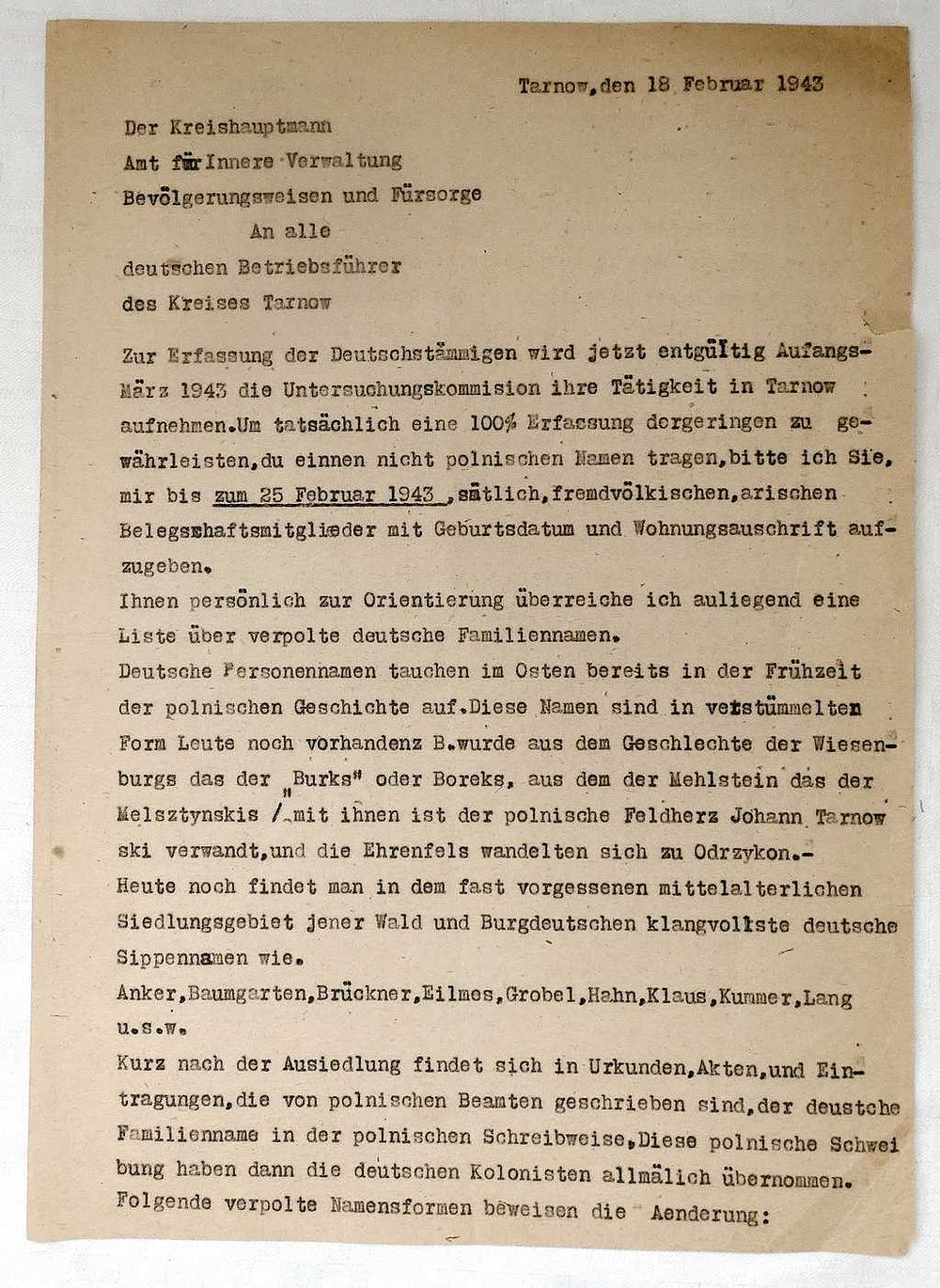
WWII Poland The District Governor A. Kipke. Order to all German business managers to registrate persons of German descent, Tarnow, 1943, in German, Rare! - WWII Poland The District Governor A. Kipke order to all German business managers to registrate persons of German descent, Tarnow, 1943, in German The document translated into English. Tarnow, 18 February 1943 The District Governor Office for Internal Administration Department of Population Affairs and Welfare To all German business managers of the Tarnow district For the registration of persons of German descent, the Investigation Commission will finally begin its work in Tarnów at the beginning of March 1943. In order to truly ensure a 100% registration of those who bear non-Polish names, I request that you submit to me, by 25 February 1943, all non-Polish, Aryan members of your staff, with date of birth and residential address. For your personal orientation I enclose a list of corrupted German family names. German personal names have already appeared in the East in the early period of Polish history. These names, in distorted form, still exist. For example, from the family of Wiesenburgs came “Burks” or “Boreks, ” from “Mehlstein” came “Melsztynskis.” Connected with them is the Polish field marshal Johann Tarnowski, and “Ehrenfels” was transformed into “Odrzykon.” Even today, in the almost forgotten medieval settlement areas of the Forest and Castle Germans, one still finds resounding German clan names such as: Anker, Baumgarten, Brückner, Eilmes, Grobel, Hahn, Klaus, Kummer, Lang, etc. Shortly after resettlement, in documents, files, and entries written by Polish officials, German family names were recorded in Polish spelling. This Polish form was then gradually adopted by German colonists. The following corrupted forms of names prove this change: Ascheing – Achtzink Aman – Amman, Amtmann Andrass – Andreas Bachowski – Bach Aker – Acker Ankier – Anker, Anger Bachman – Bachmann Bagjier – Beuger, Bayer etc. Among leading families there may here and there, for personal reasons, also have been deliberate changes of name, as the following historically documented alterations prove: Alebitzki – Ahlebeck, Hutten, Czapski – von Hutten Kochanski – Kochenstein, Kętrzyński – Winkler, etc. Thus, over the centuries, the body of names of the German settlers in the East has changed. But the people themselves have, in essence, remained the same. Under the slogan “Volk will zu Volk, Blut zu Blut” (“People to people, blood to blood”), we are striving to register all those of German descent within the district of Tarnow. I again request your assistance in this registration and ask you to also report those people outside your staff who are not yet known to this office, but who meet the requirements for recognition as persons of German descent. F.d.R. Wedekind mp. Signed Dr. Kipke / District Governor / This document comes from Tarnow, 1943, during the German occupation of Poland in World War II. They are administrative directives issued by Dr. Alfred Kipke, the Kreishauptmann (District Governor) of Tarnow, representing the Nazi civil administration. The main purpose of these orders was: Registration of Volksdeutsche (ethnic Germans): German authorities wanted to identify and officially record all people of German descent living in the Tarnów district. Focus on surnames: Since many German families in Poland had over the centuries adopted polonized forms of their names, the authorities circulated lists of “corrupted” or “altered” names. Business managers were ordered to submit, by 25 February 1943, the personal data (birth dates and addresses) of employees with “non-Polish, Aryan” names. The documents emphasize that although names may have changed, “the people remained the same in essence.” The Nazi racial slogan “Volk will zu Volk, Blut zu Blut” was used to underline the idea of racial unity and the inclusion of all ethnic Germans in the Nazi Volksgemeinschaft (“people’s community”). Such lists were part of the Umvolkung policy — the re-Germanization of people in occupied territories. Being recognized as “German” brought privileges under occupation (better rations, exemption from forced labor, administrative positions). Conversely, Poles and Jews were excluded, marginalized, or persecuted. This bureaucratic process was an essential part of the racial segregation and colonization program in the General Government (occupied Poland). About Dr. Alfred Kipke born 1898 in Germany, trained as a lawyer, joined the Nazi Party in 1933. Served as district administrator in several regions, and from 1942 he was District Governor of Tarnow. He oversaw racial and adminis