Bidspirit auction | The Story of the Lorch
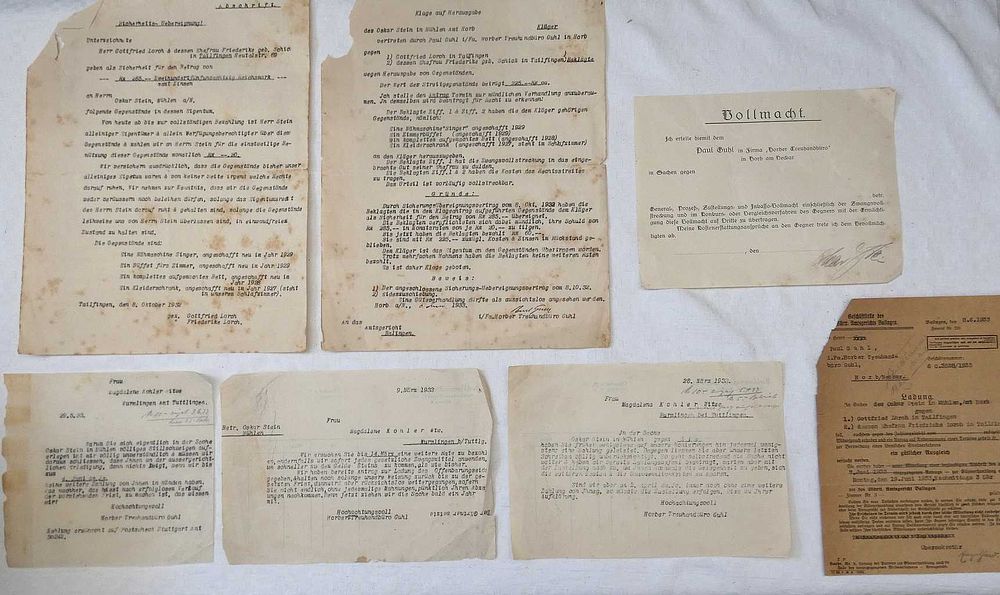
The Story of the Lorch Family and the Debt to Oskar Stein, 7 court documents, (1932–1933), in German - The Story of the Lorch Family and the Debt to Oskar Stein, 7 court documents, (1932–1933), in German The page on the Jewish community in Muehlen (district of Horb) lists Oskar Stein, resident of Lammstrasse 5, until 1936 - this is a list of members/families of the local Jewish community. Different condition: stains, brown paper, tears. The History of the Lorch Family and the Debt to Oskar Stein (1932–1933) Beginning: Loan and Property Collateral In the autumn of 1932, Gottfried Lorch and his wife Friederike (née Schick) from the city of Tallingen found themselves in financial difficulties. They borrowed 285 Reichsmarks from a local businessman, Oskar Stein from Mühlen (Amt Horb). To obtain this loan, the Lorchs signed a property collateral agreement (October 8, 1932). They pledged the following as collateral: Singer sewing machine (purchased in 1929), sideboard for the room (1929), folding bed (1928), wardrobe (1927, stood in their bedroom). Formally, these things became the property of Stein. The Lorchs could only use them until the debt was repaid, but they were obliged to pay him 20 marks monthly for use. Development of the conflict: Stein's lawsuit Almost a year passed, but the Lorchs did not return the money. In the spring of 1933, Stein, through his authorized representative Paul Guhl (Horber Treuhandbüro Guhl), filed a lawsuit against the Lorchs. In the lawsuit (1933), he demanded: to recognize his right of ownership of the furniture, to oblige the Lorchs to return the items, to collect legal costs from them. The court found his demands justified, since the debt had not been repaid. Reminders and pressure on debtors In March 1933, the Guhl company sent a reminder (a letter to Magdalena Koehler, a widow connected with the case). The letter emphasized that at least partial payments had been received previously, but now the debtors had stopped paying. They were given until 2 April 1933, otherwise the case would be transferred to the bailiffs. Powers of attorney and formalities In order to conduct the case, Stein issued a power of attorney (Vollmacht) to Paul Guhl, which gave him the right to represent him in court, collect debts, and, if necessary, delegate these powers to third parties. March 9, 1933 Address: Oskar Stein in Muehlen And Mrs. Magdalene Koler, Widow, Wuermlingen, Tuttlingen We request that you pay another installment by March 14th, otherwise we will immediately use every legal means of enforcement to obtain the money more quickly than before. We have already filed a motion to summon the court of disclosure and will withhold our instructions until the deadline set. After that, however, we will proceed without hesitation unless you finally meet your payments on time without further reminders. We will now be dragging this out for almost a year. Sincerely, Horber Treuhandbuero Guhl 3.6.33 Why you are actually imposing complete silence on yourself regarding the Oskar Stein case in Muehlen is completely incomprehensible to me, and we must conclude that you are not interested in an out-of-court settlement if we have not received any further payment from you by June 4 of this year. We know that this will have to be done later, that is, after the aforementioned deadline has passed without success! Sincerely, Horber Treuhandbüro Guhl Payment requested by postal check, Stuttgart Amt 30242. Trial On 8 June 1933, the district court of Balingen summoned the parties to a hearing. The case was considered a dispute over the return of property. The court set the date - 19 June 1933 at 15:00. The defendants (Gottfried and Friederike Lorch) were required to appear in person or send a representative with a notarized power of attorney. Otherwise, the court threatened to rule against them without their participation. The Lorch family story is an example of how a small debt (285 Reichsmarks) could lead to loss of property and a lawsuit in the early 1930s. In 1932, the Lorchs pawned their furniture to raise money. In 1933, they found themselves in court after failing to repay the money. Stein demanded the items back as their rightful owner. The court in Balingen took up the case and sought to reach a decision in the summer of 1933. Thus, the Lorchs not only lost their money, but also almost all of their main household property. Additionally: the LEO-BW certificate for Muehlen confirms the presence of a Jewish community there; ”the last three Jewish residents left after 1933” - which agrees well with the entry for Stein before 1936.