Bidspirit auction | Hermann Fechenbach (1897-1986), ”For the
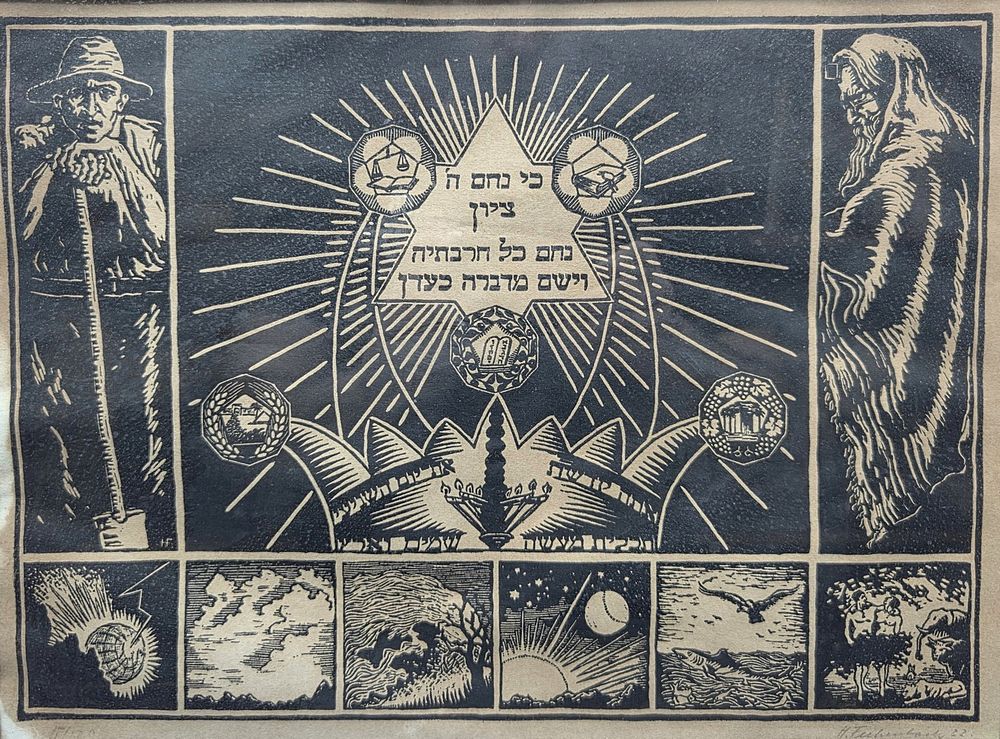
Hermann Fechenbach (1897-1986), ”For the Lord comforts Zion” - Hermann Fechenbach (1897-1986), ”For the Lord comforts Zion”, an original woodcut by the artist, decorated with Jewish and Zionist motifs. At the bottom are six small frames depicting the six days of creation, and above them one large frame depicting the Sabbath: a crown with a section from the evening prayer of the Sabbath (”You have sanctified the seventh day, the purpose of all the work of heaven and earth”) and a hanging Sabbath menorah; above it a Star of David shining with light and containing the verse ”For the Lord comforts Zion; He comforts all her ruins and makes her wilderness like Eden” (Isaiah 5:3). On the edges of the crown and the Star of David are five medallions representing the three feasts, Rosh Hashanah and Yom Kippur. In two additional frames, right and left: a figure of a Jew wearing a tallit placing tefillin and a figure of a Hebrew pioneer holding a shovel. Signed in pencil at the bottom and dated 1922. Numbered 4/100. Framed under glass with a white passepartout in a wooden frame with a silver metal stripe decoration. Dimensions: 38X54 cm. Frame: 46.5X57.5 cm. In good condition: brown paper, light folds in the paper mainly in the left margins. *** Buyer's attention! The painting will be sent with the frame but without the glass ** * Hermann Fechenbach, a Jewish painter, graphic artist and printmaker, born in Germany. He fought and was seriously injured in World War I, in which he lost his left leg. He studied art in Erfurt and Stuttgart, and worked in design and painting. With the intensification of the persecution of Jews in Germany, he immigrated with his wife to Israel, where he was unable to be assimilated, and in May 1939 he emigrated to England, where he made a living as an artist. In 1940 he was imprisoned as an ”enemy state subject” in the Hutchinson Internment Camp on the Isle of Man, alongside many other German and Austrian Jews. He spent about ten months there, during which he created a series of linoleum cuts called ”My Impressions as Refugee”. After his release he remained in England, where he continued his artistic work until his death. See: Judaica Katalog: Abteilung Jüdisches Museum by Vera Bendt. Berlin: Berlin Museum, 1989., page 377.