Bidspirit auction | Karl Wilczynski, Holocaust Suvivor “Kurzgeschichten”.
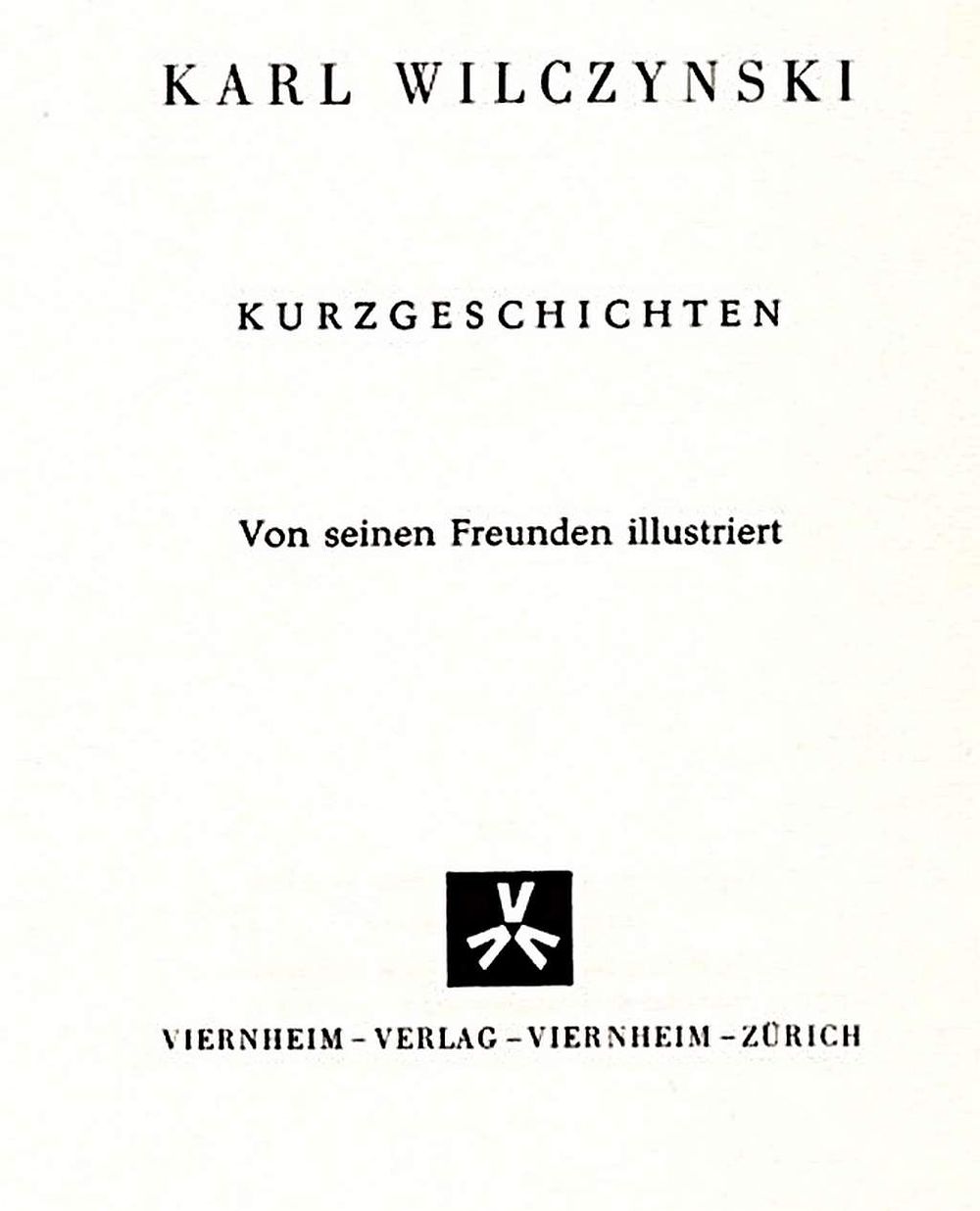
Karl Wilczynski, Holocaust Suvivor “Kurzgeschichten”. Von seinen Freunden illustriert und signiert, Ex. 219 von 350, 1st ed., in German, 1962 - Karl Wilczynski, Holocaust Suvivor “Kurzgeschichten”. Von seinen Freunden illustriert und signiert, Ex. 219 von 350, 1st ed., in German, 1962 Illustrated and signed by his friends Zurich: Viernheim Verlag, 1962., 37, (6) pp., First edition. The illustrations are original linocuts each sheet is signed by the artist, and the colophon contains the publisher's signature. The illustrations by Arnold d’Altri, Erwin von Fluee, Roland Forster, Adolf Herbst, Herta Hausmann, Fred (Engelbert) Knecht, Reinhard Liess, Willi Reischert and Sami Wuelser are hand-signed. Numbered Edition, Copy 219 of 350. Hard cloth cover with red spine label in leather, size: 23x 19 cm., Condition: some wear and discoloring to cover; yellowing to near edges internally; light brown paper to endpapers. Weight: 320 gr. Karl Wilczynski (1884–1959) was a German writer, journalist, lyricist, and cabaret author of Jewish descent. He was born on 4 September 1884 in Grünberg, Silesia, and died on 13 February 1959 in Mannheim, Germany. In the 1910s–1920s he became well known in Berlin’s cultural scene. He wrote war poems during WWI and later worked in cabaret, radio, film, and popular music. Wilczynski cooperated with major composers of the era and wrote lyrics for many popular songs (Schlager) and several early sound films. He also worked as a dramaturge and even acted in experimental sound-film productions. After 1933, because he was classified as “of Jewish descent”, he was banned from working. He fled Germany, lived first in Switzerland and then in Paris. During WWII he was interned in French camps, including Gurs and Les Milles. In 1942 he escaped back to Switzerland and survived the war there. He settled in Zuerich and later Viernheim (Germany), where he continued writing and participated in rebuilding cultural life, including the local adult education center. He spent his final years in Mannheim. Viernheim honored him with an official honorary grave. Wilczynski’s literary estate is preserved in the German Exile Archive 1933–1945. His work spans poetry, cabaret, radio, film scripts, and popular song lyrics, making him a representative figure of Weimar culture whose career was interrupted by Nazi persecution Artists: Arnold D'Altri (1904–1980) Swiss (Italian-Swiss) sculptor, plastic artist, painter, and teacher. Born in Cesena, he lived in Switzerland from 1905, studied in Zurich, worked in sculpture, participated in the Venice Biennale (1948), and later taught at the Werkkunstschule Kassel. In addition to sculpture, he produced graphic works and lithographs; one of his sheets was printed especially for this book by Wilczynski in a limited edition of 350 copies. Adolf Herbst (1909–1983) Swiss artist and draftsman. Born in Emmen (canton of Lucerne), he initially worked as an architect, then studied painting in Paris (student of Othon Friesz). He painted nudes, interiors, portraits, and still lifes, as well as monumental works (for example, sgraffito in Emmenbruecke). (Gloggner Auktionen) Herta Hausmann (b. 1892) Austrian graphic artist, working in drawing and printmaking techniques (themes include cityscapes, figures, and nudes). Listed in catalogues as a zeichnerin (draftswoman), she participated in post-war exhibitions; her prints (for example, ”View of Rome”) are sold on the art market. Fred (Fred Engelbert) Knecht (1934–2010) Full name: Alfred Engelbert Knecht. Swiss artist: painter, draftsman, etcher, illustrator, silkscreen artist, photographer, and performance artist. Born in Duebendorf, died in Thalwil. Known for his photo collages and experimental graphics, he participated in exhibitions of Swiss modernism and concrete art. Reinhard Liess (b. 1937) This is almost certainly the same person: Reinhard Liess, a German art historian born in Silesia and later a professor of art history (Braunschweig, Regensburg, Osnabrueck). He is the author of fundamental studies on Bruegel, Dürer, Velazquez, and others In the late 1950s and early 1960s, Liess also worked as a graphic artist: for the publishing house Viernheim, he created original linocuts for books, such as ”Fuenf Minuten nach dem Tode” (Funf Minuten nach dem Tode), which included five full-page linocuts signed by the artist. Willi Reischert (1921–1988) German artist, originally from Viernheim. After training as a house painter and serving in World War II, he became an independent ”Kunstgewerbler” (artist) and painter. He attended the Abendakademie Mannheim and, from 1950, was a member of the Artists' Association of Baden-Württemberg. He later lived and worked in New York; his estate (approximately 100 works) is housed in the city's archives and museum. Sami Wuelser Very little information about him is available in open sources.