Bidspirit auction | Judaica Old Typed article ”Das
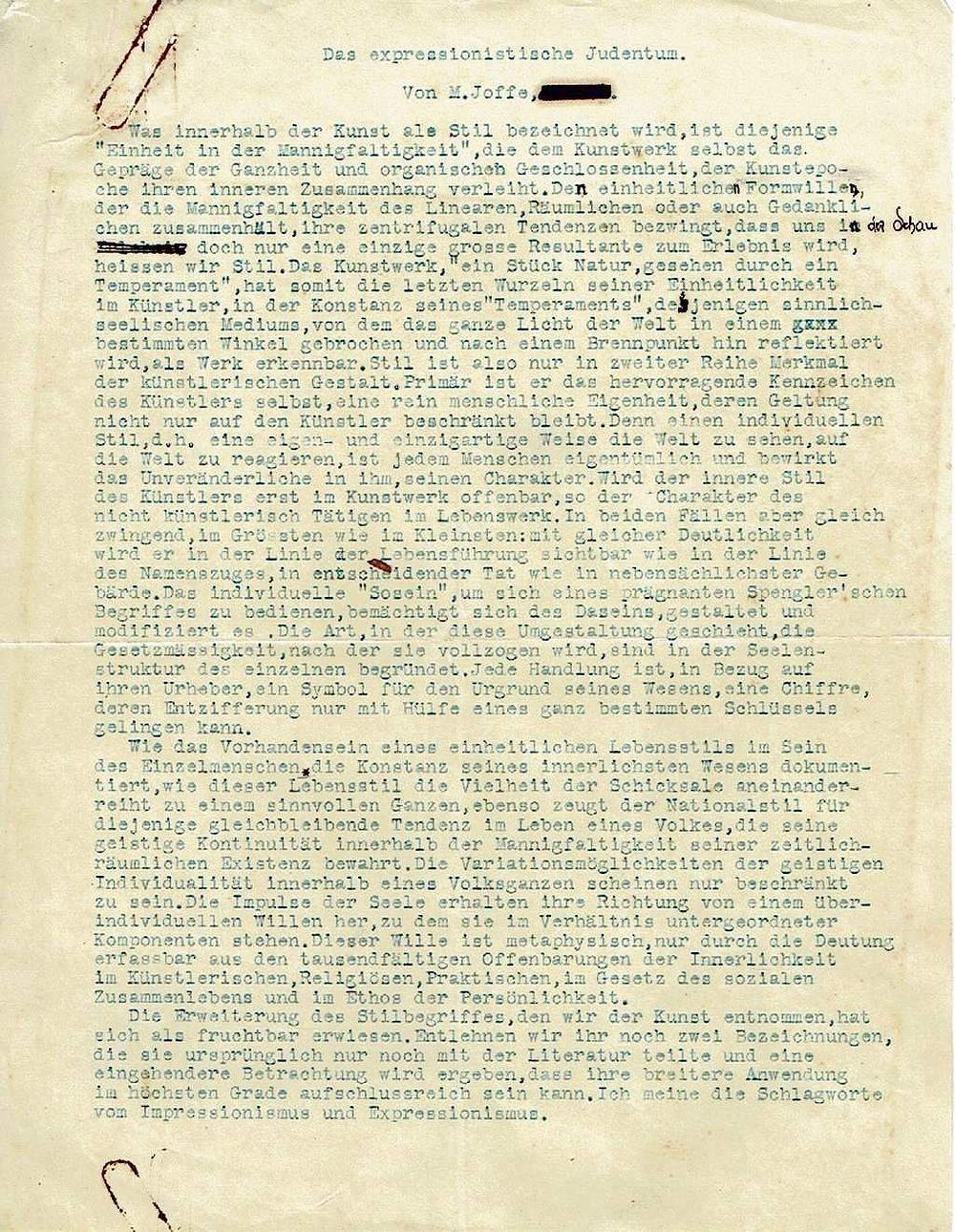
Judaica Old Typed article ”Das expressionistische Judentum” By M. Joffe In German - Judaica Old Typed article ”Das expressionistische Judentum” By M. Joffe In German Antique Article “Das expressionistische Judentum” by M. Joffe, typed, in German 6 pages with notes of the author, size: 29 x 22 cm. (11.4 x 8.6 inches) Light wear. Translation of the first page. The text discusses what constitutes **style** in art and applies these ideas to **Jewish expressionism**. According to the author, a style emerges when the diverse elements of an artwork are unified into one coherent whole. A true work of art reveals the artist’s inner nature and temperament through the consistency of form, emotion, and spiritual expression. The author argues that *style* is not merely an artistic category but an expression of a deeper unity within the individual and, by extension, within a people or nation. Every person, when reacting authentically to the world, shows a distinctive style that shapes their life and creativity. This style reveals the inner structure of the soul, which the text describes as the essential determinant behind artistic and human actions. Extending this to **Jewish culture**, the author emphasizes that a people also possesses a unified inner life-style. Despite apparent diversity in experiences and external conditions, a nation expresses an internal spiritual continuity. In the case of the Jewish people, this unity of inner being manifests through religious, ethical, and social practices, as well as through art and personal character. The text suggests that the Jewish artistic temperament – particularly in expressionism – stems from a metaphysical will and a psychological tendency to search for unity beneath surface complexity. Jewish expressionist art becomes a symbolic revelation of the inner spiritual essence of the Jewish people. Finally, the author notes that the artistic concepts used to describe style were borrowed from art theory but can be applied broadly to literature and to the study of ethnic or national psychology. Impressionism and Expressionism are mentioned as examples of stylistic labels that, once developed in art, can explain wider cultural patterns.