Bidspirit auction | Collection of 4 Antique Lithographed
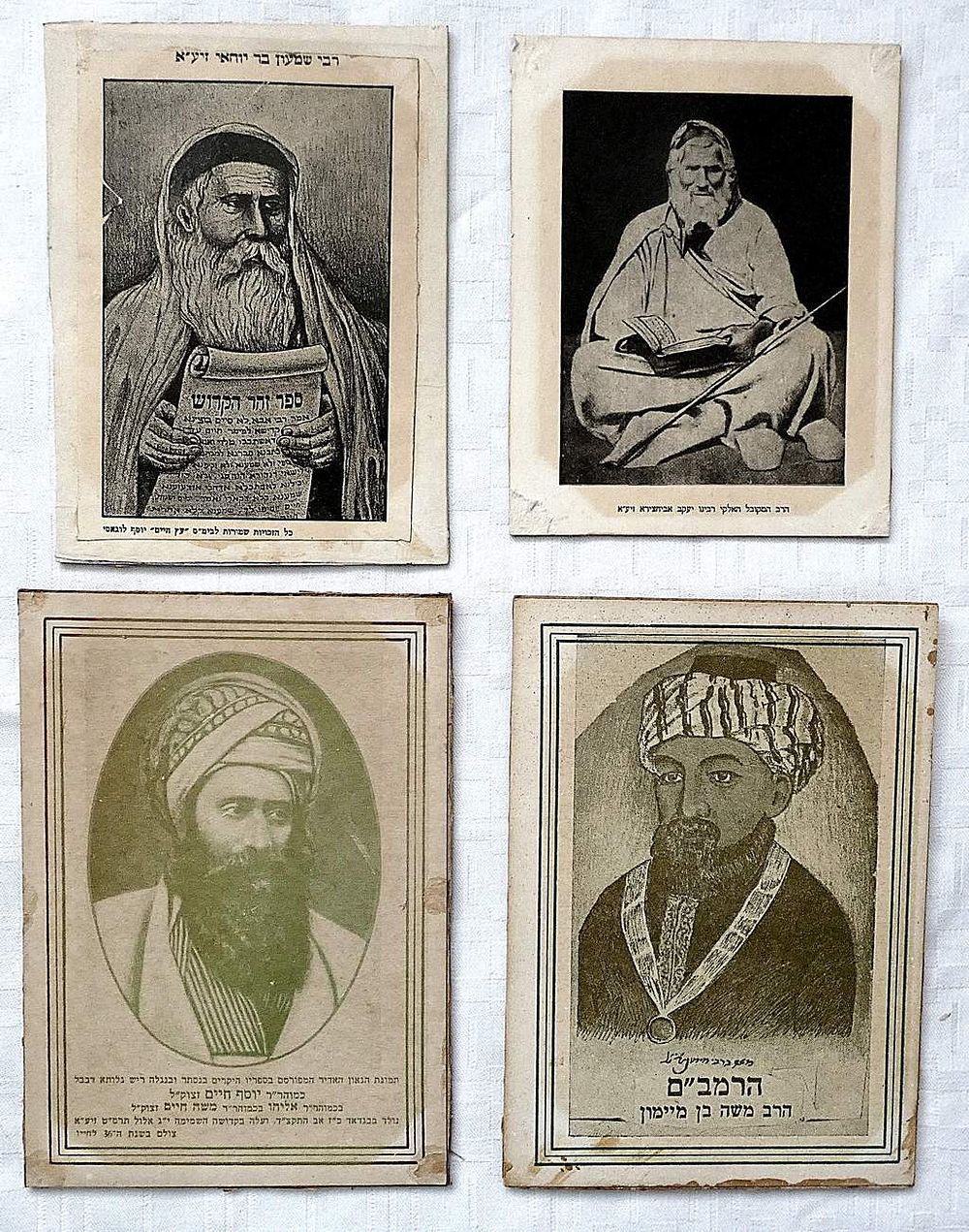
Collection of 4 Antique Lithographed Portraits of Great Rabbis. - Collection of 4 Antique Lithographed Portraits of Great Rabbis. 1. Rabbi Shimon bar Yochai (Rashbi) - author of the Zohar. 2. Rabbi Yaakov Abuhatzeira (Abir Yaakov) - a Moroccan kabbalist. 3. Rabbi Yosef Chaim of Baghdad (Ben Ish Chai) - a great rabbi and kabbalist. 4. Rabbi Moshe ben Maimon (Rambam) - was a Sephardic Jewish rabbi Sizes: 17 x 12 cm. (6.7 x 4.7 inches) 15 x 11 cm. (5.9 x 4.3 inches) 14 x 11 cm. (5.5 x 4.3 inches) Some wear, yellow paper Shimon bar Yochai (Zoharic Aramaic: שמעון בר יוחאי, Šimʿon bar Yoḥay) or Shimon ben Yochai (Mishnaic Hebrew: שמעון בן יוחאי), [note 1] also known by the acronym Rashbi, [note 2] was a 2nd-century tanna or sage of the period of Roman Judaea and early Syria Palaestina. He was one of the most eminent disciples of Rabbi Akiva. The Zohar, a 13th-century foundational work of Kabbalah, is ascribed to him by Kabbalistic tradition, but this claim is universally rejected by modern scholars Rabbi Yaakov Abuhatzeira (Hebrew: יעקב אבוחצירא, Yiddish: יעקב אבוחצירא) also known as the Abir Yaakov and Abu Hasira (1806–1880), was a leading Moroccan-Jewish rabbi of the 19th century. Yosef Hayim (1 September 1835 – 30 August 1909) (Iraqi Hebrew: Yoseph Ḥayyim; Hebrew: יוסף חיים מבגדאד; or Yosef Chaim) was a leading Baghdadi hakham (Sephardi rabbi), authority on halakha (Jewish law), and Master Kabbalist. He is best known as author of the work on halakha Ben Ish Ḥai (בן איש חי) (”Son of Man (who) Lives”), a collection of the laws of everyday life interspersed with mystical insights and customs, addressed to the masses and arranged by the weekly Torah portion. Moses ben Maimon, [a] commonly known as Maimonides[b] and also referred to by the Hebrew acronym Rambam, [c] was a Sephardic Jewish rabbi who is widely acknowledged as one of the most prolific and influential Torah scholars of the Middle Ages. Originally from Córdoba, where he was born on Passover Eve of 1135 or 1138,[d] his family was exiled from Muslim-ruled Spain when they refused to convert to Islam shortly after the Almohad Caliphate conquered the Almoravid Caliphate in 1148.[6][7][8] Over the course of the next two decades, Maimonides resided in Fez, Acre, Jerusalem, Alexandria, and Cairo before finally settling in Fustat between 1168 and 1171. During this period, he advanced his vocations and became renowned for his achievements as an astronomer, philosopher, and physicianCollection of 4 Antique Lithographed Portraits of Great Rabbis. 1. Rabbi Shimon bar Yochai (Rashbi) - author of the Zohar. 2. Rabbi Yaakov Abuhatzeira (Abir Yaakov) - a Moroccan kabbalist. 3. Rabbi Yosef Chaim of Baghdad (Ben Ish Chai) - a great rabbi and kabbalist. 4. Rabbi Moshe ben Maimon (Rambam) - was a Sephardic Jewish rabbi Sizes: 17 x 12 cm. (6.7 x 4.7 inches) 15 x 11 cm. (5.9 x 4.3 inches) 14 x 11 cm. (5.5 x 4.3 inches) Some wear, yellow paper Shimon bar Yochai (Zoharic Aramaic: שמעון בר יוחאי, Šimʿon bar Yoḥay) or Shimon ben Yochai (Mishnaic Hebrew: שמעון בן יוחאי), [note 1] also known by the acronym Rashbi, [note 2] was a 2nd-century tanna or sage of the period of Roman Judaea and early Syria Palaestina. He was one of the most eminent disciples of Rabbi Akiva. The Zohar, a 13th-century foundational work of Kabbalah, is ascribed to him by Kabbalistic tradition, but this claim is universally rejected by modern scholars Rabbi Yaakov Abuhatzeira (Hebrew: יעקב אבוחצירא, Yiddish: יעקב אבוחצירא) also known as the Abir Yaakov and Abu Hasira (1806–1880), was a leading Moroccan-Jewish rabbi of the 19th century. Yosef Hayim (1 September 1835 – 30 August 1909) (Iraqi Hebrew: Yoseph Ḥayyim; Hebrew: יוסף חיים מבגדאד; or Yosef Chaim) was a leading Baghdadi hakham (Sephardi rabbi), authority on halakha (Jewish law), and Master Kabbalist. He is best known as author of the work on halakha Ben Ish Ḥai (בן איש חי) (”Son of Man (who) Lives”), a collection of the laws of everyday life interspersed with mystical insights and customs, addressed to the masses and arranged by the weekly Torah portion. Moses ben Maimon, [a] commonly known as Maimonides[b] and also referred to by the Hebrew acronym Rambam, [c] was a Sephardic Jewish rabbi who is widely acknowledged as one of the most prolific and influential Torah scholars of the Middle Ages. Originally from Córdoba, where he was born on Passover Eve of 1135 or 1138,[d] his family was exiled from Muslim-ruled Spain when they refused to convert to Islam shortly after the Almohad Caliphate conquered the Almoravid Caliphate in 1148.[6][7][8] Over the course of the next two decades, Maimonides resided in Fez, Acre, Jerusalem, Alexandria, and Cairo before finally settling in Fustat between 1168 and 1171. During this period, he advanced his vocations and became renowned for his achievements as an astronomer, philosopher, and physician—even being appointed to serve as personal physician to Saladin of the Ayyubid Sultanate.