Bidspirit auction | Melech Ravitch, Autograph on his
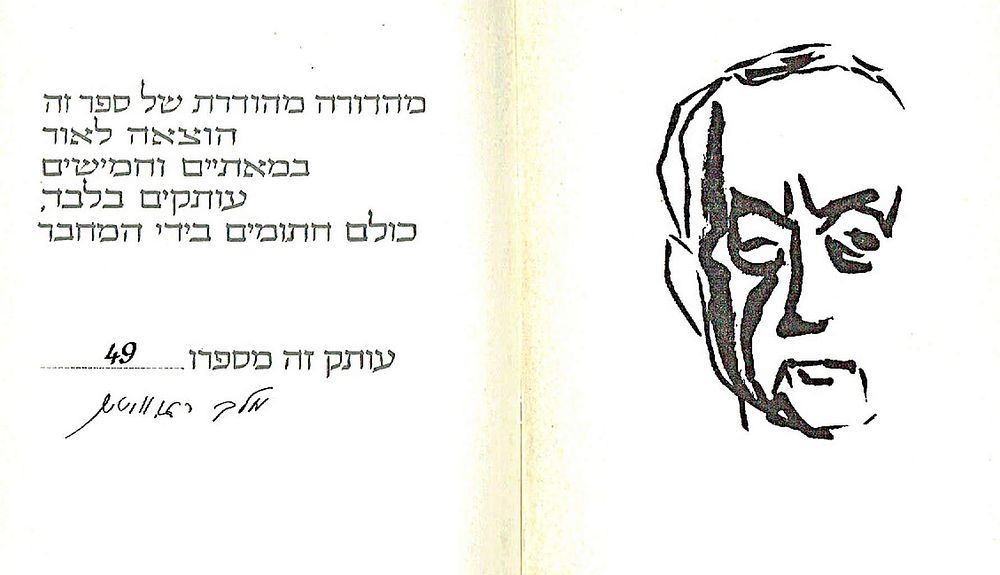
Melech Ravitch, Autograph on his Autobiography, Ex. 49/250, illust. by Audrey and Yosl Bergner, 1976, in Hebrew. - Melech Ravitch, Autograph on his Autobiography, Ex. 49/250, illust. by Audrey and Yosl Bergner, 1976, in Hebrew. “Sefer ha-maasiyot shel hayai” - Autobiography “Hadekel” Tel-Aviv, 1976, 565 pp., with portrait of the author by his son Yosl Bergner, many colored and b/w woodcuts by Audrey Bergner, wife of Yosl Bergner Limited edition of 250 copies, this is copy # 49 Hard cloth cover with gilt lettering to spine and cover, DJ, 24 x 17 cm. Condition: DJ worn, soiled; stained, with tears and holes; foxing stains to endpapers; yellow paper and light brown paper near edges internally; fair condition Weight: 1400 gr. Zechariah Choneh Bergner (Yiddish: זכריה חנא בערגנער, romanized: Zekharye Khone Bergner; 27 November 1893 – 20 August 1976), better known by his pen name Melech Ravitch (Yiddish: מלך ראַוויטש), was a Yiddish poet and essayist. Ravitch was one of the world's leading Yiddish literary figures both before and after the Holocaust. His poetry and essays appeared in the international Yiddish press and in anthologies, as well as in translation. Yosl Bergner, Israeli, Austria, 1920-2017 Yosl Bergner was born in Vienna, Austria, in 1920, and named Vladimir Jossif Bergner. His father was the Yiddish poet Melech Ravitch, and his mother was the opera singer Fanya Bergner. He was sent to study in the school of the organization known in Europe as the Bund. In his youth he studied at the Warsaw University of Technology Division of Metallurgy and Metals, and also studied painting with Hirsch Altman. In 1937, with the growth of antisemitism, his family emigrated to Melbourne, Australia. There he studied art and joined the “Contemporary Art Society of Australia, ” which sought to free itself from. academic painting in Australia. During World War II, Bergner was drafted into the Australian army and served in its Labor Division. During this period he married his first wife, Mary Tauman, whom he divorced shortly after. After the war, he returned to his studies for a time. In 1948 he immigrated to Paris, where he separated from his second wife, the painter Audrey Bergner. In 1950 he immigrated to Israel, where he settled first in Safed and then in Tel Aviv, where he designed for the theater, particularly for the plays of Nissim Aloni. In 1980 he was awarded the Israel Prize for painting. The early works of Bergner, from the period when he lived in Australia, are social and realistic in style, paintings with obvious brush strokes, using dark colors and a thick impasto technique. From the 1950s we see in his works a transition from realistic painting to symbolic painting, influenced by Australian art. In these works he uses imagery such as kitchen implements or symbolic images that reflect memories from the Jewish shtetl. Among his best known series of drawings are his drawings for Kafka’s stories (1959), Four Women (1964), etc. Audrey Bergner (May 1927 - 9 May 2022) was an Australian-born Israeli artist. Audrey Bergner was born in Sydney and grew up in Melbourne. In 1950, she immigrated to Israel with her partner, the artist Yosl Bergner. They initially settled in Kibbutz Gvat, but left the kibbutz for Tel Aviv. After her marriage to Bergner, they moved to Safed. In the 1960s, they returned to Tel Aviv.